How Amador County USD Reduced Chronic Absenteeism by 15% in a Year
In one year, Amador County USD cut chronic absenteeism by 15% and average absences by 1.5 days per student, powered by SchoolStatus Attend.
District Overview

District: Amador County Unified School District
Size: 11 schools; 3,877 students
Products Used: SchoolStatus Attend
Location: Jackson, California
Amador County Unified School District is one of only six “single single” districts in California, serving as both the county office of education and the only school district for the entire county. Amador is also unique geographically, with campuses ranging from a dry, near-desert flatland on one end of the county to elevations near 3,000 feet on the other, where snow can close roads and keep students home.
For Patty Horn, the district’s Assistant Superintendent of Educational Services, who oversees attendance, curriculum, and instruction, the district’s unique features necessitate a real focus on attendance. She sees it as the foundation for everything else the district hopes to accomplish.
I don’t care how great your curriculum is. I don’t care how great your teaching strategies are…If students aren’t there, it’s not going to make a difference. We need them to be present.
— Patty Horn, Amador USD Assistant Superintendent of Educational Services
That belief shaped Amador USD’s approach to attendance. The district focused on reaching families earlier, celebrating good attendance, and using absenteeism concerns as an opportunity to build stronger relationships. Their partnership with SchoolStatus Attend helped the district do that at scale.
Using Digital Outreach to Start Real Conversations
Amador USD has been a SchoolStatus partner for many years, using the platform to automate attendance interventions and better understand attendance trends. Three years ago, the district expanded its partnership to include positive digital campaigns.
Ms. Horn’s background in Positive Behavioral Interventions and Supports made the expansion an easy choice. She wanted attendance communications to celebrate families, with the goal of moving closer to the 4-to-1 positive-to-corrective ratio she had relied on as a classroom teacher.
In the first year of sending automated digital messages through Attend, 93% of enrolled students, representing over 3,700 guardians, received at least one message.
Five positive campaigns reached families throughout the year, including a “95% Attendance Rate” recognition push and targeted outreach to students nearing chronic absenteeism. In total, the district sent nearly 13,900 emails and 11,800 texts. Email delivery was 98%, and over half of those emails were opened. Text messages also performed well, with families visiting the Parent Portal from a message 2,760 times.
The outreach also opened the door to conversations. Ms. Horn and her team treated every call, whether from a family happy to receive a message or one complaining about the frequency, as an opportunity to connect.
One parent called to say the reminders felt excessive. During the conversation, the district learned the family was caring for an ill relative and needed more support than they had known to ask for. The district connected them with a liaison.
“We wouldn’t have known that if all we had were numbers,” Ms. Horn said.
That experience reinforced something Ms. Horn has always felt to be true: missed days can be an early sign that a family needs help. Reaching out after a few missed days helps school and district employees understand what’s happening and how they can better serve families. “It lets us kind of have a glimpse of ways that we can come alongside,” Ms. Horn continued.
The Results Presented to the Board
After a year of sending digital messages, Ms. Horn presented the results to the board:
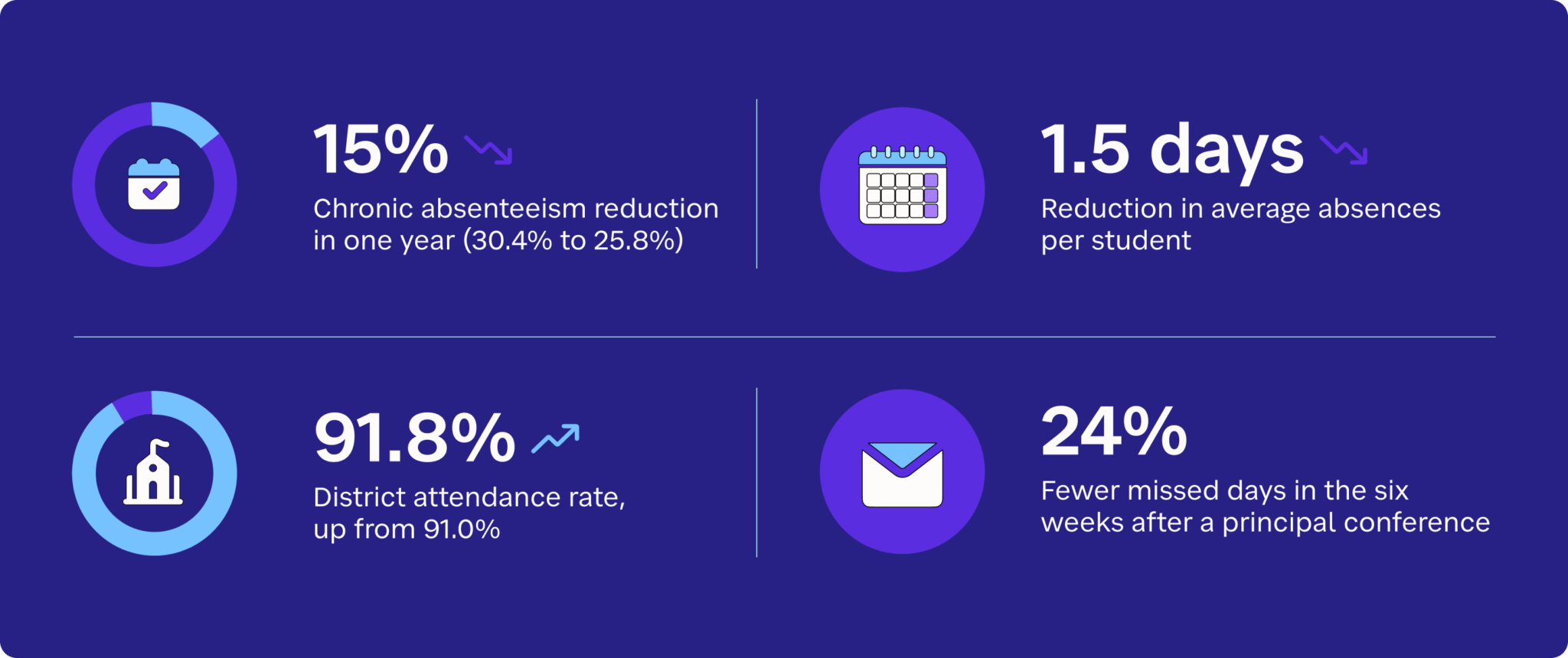
- Average daily attendance increased from 91.0% to 91.8%
- Chronic absenteeism fell 15% districtwide, from 30.4% to 25.8%
- The average number of absences per student dropped by 1.5 days
The improvement extended to student groups and grade levels that had traditionally experienced more absences than the district average. Eleventh-grade chronic absenteeism fell 30%, while eighth grade fell 23%. Campuses including Ione Junior High, Sutter Creek Elementary, and Argonaut High posted double-digit percentage drops. Amador USD also saw attendance gains among English Language Learners and students receiving special education services.
One surprising data point was the impact of attendance conferences, which the district facilitated through SchoolStatus Attend. When a principal held a conference with a family, the students involved missed 24% fewer days in the six weeks after the conversation than in the six weeks before.
The results had a financial impact, too. California funds schools through Average Daily Attendance (ADA), so improving attendance helps protect district funding. The amount of funding recovered was a key topic when Ms. Horn presented the attendance results.
Building Stronger Family Connections
For Ms. Horn, improving attendance is about supporting every other initiative the district is pursuing—and it’s also about helping families.
With SchoolStatus handling attendance interventions and positive messages, school and district employees have more time to notice when students begin missing school more frequently and focus on the relationships behind the data so they can partner on a solution.
SchoolStatus frees us up to be able to focus on the relational piece of attendance, not the data piece.
— Patty Horn, Amador USD Assistant Superintendent of Educational Services
What’s Next for Amador USD
With attendance systems running smoothly, Ms. Horn is turning more of the district’s attention toward the classroom. “We are really focused right now on shifting back to the idea that we’re an educational institution and our job is to educate,” she said.
The district’s top initiative, Quality First Instruction, centers on training teachers, providing the materials they need, and incorporating Universal Design for Learning so every student has barrier-free access to the curriculum. Amador USD is also piloting a new elementary math curriculum this year, ahead of a secondary rollout next year.
With more students showing up consistently, the district will have a clear picture of how these instructional initiatives are affecting student outcomes, reducing concerns about whether chronic absenteeism is impeding academic progress.
And the district isn’t done testing new approaches to attendance. Ms. Horn’s team plans to keep experimenting with incentives, including post-holiday-break campaigns, and is looking forward to new SchoolStatus Attend features, including Positive Notes, which staff can send on demand to recognize and celebrate families and students.