

Use Process Optimization to Unlock Gains in K-12 Administrative Efficiency

Administrative efficiency protects three of your most valuable resources: time, budget, and trust.
When schools and districts run smoothly, every role can focus on supporting students. Administrative efficiency looks different for each role, but the result is fewer distractions and more energy directed toward learning.

Teachers get time back when repetitive tasks are automated, routines are batched, and some responsibilities are shared with staff, volunteers, or even students. That means more energy for the classroom.
Principals free themselves to lead when they delegate tasks, use clear agendas to keep meetings focused, organize their workspaces, and set boundaries that minimize interruptions.
District leaders gain clarity and save time by centralizing data, streamlining workflows, and replacing paper processes with digital systems, making it easier to plan, prioritize, and act with confidence.
An integrated suite of solutions brings these efficiencies together and amplifies them. By reducing manual work, minimizing errors, and cutting down on duplicate tools and licenses, districts protect their budgets while building systems that support lasting student success.
Streamlining Systems Builds Trust and Improves Student Outcomes
For staff, clear and optimized processes send a different but equally powerful message that their time matters. When routine tasks are simple, predictable, and well-supported, educators can focus more of their energy on students. Leaders show respect for staff by giving them tools that reduce stress and make their workday smoother.
Together, these small efficiencies add up to stronger relationships, smoother school operations, and a community that feels supported on all sides.
The impact is real. Erie 1 BOCES needed a solution to manage complex workflows, from processing special class referrals across 48 districts to handling related service requests and summer school placements. Their system also had to support large referral packets for each student with strong document management. When the tech team flagged their internal system as unsustainable, it created an urgent need for an option that could simplify upkeep while improving on existing processes. SchoolStatus Forms & Flows helped Erie 1 BOCES reduce manual steps and create clear visibility across departments. Now, their attendance interventions are sent faster, there are fewer opportunities for human error, and more students are getting the support they need when they need it most.
NYCDOE uses SchoolStatus Forms & Flows to automate their Blue Card procedure, eliminating paper forms for families, and giving staff instant access to emergency contact information anytime and anywhere.
Learn how you can incorporate more efficient processes and automated workflows for your own district in “How Efficient Districts Reclaim Time” and our playbook on “Operationalizing MTSS for Attendance.” Each shows how thoughtful process design and integrated tools turn everyday efficiencies into measurable outcomes for K-12 districts.
Administrative Efficiency vs. Digitization
A digital form is one important step toward process optimization. Uploading a PDF to your website cuts down on printing costs and paper waste, but it still leaves staff chasing signatures, tracking payments, and re-entering data into multiple systems.
Administrative efficiency streamlines operations. Every detail, from the first request to the final approval, is automated, trackable, and connected to the data you already have.
Imagine field trip requests triggering an automated approval flow, including a permission slip and payment collection. Or digital forms and automated processes for PTO requests, incident reports, counselor meeting requests, reimbursements, and fundraising. No more manual follow-ups, misplaced documents, or searching for a checkbook.
Plus, digital forms and workflows have fewer errors and less repetition, saving staff and teachers a significant amount of time.
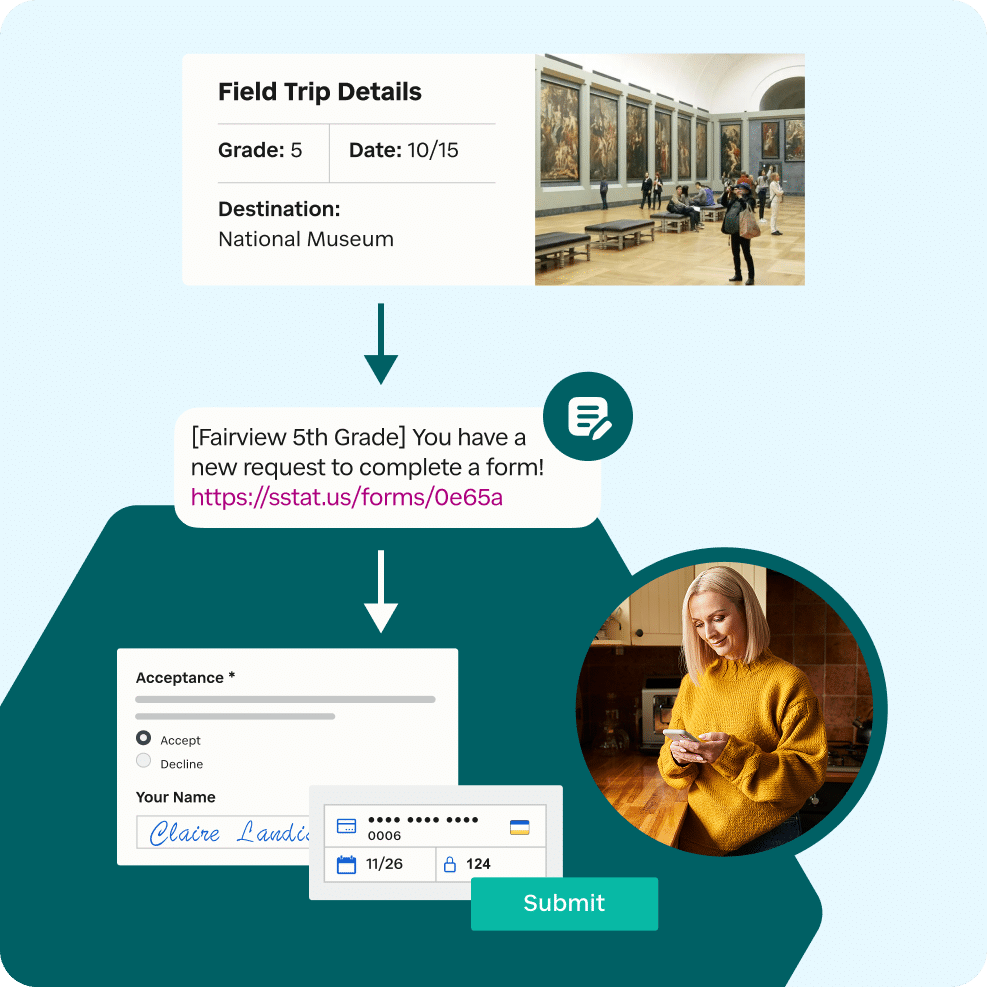
As Principal Dina Testa from Elias Bernstein Intermediate School 7 shared, “Inevitably, parents often thought that submitting payment through the website also counted as consent. Kids would frequently arrive for a trip in the morning, only to be told that they had no permission slip and could not attend.”
With SchoolStatus Forms & Flows, permissions, payments, and reminders happen automatically. Staff can see the status in real-time, and families get a clear and simple process that works every time. And it is all delivered in each family’s chosen language, so communication is even more effective.
When you implement workflow automation software, enhanced data visibility and integrated actions remove friction at every step. That’s when “going digital” becomes a trustworthy source of administrative efficiency.
Administrative Efficiency Use Cases in K-12 Education
Administrative efficiency in K–12 education comes from reducing repetitive work and simplifying daily processes. By automating routine tasks, districts save time, reduce mistakes, and give staff more space to focus on students. The examples below show how schools are streamlining operations, protecting resources, and strengthening support for students and families.
Automated Attendance Interventions Save Administrative Time
When schools act fast on attendance issues, students are more likely to stay on track. SchoolStatus Attend’s Early Warning Insights feature spots risk within the first 60 days of school. Educators can see patterns as they form and intervene early.
Automated letters, notifications, and follow-ups keep outreach consistent and save staff from hours of manual work. Districts spend 75% less time on attendance notifications, and 54% of students return to class after initial contact.
The Troup County School System (TCSS) uses automated attendance interventions to eliminate the manual process of generating and mailing attendance letters. Their approach reduces the administrative burden. As a result, students return to class more quickly, achieving a 25% reduction in chronic absenteeism within just two years.

“The biggest piece is the organizational aspect. Everything is in one location. You can see everything,” said Candice McGhee, Director of Preventions and Interventions at TCSS.
Streamlined Teacher Observations and Professional Development
Teachers grow best when feedback is clear and support is consistent. SchoolStatus Boost: Inspire and SchoolStatus Boost: Coach give districts two focused ways to make that happen.
SchoolStatus Boost: Inspire helps administrators with observations and evaluations. Feedback is captured in real-time, tied to district rubrics, and stored in one place. As a result, administrators have more time for conversations that help teachers improve their practice.
SchoolStatus Boost: Coach gives instructional coaches an organized way to manage their work. They can track coaching cycles, follow progress toward goals, and see the impact of their efforts. Most importantly, it keeps coaching separate from evaluation, so teachers have a safe space to reflect, set goals, and grow.
Districts can use one or both, depending on their needs. Either way, the result is a simpler and more supportive approach to teacher development that saves time and helps educators focus on what matters most: their students.
In districts like Hesperia USD and IDEA Public Schools, SchoolStatus makes it easier to set clear goals, monitor progress, and provide support without drowning in documentation. The results are faster feedback cycles, higher teacher engagement, and a stronger focus on professional growth.
Quick Access to Insights That Streamline Family Outreach
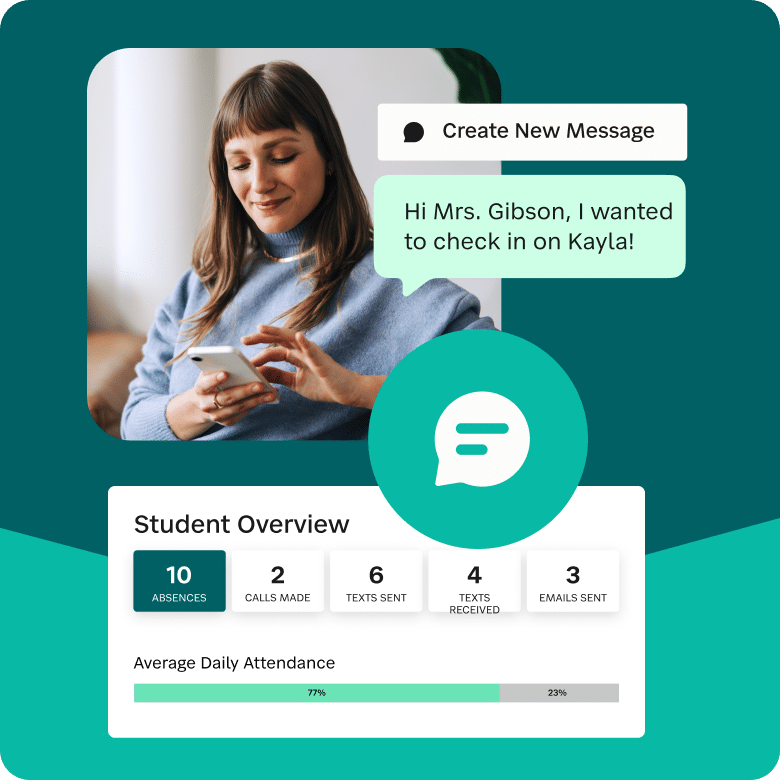
Clear, timely communication builds trust with families. With quick access to student insights and communication history, staff can send specific, relevant updates like attendance notes, progress check-ins, schedule changes, and reminders quickly. Communication is personalized, efficient, and impactful.
During a critical outreach period, Pass Christian Public Schools used SchoolStatus to contact every family in their district. They streamlined this procedure and reduced the burden on their teachers.
“What would have been a heavy lift for us became so much lighter for our teachers,” said Superintendent Dr. Carla J. Evers, Pass Christian Public Schools. “They were able to reach out to 100% of our parents this week, and that was our ultimate goal, letting parents know we are here and we are with you.”
Two-way, translated communication improves attendance and engagement while reducing the time and effort needed to keep families informed.
Digital Forms & Workflow Automation
SchoolStatus Forms & Flows takes tasks like student registration and field trip management and turns them into secure, trackable workflows. Families can confidently complete and sign forms or submit payments on their phone, tablet, or computer, knowing their information is protected. Forms are automatically translated into each family’s chosen language, and approvals are routed to the right teachers and staff. The end-to-end process is simple, safe, and efficient for everyone.
Warwick Valley Central School District used SchoolStatus Forms & Flows to automate registration, eliminating manual data entry and giving families a smoother experience. Staff could instantly see the status of each form, reducing follow-up calls and preventing lost paperwork. The district has saved over 100 hours of staff time by reducing the amount of time staff spend reviewing registration applications.

Elias Bernstein Intermediate School 7 automated their end-to-end field trip management. Now, staff have anytime access to emergency information for every student, right from their phones, and even offline if needed. Parental consent is part of the workflow automation. Everything is faster, simpler, and more accurate for everyone.
Erie 1 BOCES applied this same approach to special education referrals, streamlining collaboration between departments and speeding up the time it took for students to receive services.
“We’ve only scratched the surface of what these programs can do,” said Emily Sass, Supervisor of Exceptional Education, Erie 1 BOCES. “Once we get every program on, I’ll be ready to explore what else we can accomplish.” To date, Erie 1 BOCES estimates they’ve eliminated more than 2,400 emails from their summer application process.
All of these use cases demonstrate the power of administrative efficiency. They all demonstrate ways that schools and districts can move faster, communicate better, and have more time to focus on helping students succeed.
What Does Administrative Efficiency Look Like in Practice
Imagine this…
Before: It’s the first week of school. You either mailed forms beforehand or sent them home with students, but you haven’t received very many back. Your carefully prepared forms are stuffed in backpacks, torn or crumpled, missing entirely. Families aren’t sure if the forms made it to the office. Teachers aren’t sure if forms are complete. Staff spend hours sorting papers, tracking down missing information, calling families who swear they already filled out the information, and entering the same details into multiple systems…all while juggling the start-of-year rush.
After: You create a digital form once and email it to parents and guardians. Families complete the forms online, in their own language, where and how it’s convenient for them. As soon as they hit “submit,” the approvals route automatically to the right person. Club dues and uniform fees are collected instantly and securely. Field trip payments and permissions happen at the same time. Staff can see who has submitted forms and which forms are still outstanding. An automatic follow-up is sent to parents who haven’t completed forms. The process moves faster. There isn’t any confusion about which students can go to the museum. No one has to run to the bank for a check. Because you’re starting the year with clear and easy communications, families feel informed and teachers feel supported. Now, everyone has more time to focus on students.
That’s the shift districts see with SchoolStatus Forms & Flows. Digitizing and streamlining your process transforms how you and your staff spend time by eliminating stuffing envelopes, waiting for the copier to be fixed, sending reminder emails, and asking your boss if she’s had time to approve your PTO yet. Every step is seamless, trackable, and connected.
At PS 8 Emily Warren Roebling School, this transformation started with a single, high-volume process optimization: the annual collection of emergency contact information. The old system required families to fill out the same information year after year, by hand, on a blue card. Staff had to file the cards and update records manually. By automating Blue Card data collection with SchoolStatus Forms & Flows, families don’t need to fill out student information by hand, in triplicate, for every child. Now, they submit information electronically once, the system stores the forms securely, and staff can easily access contact information at any time. As a result, the district spent significantly less time on form collection and data entry had fewer errors, and saw a big lift in staff capacity during one of the busiest times of the year.
“[SchoolStatus Forms & Flows] does all of the distribution and chasing for us until everything is signed and returned,” said Trish Peterson, Principal at PS8, The Emily Warren Roebling School. “It eliminates wasted time, paper, and human error while delivering better and faster response rates. Parents are more engaged, student participation is up, and our staff can concentrate on delivering a better school experience rather than inefficient admin tasks.”
By removing the guesswork, reducing delays, and keeping every step connected, you create a smoother experience for families and a more reliable system for staff. And when the start-of-year rush runs this smoothly, you set the tone for an entire school year built on clarity, consistency, and confidence.
Administrative Efficiency in Action
Districts partner with SchoolStatus to combine clear insights, implement better systems, and deliver meaningful support for the people doing the work. These are just a few of the real-world results from the case studies you’ve seen in this guide.
Elias Bernstein Intermediate School 7
Saw faster, simpler emergency contact management after replacing repetitive paper Blue Cards with mobile-friendly automation.
Erie 1 BOCES
Reduced manual steps in special education referrals, creating clear visibility across departments and speeding up support for students.
Warwick Valley Central School District
Automated student registration. Eliminated manual data entry, giving families a smoother, faster enrollment experience.
School of Arts and Sciences
Streamlined internal procedures and improved communication, enabling staff to spend more time on instruction and student support.
New York City Department of Education
Eliminated paper Blue Cards across the largest school district in the U.S., giving staff instant, secure access to emergency contact information anytime.
PS 8 Emily Warren Roebling School
Achieved faster updates, fewer errors, and higher family engagement by automating its annual student data collection.
Troup County School System
Simplified attendance interventions with automation, reducing staff workload and helping students return to class sooner.
Hesperia Unified School District
Improved teacher coaching and observations, enabling timely feedback and streamlined goal tracking.
Pass Christian Public Schools
Reached 100% of parents in a single week using automated, two-way communication in their preferred language and channel.
IDEA Public Schools
Optimized teacher observation and coaching, making it easier to provide feedback that sticks and strengthens teacher development.
How to Bring Administrative Efficiency to Your District
You don’t have to overhaul everything at once. Small, strategic changes can have a significant impact when they’re built on the right systems.
Here are practical steps you can take now, along with free resources to make your school or district more efficient.
Act Early on Attendance
Start the school year by building positive attendance habits by creating a culture that celebrates positive attendance. Use real-time data to spot students at risk before absences become chronic. Automate outreach so your team can act quickly and consistently.
- Read: Operationalizing MTSS for Attendance
- Resource: Guide to Choosing the Right Attendance Management Solution
- Download: School Attendance Tracker
- Download: Attendance Goal-Setting Worksheet
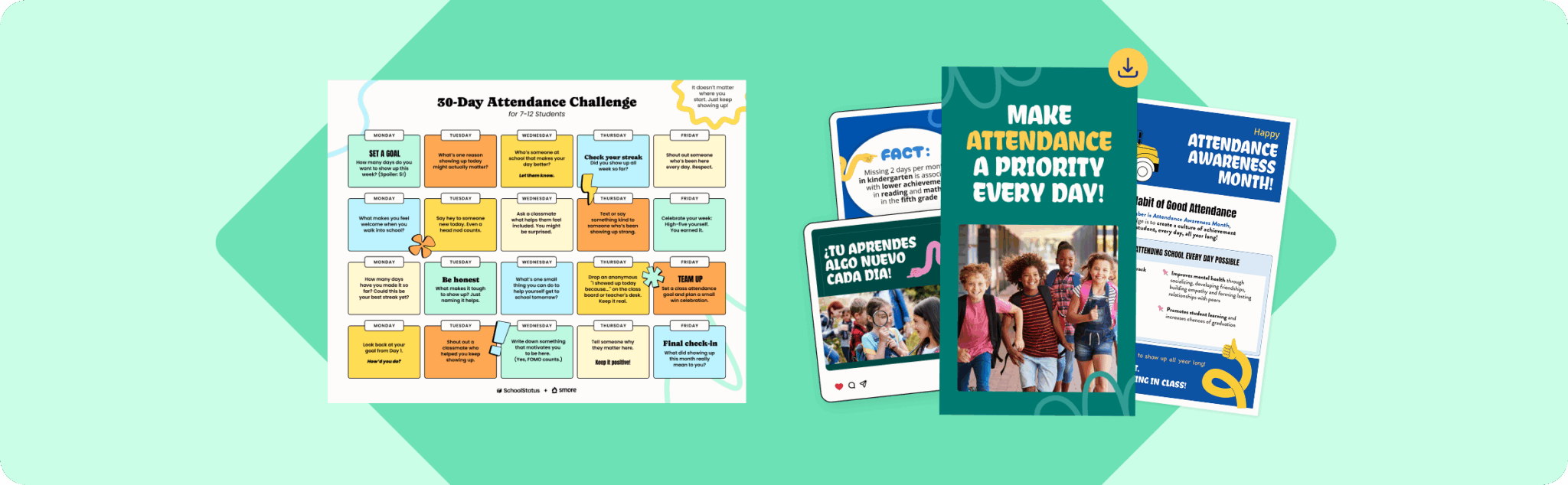
- Download: 30-Day Attendance Challenge Kit
Ready to revolutionize your attendance management? Learn more about SchoolStatus Attend.
Communicate with Every Family
Reach families in their preferred language and through their preferred channel. Automate reminders, send districtwide updates, and support easy, personalized two-way conversations.
- Read: What Families Want—and How to Best Engage Them
- Go deeper: Your Guide to Improved Communication & Academic Success
- Download: Student Connection Audit
- Download: Communication Calendar Template
- Ready to centralize all of your communications and student data? Learn more about SchoolStatus Connect.
Automate Everyday Workflows
Automate and optimize paper-heavy processes. Digitize all of your school forms so they’re trackable and secure. Collect digital payments for everything from student registration to club dues.
- Download: How K–12 Administrators Can Save Time on Forms and Workflows
- Read: 10 Best Practices for Support ELL Families in Your School
- Ready to digitize forms for your entire district? Learn more about SchoolStatus Forms & Flows.

Simplify Observations and Coaching
With better tools, leaders can reduce the time spent on observations by capturing and organizing feedback as it occurs. Coaches can simplify their work by managing cycles, tracking progress, and showing impact. As a result, districts save time on paperwork and provide teachers with more support.
- Read: 7 Powerful Questions to Launch Your Instructional Coaching
- Download: Collaborative Learning Log & Resource Sharer
- Download: Instructional Practice Self-Assessment and Improvement Planner
- Ready to streamline your observations and make coaching more collaborative? Explore SchoolStatus Boost: Inspire and SchoolStatus Boost: Coach
Build Habits That Last
Efficiency isn’t a one-time project. It’s a culture shift. Align your team on priorities, track progress, and regularly revisit your progress.
- Download: 7 Habits of Highly Efficient School Districts
- Read: How Efficient K–12 Districts Reclaim Time
- Align your team: Technology Alignment Assessment
Ready to Start?
Every improvement you make builds momentum, whether it’s automating a form, streamlining communication, or simplifying attendance follow-ups. The districts you’ve read about didn’t wait for the “perfect time” to make a change. They started small, proved the value, and built from there. You can do the same.
Students thrive when they’re in the classroom and when the people around them have the tools to help them stay.
Schedule a Demo and see how your district can save time, protect resources, and create more space for what matters most.