


Featured Resource
New Book Gives District Leaders a Practical Framework for Improving Chronic Absenteeism—and a Comprehensive Look at State-Level Attendance Policies
Read More >

New Book Gives District Leaders a Practical Framework for Improving Chronic Absenteeism—and a Comprehensive Look at State-Level Attendance Policies
Read More >

Key Attendance Trends from the 2025-26 School Year: Insights from 1.1M Students
Read More >Operationalizing MTSS for Attendance:
A Step-by-Step Framework to Improve Student Outcomes
Learn how to put MTSS into action with real strategies, tools, and metrics to reduce chronic absenteeism and better support students.
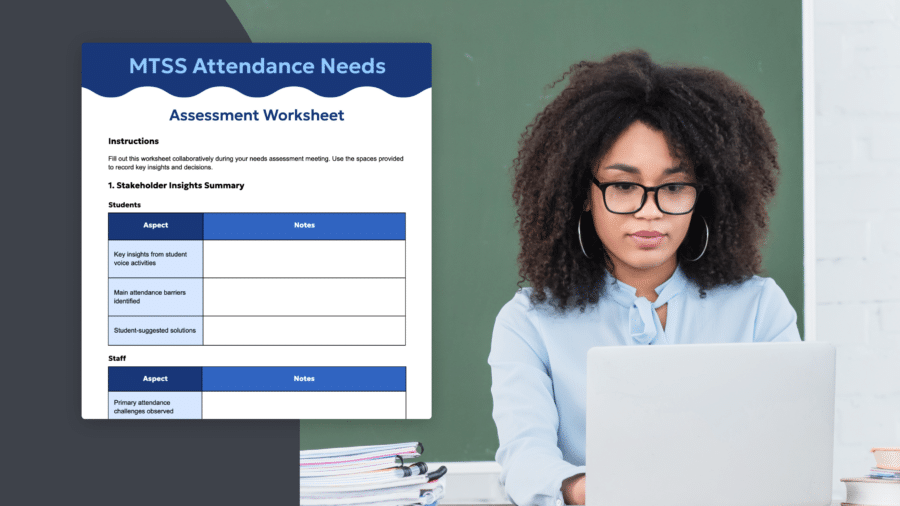
MTSS (Multi-Tiered System of Supports) is powerful in theory—but how do you apply it specifically to attendance? Many districts struggle to move from policy to practice. This guide will help your team transform MTSS into a daily, operational strategy that proactively addresses absenteeism, improves accessibility, and strengthens student support systems.
Common challenges include:
Let’s explore the 5 steps you can take to harness the power of MTSS to transform attendance in your district.
Pro Tip: Districts that embed attendance into MTSS see up to a 30% reduction in chronic absenteeism within one year.
Having a strong MTSS leadership team is the foundation for success. So it’s important to ensure you have the right people involved—and that everyone is on the same page.
First, review the current team composition and ensure you have representation from principals, counselors, teachers, IT staff, and family liaisons. If necessary, redefine roles to make responsibilities clear such as a data analyst, family engagement coordinator, and intervention specialist.
This team will work together to implement accurate daily attendance tracking based on district goals and state requirements, including partial absences and reasons for absence. It will be important to analyze data regularly to identify at-risk students before they become chronically absent. Schedule bi-weekly meetings to review progress and address challenges as they occur.
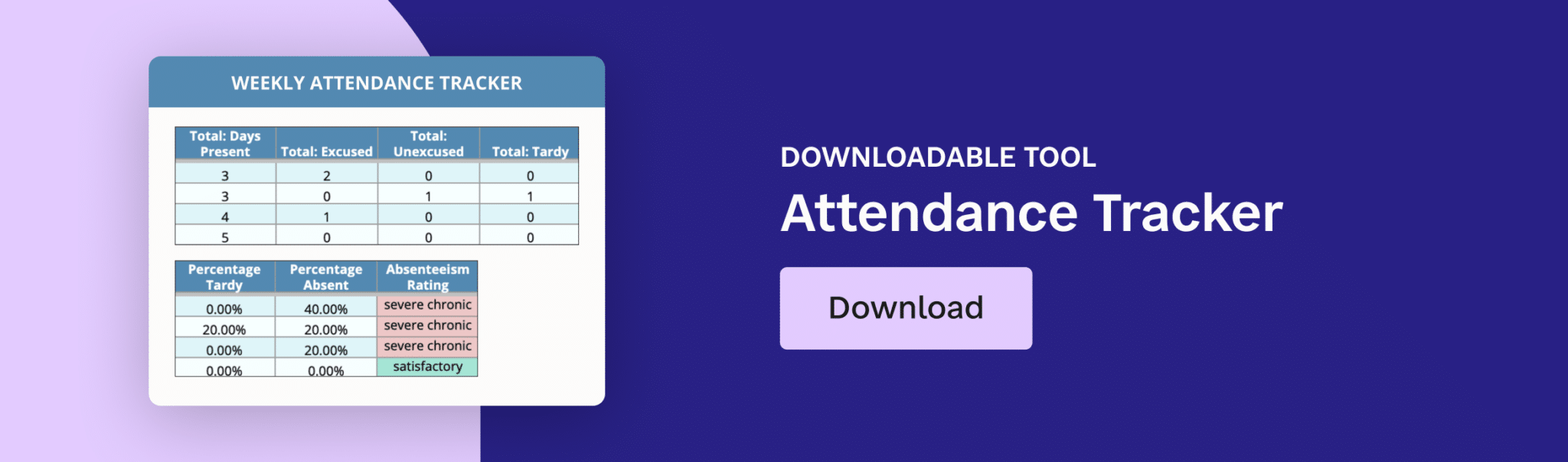
Not sure how to begin? Start tracking attendance easily with this downloadable template. Use it as a simple tool to manage attendance and monitor absenteeism.
A Needs Assessment is a systematic process for determining and addressing gaps between current conditions and desired outcomes. In the context of attendance, it helps identify the specific challenges and barriers that contribute to absenteeism in your district.
Consider these engaging and easy-to-implement methods for collecting input from various stakeholders:
1. Student Voice:Form a Student Attendance Advisory Committee with representatives from each grade level. Host a school-wide “Attendance Matters” poster contest, where students visually represent why attendance is important. Implement a quick “exit ticket” system where students share one reason they came to school today and one challenge they faced in a sentence or two.
2. Staff Insights:Use existing staff meeting time for a brief brainstorming session on attendance barriers and potential solutions. Create an anonymous suggestion box (physical or digital) where staff can share observations and ideas throughout the week. Designate “Attendance Champions” in each grade level or department to collect and synthesize feedback from their peers.
3. Family Engagement:Partner with the PTO/PTA to host a family night focused on attendance, combining fun activities with opportunities for feedback. Set up an “Attendance Matters” booth at school events (sports games, concerts, etc.) to engage families in quick conversations about attendance. Implement a “Coffee with the Principal” series where families can drop in for informal discussions about school matters, including attendance.
4. Community-Wide Approach:Organize an “Attendance Awareness Week” with daily themes and activities that engage all stakeholders in discussions about attendance. Create a simple “Attendance Barrier Bingo” card that students, staff, and families can fill out, identifying common challenges they face. Use social media to run quick polls or ask for brief responses to attendance-related questions.
5. Incentivizing Participation:Offer small incentives for participation, such as extra recess time for classes with high participation rates. Create a friendly competition between grade levels or schools for the most creative ideas to improve attendance. Provide community service hours for students who help organize and run feedback collection activities.
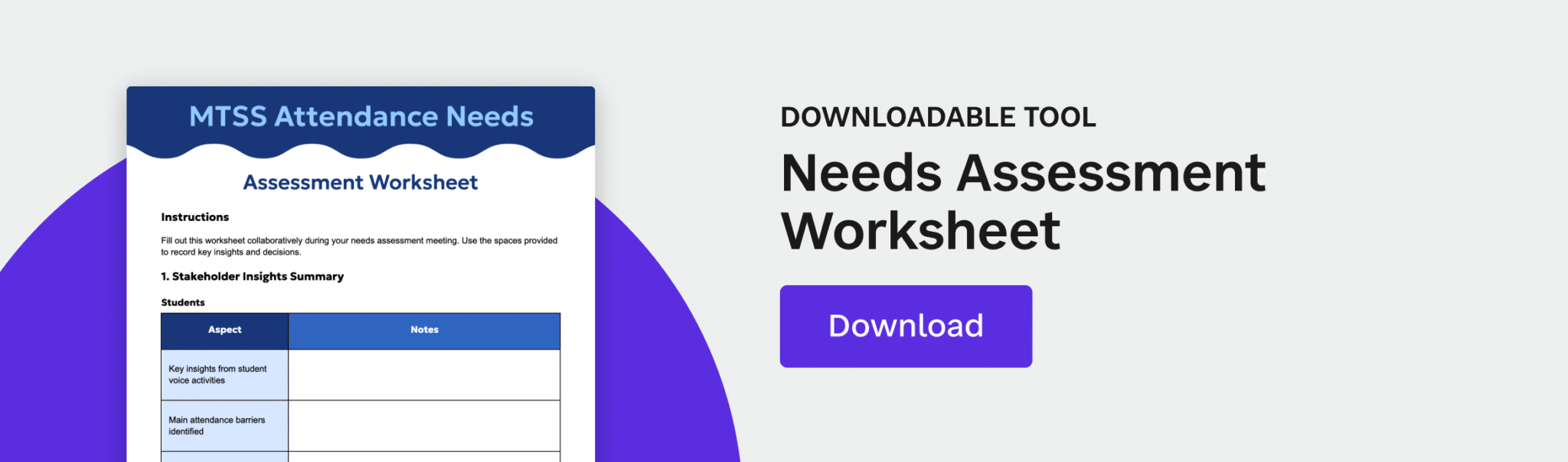
To help you synthesize the information gathered, we’ve created a straightforward Needs Assessment Protocol and Worksheet. The protocol provides a structured approach to guide your team through analyzing data, identifying challenges and strengths, and determining priority actions. It incorporates various collaborative activities such as individual reflection, small group discussions, and a gallery walk to ensure all voices are heard and to build consensus. The accompanying worksheet is designed to be filled out collaboratively during a leadership team meeting, using the insights gathered from your stakeholder engagement activities.
By reviewing and refining each of these elements, you’ll strengthen the foundation of your MTSS Attendance Framework, ensuring you have the right team, accurate data, and a clear understanding of your district’s ongoing needs for effective operationalization.
When it comes to attendance, MTSS helps organize efforts from school-wide initiatives to individualized support. Here are some ideas for how to enhance and operationalize each tier to more effectively address attendance issues.
Establish a Positive Attendance Culture
Create an “Attendance Matters” campaign to show students how regular attendance impacts them both in school and beyond. Make sure positive attendance messages are present in all schools and online to reinforce the importance of coming to school throughout the year.
Educate Families on Attendance Importance

Identify students missing 10-19% of school days using your Attendance Tracker. Implement a “Check & Connect” mentoring program:
For students missing 20% or more of school days, create Personalized Attendance Plans:
By refining each tier of your existing MTSS framework, you can create a more responsive and effective system for addressing attendance issues. A tiered strategy ensures that each student receives the right level of support based on their individual attendance needs while using your staff’s time and resources efficiently.
Strong family and community engagement is crucial for the success of any MTSS attendance initiative. By involving families and the broader community, you can create a supportive environment that reinforces the importance of regular school attendance. Here’s how to further develop these vital connections.
Map out strategies for reaching families through various channels:
Meet quarterly to review data and strategies and use family feedback surveys to gather ongoing input.

For MTSS to be effective, all staff members need to understand the framework and their role within it. Ongoing professional development ensures that your team has the knowledge and skills to implement and sustain the MTSS attendance initiative. Consider the following strategies:

Operationalizing MTSS is an ongoing process that requires continuous attention and refinement. Regular monitoring and evaluation help ensure that your efforts are effective and allow for timely adjustments. Additionally, planning for sustainability from the outset increases the long-term impact of your MTSS attendance initiative. Here’s how to keep your program on track and growing.
Set clear, measurable goals based on your needs assessment:
Implement a robust data collection and analysis process:
Conduct quarterly progress reviews:
Schedule monthly cross-departmental meetings:
Develop a comprehensive sustainability plan:
Foster a culture of continuous improvement:
Create an annual MTSS report:
By following these steps, you can ensure that your MTSS attendance initiative remains effective, adaptable, and sustainable over the long term. Remember, the key to success is consistent monitoring, data-driven decision-making, and a commitment to ongoing improvement.
While implementing MTSS for attendance can significantly improve student outcomes, districts may encounter several challenges along the way. Here are some common obstacles and strategies to overcome them.
Resistance to ChangeChallenge: Staff may be reluctant to adopt new practices or systems.
Solution: Clearly communicate the benefits of MTSS, provide ongoing professional development, and celebrate early successes to build buy-in.
Challenge: Collecting, organizing, and interpreting attendance data can be overwhelming.
Solution: Invest in user-friendly data systems, provide training on data analysis, and designate data leads in each school.
Challenge: Limited staff time and budget for implementing new initiatives.
Solution: Start with pilot programs, seek grant funding, and integrate MTSS practices into existing roles and meetings where possible.
Challenge: Ensuring all schools in the district implement MTSS with fidelity.
Solution: Develop clear district-wide guidelines, provide implementation checklists, and conduct regular cross-school sharing sessions.
Challenge: Reaching and involving families, especially those of chronically absent students.
Solution: Utilize multiple communication channels, offer flexible meeting times, and emphasize a strengths-based approach in family interactions.
Challenge: Maintaining focus and energy on attendance initiatives over time.
Solution: Regularly share progress and success stories, continually refine practices based on data, and integrate attendance goals into broader school improvement plans.
Remember, overcoming these challenges is part of the implementation process. Stay patient, flexible, and focused on your ultimate goal of improving student attendance and success.
Implementing MTSS for attendance is a journey. Here’s a roadmap to get you started:
Remember, each step you take makes a difference in a student’s life. You’ve got this!
While the strategies outlined in this guide can significantly improve family engagement and, subsequently, attendance, managing this process across an entire district requires a unified system and approach. SchoolStatus offers a comprehensive, unified solution that automates and streamlines these best practices:
By centralizing these capabilities into one unified solution, SchoolStatus enables districts to efficiently coordinate consistent, accessible, proactive attendance management. It takes the principles and strategies outlined in this guide and amplifies their impact through powerful technology and data-driven insights.
Ready to take your attendance management to the next level? Book a demo with SchoolStatus today and see how we can partner with your district to dramatically improve attendance rates and student outcomes.

Ready to learn more about our suite of solutions?


