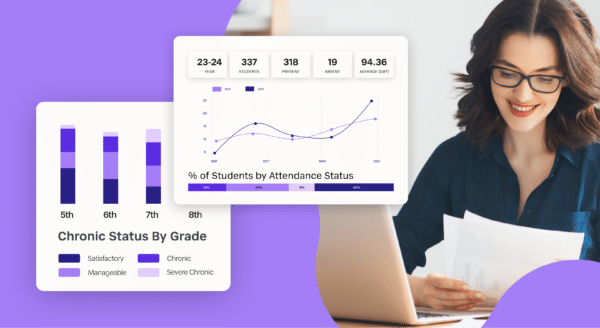
Your Attendance Data Is Trying to Tell You Something
read more


SchoolStatus Launches Literacy Solution to Help Districts Engage Families in Improving Reading Outcomes
Read More >
Key Attendance Trends from the 2025-26 School Year: Insights from 1.1M Students
Read More >

Schools collect plenty of data, but too often it sits in silos or goes unused. The ebook Empower Districts to Make Data-Driven Decisions introduces the I.D.E.A.S. framework—five qualities that help districts turn information into action:
Download the ebook for a deeper dive and practical examples.
District leaders often face a paradox: they’re data-rich but insight-poor. Attendance reports, assessment scores, surveys, and communications all generate numbers. But without the right practices, those numbers rarely become clear insights that drive better decisions.
The eBook Empower Districts to Make Data-Driven Decisions outlines five qualities that help districts unlock the power of their data. Together, they are known as the I.D.E.A.S. framework.
Good decisions depend on good data. If numbers are inconsistent or definitions vary between schools, leaders lose trust in the system. Integrity means setting shared standards for how data is entered, tracked, and reviewed.
Think about attendance: if one school marks tardies differently than another, it’s impossible to compare trends across the district. When definitions are consistent, leaders can trust the picture and know where to focus their attention.
Data locked in a central office doesn’t help teachers or principals act quickly. Democratization means giving the right people access to the same “source of truth.”
When educators can see real-time attendance, grades, or engagement patterns, they can intervene faster. It also creates alignment across the district. Everyone is working from the same information instead of relying on scattered reports.
Raw data doesn’t automatically reveal the right answers. Leaders need to ask clear, focused questions. Examination is deciding which numbers matter most and how to measure progress over time.
For example, high-performing districts often ask: What percentage of families are regularly opening communications? or Which student groups are slipping into chronic absenteeism? By examining data through the right lens, leaders avoid dashboard overload and zero in on insights that affect student outcomes.
Data is most valuable when it informs action. Application means using insights to guide decisions at every level, including district, school, and classroom.
If attendance reports show that ninth graders are slipping, a principal can organize grade-specific outreach. If family engagement data shows low response rates in a particular language, the district can prioritize translation support. Applied data makes it easier to move from knowing a problem exists to taking action.
Complex systems discourage action. Simplification makes insights easy to understand and use.
That might mean color-coded charts that highlight performance trends, or family engagement reports that show at a glance which households are unresponsive. When data is presented clearly, leaders and staff can act without needing a manual to decode the numbers.
Simplification builds confidence. Educators can focus on solutions instead of wrestling with complicated reports.
Districts need better ways to use the data they already have. The I.D.E.A.S. framework—Integrity, Democratization, Examination, Application, and Simplification—offers a practical roadmap.
Leaders who embrace these qualities see stronger results:
In short, I.D.E.A.S. turns numbers into stories leaders can act on.
To explore each part of the I.D.E.A.S. framework and see how real districts are applying it, download the full ebook:
Empower Districts to Make Data-Driven Decisions
It’s filled with examples, benchmarks, and visuals that show how data can be used to inform and improve.
It’s a five-part approach—Integrity, Democratization, Examination, Application, and Simplification—that helps districts use data more effectively.
Most districts collect large volumes of data, but without consistent practices, it remains siloed, inconsistent, or too complex to apply.
When teachers, principals, and district leaders all have access to the same information, they can respond faster and stay aligned.
Color-coded trend charts or family engagement reports that quickly show who is connected and who isn’t. These reduce confusion and make it easier to act.
Begin with one area, such as attendance or family engagement, and apply the I.D.E.A.S. qualities there. Build momentum before expanding into other areas.
Nef DukesManager of Education Strategy and Insights
Nef is a former teacher who is passionate about helping educators use data and communications to build family trust and improve educational outcomes. At SchoolStatus, Nef partners with districts to share practical insights and stories about what works in schools today.

News, articles, and tips for meeting your district’s goals—delivered to your inbox.




















Ready to learn more about our suite of solutions?