New Automated Early Warning System Identifies At-Risk Students Months Before They Become Chronically Absent
read more


SchoolStatus Launches Literacy Solution to Help Districts Engage Families in Improving Reading Outcomes
Read More >

Key Attendance Trends from the 2025-26 School Year: Insights from 1.1M Students
Read More >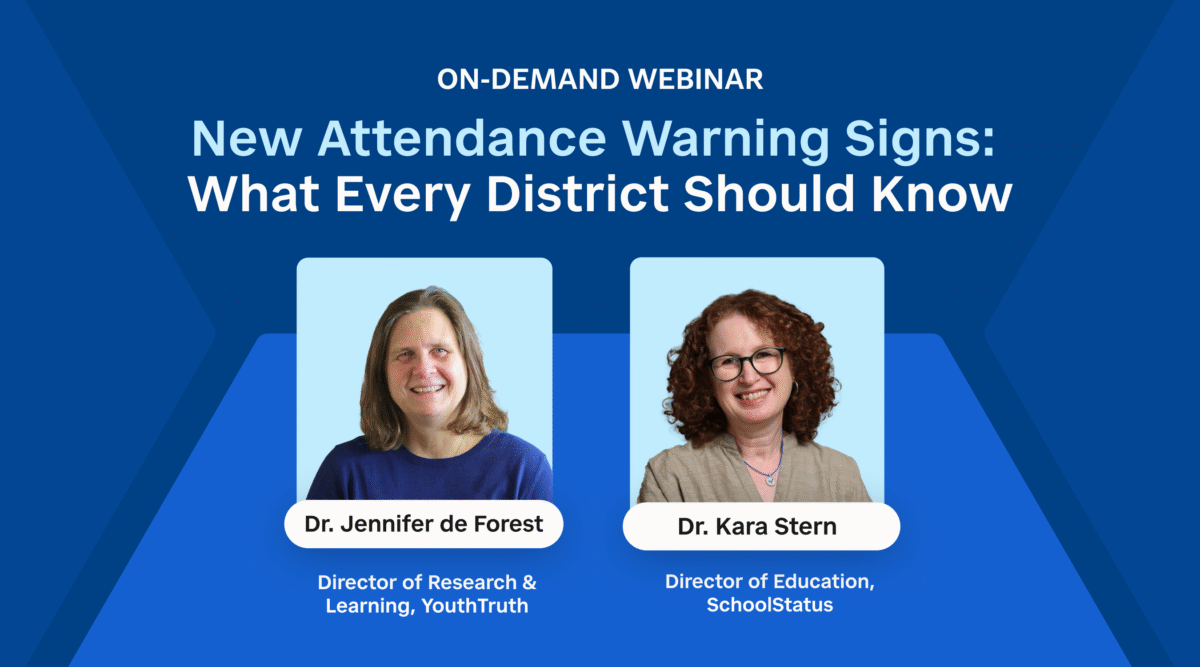

Attendance patterns become clearer when schools look at student experience alongside attendance and family communication data. Strong attendance is supported by early outreach, consistent family engagement, and listening to students about their daily experience at school. Schools that focus on key transition years and align data with communication see earlier opportunities to support students and families.
District leaders across the country are paying close attention to attendance.
Dashboards are reviewed regularly. Chronic absenteeism trends are monitored closely. Family outreach continues throughout the year. Together, these efforts provide a strong view of attendance patterns across schools.
Attendance warning signs often show up before chronic absenteeism takes hold, especially during key transition years and shifts in student experience.
In the January SchoolStatus webinar, The New Attendance Warning Signs, SchoolStatus and YouthTruth brought together two complementary data sets to deepen that understanding.
Together, these data sets show how attendance trends align closely with students’ day-to-day experiences at school and with the ways schools engage families.
Attendance patterns shift gradually across grade levels, with clear transition points where additional support creates meaningful impact.
In elementary school, attendance rates remain strong overall. Grades two through five show particularly high average attendance. Kindergarten and fourth grade stand out as early signal years, reflecting the importance of routine-building and preparation for upcoming transitions.
Middle school marks a clear turning point. Sixth grade shows a noticeable increase in chronic absenteeism, followed by continued growth in seventh and eighth grades. This stage highlights the importance of coordinated academic, social, and family engagement supports as students adjust to new environments and expectations.
High school attendance patterns reflect the cumulative effect of earlier experiences. Ninth grade emerges as a critical year for reinforcing engagement, with sustained attention supporting stronger attendance through graduation.
Attendance data shows when patterns shift. Student experience data explains how students experience school during those moments.
YouthTruth’s research highlights how feelings of safety, connection, and being heard shape students’ engagement at every level.
Most elementary students report feeling safe at school. At the same time, many students describe varying levels of connection to their school community. Feelings of safety show a gradual change between third and fifth grade, signaling the value of early attention to school climate.
Transportation plays an important role in the daily experience. A large share of elementary students who ride the bus report safety concerns during transportation, making it an important part of the full school-day experience.
In middle school, students’ sense of connection becomes more closely linked with attendance patterns. Fewer students report feeling strongly connected to their school community by eighth grade, highlighting the importance of consistent relationship-building.
Student and staff perspectives on safety differ most clearly during these years. Students describe varied experiences across classrooms, hallways, bathrooms, and buses, emphasizing how daily environments influence comfort and focus.
In high school, students continue forming judgments about how connected and supported they feel. Peer interactions, school culture, and perceptions of safety play a strong role in shaping attendance decisions.
Students who report being treated with care and respect are more likely to stay engaged. Preparedness, communication, and trust contribute directly to students’ sense of stability and commitment to school.
SchoolStatus communication data highlights clear patterns in family engagement.
Families respond quickly and consistently to text messages, with average response times measured in minutes. Messages sent during weekday mornings and mid-afternoons receive the highest engagement. Early outreach, especially when attendance patterns first appear, supports positive behavior changes across grade levels.
Written communication continues to play an important role in high school, supporting consistent engagement even as students’ schedules and responsibilities grow more complex.
Attendance outcomes improve most when communication is paired with listening. YouthTruth’s research shows that students who feel heard report much stronger feelings of safety. Listening strengthens trust, clarity, and connection across school communities.
Schools seeing positive attendance momentum focus on a few consistent practices:
These actions support a culture where students feel supported, families feel connected, and educators have timely information to guide outreach.
Attendance improves when schools align data, communication, and student experience around shared goals.👉 Watch the full on-demand webinar to explore the data, hear real district examples, and learn how attendance, communication, and school climate work together.
Sixth and ninth grades show strong returns when attendance, climate, and communication strategies align.
Text messaging supports timely, two-way communication and high response rates across grade levels.
Attendance outcomes improve most when communication is paired with listening. YouthTruth’s research shows that students who feel heard report much stronger feelings of safety. Listening strengthens trust, clarity, and connection across school communities.Students who feel heard report stronger feelings of safety and connection, which directly supports consistent attendance.
 Dr. Kara Stern
Director, Education and Engagement
Dr. Kara Stern has seen school from just about every angle: high school English teacher, middle school principal, fellowship director for math and science teachers across New York City, and head of school at a rural N-12 school. That breadth is what she brings to her work at SchoolStatus, where she writes, speaks, and challenges educators to build the kinds of school communities where every student thrives. She holds a Master’s in Education Leadership from Teachers College and a Ph.D. in Teaching and Learning from NYU.
News, articles, and tips for meeting your district’s goals—delivered to your inbox.




















Ready to learn more about our suite of solutions?