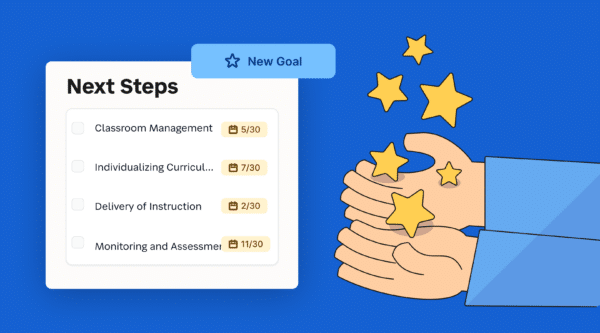
Why Teachers Need A Consistent Coaching Model To Grow
read more

New Book Gives District Leaders a Practical Framework for Improving Chronic Absenteeism—and a Comprehensive Look at State-Level Attendance Policies
Read More >
Key Attendance Trends from the 2025-26 School Year: Insights from 1.1M Students
Read More >

Paige Bergin, an instructional coach in Oklahoma, walks through a three-step process for helping teachers design lesson plans that articulate learning intentions, relevance, and success criteria for staff and students.
As a coach, it’s my job to understand the direction our district and building administration are taking us to support that journey. What became glaringly obvious as we approached the 2020-21 school year, though, was a need for a clear plan for what was to come, which seemed like an impossible task! I mean, who has a plan for unplanned events?!
What we did know and understand were our state standards, and what we were learning along the way was our students’ ability levels. This then became the beginning of our study of teacher clarity at our site.
During grade-level coaching cycle sessions, we used The Teacher Clarity Playbook from Doug Fisher and Nancy Frey to guide our study.
Throughout the year, and at each session, we studied learning intentions (what we wanted our students to learn), relevance (why they needed this knowledge), and success criteria (how we define mastery). This practice helped teachers get to the heart of their standards and objectives, think about what assessments could look like, and the steps in between. These questions serve as the backbone for our planning:
I thought it might be helpful to share what this looks like in action. Below, I’ll explain how I worked with two fifth-grade ELA teachers to develop an opinion writing unit with learning intentions and success criteria clearly stated with each daily lesson.
First, the teachers identified the state objective they wanted to break down. Because this was the first opinion writing unit they had done with this group of students, they also knew that they needed to build upon the learning that had taken place the previous year. Here’s how they did it:
Students will write opinion essays that:
Next, it was time to create a rubric that represented our learning intentions and success criteria, which meant students would go into the writing unit with a greater sense of clarity.
This rubric allowed us to see how we could utilize the standard and, from there, begin to create the learning progressions. Of course, not every lesson is represented on the rubric, and along the way, we had to adjust our learning progressions based on what we were seeing in class! This rubric helped us to keep the progression in mind while remaining responsive to students’ needs.
After we had broken down the objective and created our rubric, we began thinking about the sequence of lessons. This allowed us to write our learning intention for each day. One example (which came shortly after students had established their opinions on the assigned topic) was regarding supporting their opinions:
By posting these sentence frames in classrooms, both teachers and students gained a greater understanding and a focus for lessons. Students were more engaged because we were inviting them into the learning intentions.
Being intentional from the beginning and through backward planning has allowed teachers to understand what success looks like and then articulate it to students. When students have a better understanding of what success is, they have a higher likelihood of actually hitting that target.
This year, our district has implemented teacher clarity through content area professional development, allowing all teachers to gain the understanding we first learned last year. Teachers I worked with last year have been able to give their work a second look and refine their previous learning progressions.
Our students can better articulate what they are learning, why they are learning it, and what success looks like. That has been a huge shift, and has made a big difference for both students and teachers!
We are making consistent, transformational changes. While this work certainly takes time, our teachers have experienced a sense of ownership and a depth of understanding that they had longed for.
When teachers have clarity, students benefit. That’s exactly the kind of growth mindset SchoolStatus Boost supports. SchoolStatus Boost gives coaches and administrators a simple way to share meaningful feedback, set clear goals, and track progress over time without the paperwork overload.
Whether you’re helping teachers plan with intention or reflect on their practice, SchoolStatus Boost brings structure and support to professional learning.
Get more information on teacher coaching strategies.
Find out how Hesperia Unified School District built a data-driven coaching system.
Learn more about SchoolStatus Boost
Teacher clarity refers to clearly defined learning intentions, relevance, and success criteria for both educators and students. When students understand what they’re learning, why it matters, and how success is measured, engagement and achievement improve.
Backward planning in education helps teachers start with the desired outcome and work backward to design intentional lessons. It ensures that each step builds toward a clearly defined goal.
Learning intentions explain what students should learn, while success criteria describe how students (and teachers) will know the goal has been achieved. These elements create focus and transparency in the classroom.
Start with your state standards, break them into student-friendly language, and define what success looks like. Use clear verbs and connect the objective to what students will do and why it matters.
Use sentence frames like “I am learning… so that I can…” and co-create rubrics with students. Break down standards into manageable parts and align every lesson to a clear learning goal.
 Paige BerginPaige Bergin is in her tenth year as an instructional coach in Oklahoma. She began her career in education as a 5th-grade teacher in 2002. She received her bachelor’s degree in Early Childhood Education from Oklahoma State University and holds a master’s degree in Educational Administration and Curriculum Supervision from the University of Oklahoma. In 2010, Paige was awarded the Presidential Award for Excellence in Math and Science Teaching for Elementary Math for the State of Oklahoma.
News, articles, and tips for meeting your district’s goals—delivered to your inbox.













Ready to learn more about our suite of solutions?