Real Data-Driven Attendance Strategies for District Leaders
read more


New Book Gives District Leaders a Practical Framework for Improving Chronic Absenteeism—and a Comprehensive Look at State-Level Attendance Policies
Read More >
Key Attendance Trends from the 2025-26 School Year: Insights from 1.1M Students
Read More >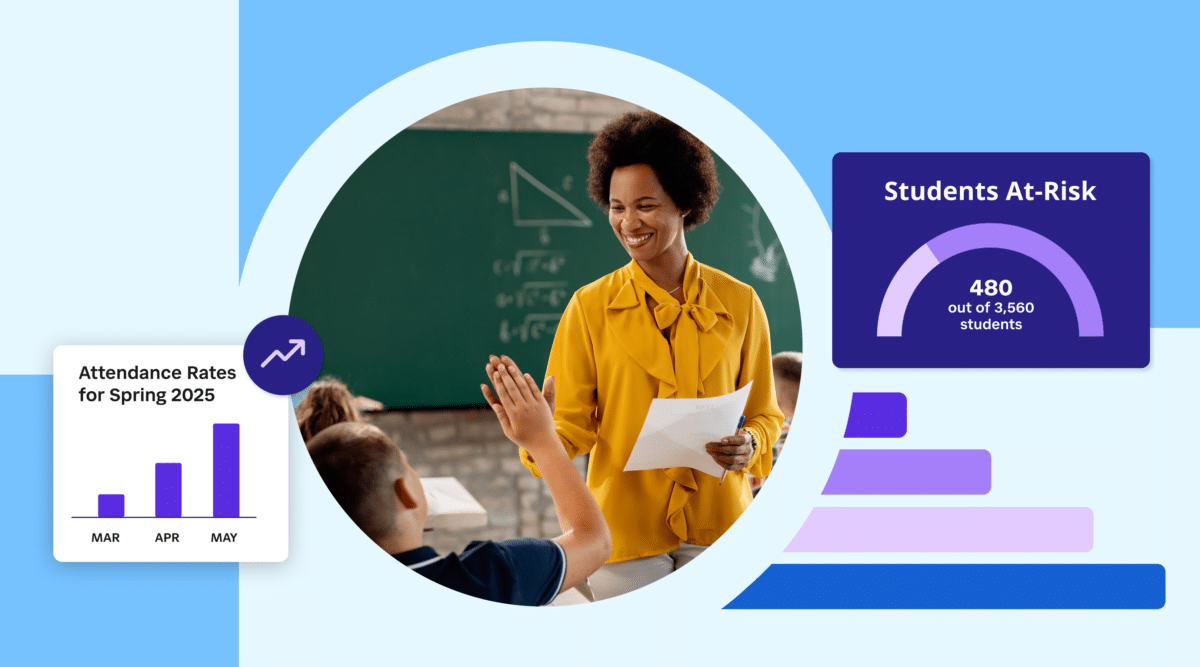

Chronic absenteeism keeps rising, but attendance data now shows districts exactly which interventions work. The strongest results come from early identification, consistent family communication, incentives, and addressing root causes, backed by real-time student-level data that helps teams prioritize support and track progress. District case studies show the biggest gains when teams collaborate around shared data and follow through consistently. These insights come from both our Mid-Year Attendance Report and the What Really Works for Attendance & Engagement webinar.
Chronic absenteeism has become one of the largest challenges facing schools today. When students miss too much class time, it affects academic performance, family engagement, school climate, and, in many states, even district funding.
At the same time, districts now have more data than ever before about attendance trends, disengagement patterns, and early warning signs. Our Mid-Year Attendance Trends Report highlighted how real-time insights help educators intervene earlier and more effectively throughout the year.
This combined perspective, including research, real district practice, and live attendance data, reveals a clear picture of what works.
Chronic absenteeism surged post-pandemic, with some districts seeing rates double. High absences correlate with lower achievement, disengagement, and drops in on-track-to-graduate indicators.
Our mid-year report found that transitional grades, especially middle school, continue to struggle, and that many students show early patterns long before they cross chronic thresholds. These early patterns make timely interventions essential.
Districts that saw the strongest gains in attendance shared three things in common:
Research reinforces these findings. The most effective interventions also include:
Together, these insights show that proactive, relationship-centered approaches outperform punitive ones.
Schools that monitor daily attendance trends can spot warning signs before absences accumulate
When schools implement a real-time student data tracker, educators have a clear view of patterns, including excused vs. unexcused absences, consecutive days missed, and sudden shifts.
Examples:
Districts with the most improved attendance emphasized consistent outreach, especially two-way conversations. Families respond better when messages are personalized, positive, and clear about supports.
Examples:
Incentives, especially those highlighting week-over-week improvement, help motivate students.
Examples:
Data can reveal patterns tied to transportation, health, or safety concerns. District teams in our report held collaborative meetings to uncover what was really causing absences and matched supports accordingly.
Examples:
Schools that improved most used shared dashboards and intervention logs to coordinate efforts across attendance clerks, teachers, counselors, and administrators.
Examples:
Teams that operate from the same data see improved response times and more consistent interventions.
Roseville City School District (CA) used daily attendance tracking and proactive outreach to reduce chronic absenteeism. Their focus on consistent follow-up across school teams led to meaningful improvements.
We needed a better way to connect with families in real time. SchoolStatus helped us do that without increasing staff burden.
Derk Garcia, Superintendent
Lake Worth ISD (TX) emphasized positive communication and barrier-removal strategies. Staff collaborated across roles, using shared data to deliver timely interventions.
Our families feel heard. That trust is changing the game for our students.
Dr. Rose McCarthy, Superintendent
Schools that combine real-time data with targeted, student-centered supports consistently see stronger attendance gains. The key is ensuring staff have access to the same information—and that interventions are logged, reviewed, and adjusted regularly.
Together, the insights from our Mid-Year Attendance Trends Report and our What Really Works for Attendance & Engagement webinar show that small, consistent actions build momentum over time.
Download the Mid-Year Attendance Trends Report for district-level benchmarks and actionable data.
Watch the full webinar What Really Works for Attendance & Engagement for practical strategies and district examples.
Or, explore how SchoolStatus solutions support intervention work:
Any action aimed at improving a student’s attendance—communication, relationship-building, incentives, problem-solving, or support planning.
Yes, when they recognize improvement rather than perfect attendance.
Because monthly or quarterly reports come too late for meaningful intervention.
Start with the data, talk with families, and look for patterns that point to root causes.
Use shared dashboards and keep all communication and interventions logged in one place.
 Dr. Kara Stern
Director, Education and Engagement
Dr. Kara Stern has seen school from just about every angle: high school English teacher, middle school principal, fellowship director for math and science teachers across New York City, and head of school at a rural N-12 school. That breadth is what she brings to her work at SchoolStatus, where she writes, speaks, and challenges educators to build the kinds of school communities where every student thrives. She holds a Master’s in Education Leadership from Teachers College and a Ph.D. in Teaching and Learning from NYU.

News, articles, and tips for meeting your district’s goals—delivered to your inbox.















Ready to learn more about our suite of solutions?