What Makes an Effective Attendance Solution for Schools?
read more


New Book Gives District Leaders a Practical Framework for Improving Chronic Absenteeism—and a Comprehensive Look at State-Level Attendance Policies
Read More >

Key Attendance Trends from the 2025-26 School Year: Insights from 1.1M Students
Read More >

Districts using SchoolStatus saw real gains in elementary attendance and a drop in chronic absenteeism. The most successful districts took early, data-informed action with aligned intervention systems. But high school attendance needs urgent attention.
If you’re a superintendent trying to understand where attendance stands and what’s working to move the needle, the most important thing to look at is data over time. SchoolStatus recently analyzed year-over-year attendance data from 172 partner districts across 10 states, representing more than 1.3 million students. The findings reveal both encouraging progress and persistent gaps that demand targeted action.
Here are three big takeaways every superintendent should have on their radar.
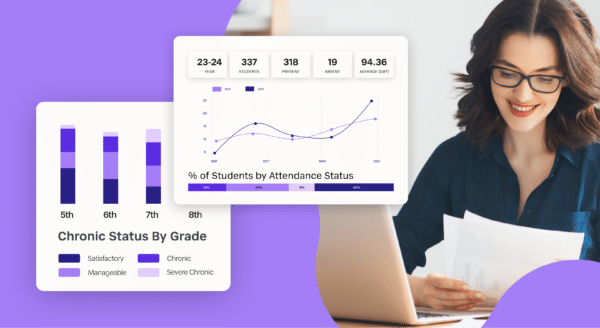
Middle school had some of the most concerning absenteeism trends last year. More than 21% of 7th- and 8th-graders were chronically absent. That’s nearly one in five students missing weeks of instructional time.
This age group has often been overlooked in attendance strategies. Many efforts focus on early intervention or high school prevention. These data point to a need for urgent focus on the middle years. These are the years when students are navigating major social, emotional, and academic changes.
Superintendents can work with their teams to audit existing interventions and ask: Are we giving middle schoolers the engagement and support they need to show up consistently?
Ninth grade remains a danger zone. Last year, more than 27% of 9th graders in our data set were chronically absent.
This is an important reminder that transition years need extra attention. Students moving from middle to high school often struggle to stay engaged. They also face increasing demands on their time. They are asking themselves if they belong in high school. They are wondering if they are connected enough to show up when things get hard.
Targeted transition planning, consistent adult relationships, and family engagement that keeps parents in the loop all help smooth the 8-to-9 bridge.
Preschool may not be mandatory. Still, consistent attendance in the early years sets the tone for everything that follows. In 2023-24, more than a quarter of PreK students in our data set were chronically absent.
These missed days mean missed opportunities to build routines, confidence, and early learning momentum.
District leaders can use this insight to strengthen PreK attendance messaging. They can connect families to transportation and child care resources. They can work with elementary principals to track attendance patterns starting in the earliest grades.
One of the clearest takeaways from the data is that isolated interventions aren’t enough. The districts seeing progress have implemented attendance strategies at scale, backed by automation, aligned teams, and tools that make it easy to act on real-time insights.
This includes mailed letters, multilingual communication, and easy-to-read dashboards. It also includes ongoing support for attendance teams and leadership to stay focused on what works.
Attendance is a signal. These trends show us where to look next. They show us how to build supports that make a real difference. And how to get ahead of a slide into chronic absenteeism. If your district is ready to move from data to action, we’re here to help. SchoolStatus partners with superintendents nationwide to design early warning systems, support family outreach, and deliver real-time insights that help every student get to school and stay there.
This analysis is based on year-over-year attendance data from 172 SchoolStatus partner districts across 10 states. The dataset includes more than 1.3 million students and reflects real-time, period-level attendance patterns from the 2024–25 school year.
Attendance data shows a sharp rise in chronic absenteeism beginning in middle school. More than 21% of 7th- and 8th-grade students were chronically absent last year. These years are often overlooked, yet they represent a critical transition point where disengagement accelerates if schools don’t intervene early.
Start by identifying grade-level risk points, especially in PreK, middle school, and 9th grade. Then align attendance teams around consistent interventions, clear family communication, and regular data review. Districts seeing progress are acting earlier and at scale, not relying on isolated school-level fixes.
Districts need systems that surface patterns quickly and make follow-up easy. Tools that connect attendance data, communication, and intervention workflows help teams move from insight to action without adding manual work for staff.
 Dr. Kara Stern
Director, Education and Engagement
Dr. Kara Stern has seen school from just about every angle: high school English teacher, middle school principal, fellowship director for math and science teachers across New York City, and head of school at a rural N-12 school. That breadth is what she brings to her work at SchoolStatus, where she writes, speaks, and challenges educators to build the kinds of school communities where every student thrives. She holds a Master’s in Education Leadership from Teachers College and a Ph.D. in Teaching and Learning from NYU.

News, articles, and tips for meeting your district’s goals—delivered to your inbox.
















Ready to learn more about our suite of solutions?