New Automated Early Warning System Identifies At-Risk Students Months Before They Become Chronically Absent
read more


New Book Gives District Leaders a Practical Framework for Improving Chronic Absenteeism—and a Comprehensive Look at State-Level Attendance Policies
Read More >
Key Attendance Trends from the 2025-26 School Year: Insights from 1.1M Students
Read More >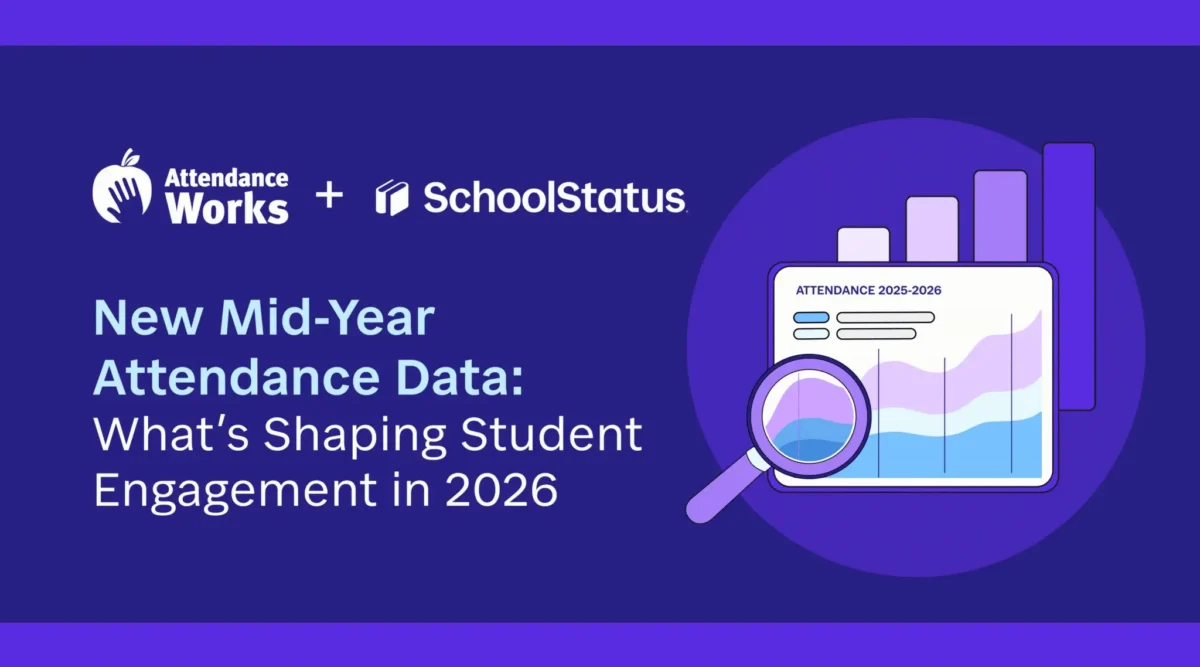

Chronic absenteeism is declining where consistent, early outreach took hold. The data shows the effort districts are putting in works, and it clearly points to where we need to go next.
Here’s what three years of attendance data across 1.17 million students tells us: absenteeism is predictable, and it’s preventable. We know who is likely to become chronically absent by Thanksgiving. We know that one well-timed, relevant outreach message can be enough to turn the pattern around. We know the approach works.
What the mid-year data adds to that picture is a clearer sense of where the work is done—and where it still needs to go.
Chronic absenteeism across 146 districts dropped from 22.44% to 18.98% over three years. Among students facing economic barriers, those learning English, and students in foster care, it dropped from 23.81% to 21.30%. At the grades with the most riding on them—6th and 9th—the improvement is visible and meaningful.
Three years of consistent effort produced these results. Against a national backdrop where chronic absenteeism sits around 23%, roughly 50% above pre-pandemic levels, these districts are outperforming.
The reason is legible in the data: early identification, followed by outreach that connects rather than complies. Among students who received an early attendance communication, 48% didn’t need a follow-up. One relevant, timely message was enough.
Students outside traditional risk categories are holding steady at nearly 1 in 5 chronically absent. And students without stable housing are chronically absent at 36.21%—nearly twice the rate of their stably-housed peers. That gap hasn’t narrowed in three years.
What the progress we’ve seen tells us is that these numbers are movable with the same approach that worked everywhere else: knowing early, reaching out personally, and building the kind of trust that brings a kid back to school. The question is whether we’re building systems that extend that to every student, not just the ones who fit the profile we already knew to look for.
We brought this data to Cecelia Leong of Attendance Works and our Manager of Data Science, Dr. Joy Smithson, and asked them both the hard questions. The conversation—including what Cecelia says about building family relationships before there’s ever a problem to solve—is worth watching.
A student is considered chronically absent when they have missed 10% or more of their enrolled school days. In a typical 180-day school year, that’s 18 days.
Most national data captures attendance at the end of the school year, which means districts often don’t see the full picture until it’s too late to act. Mid-year data gives districts a chance to identify students trending toward chronic absence and intervene while there’s still time.
Both are transition years — entry into middle school and high school respectively. Research consistently shows that chronic absence at these grades is among the strongest predictors of high school graduation.
Early Insights is a feature within SchoolStatus Attend that analyzes attendance and tardy data from the first 60 instructional days of the school year to identify students at risk of chronic absenteeism. It flags students with approximately 75% predictive accuracy, giving districts a meaningful head start on outreach.
Cecelia Leong of Attendance Works identifies four categories of absence reasons: barriers, aversion, disengagement, and misconceptions. For students without concrete logistical barriers, reasons often include beliefs that missed work can be made up easily, lack of connection to trusted adults, and grading structures that don’t signal the real academic cost of missing school.
 Dr. Kara Stern
Director, Education and Engagement
Dr. Kara Stern has seen school from just about every angle: high school English teacher, middle school principal, fellowship director for math and science teachers across New York City, and head of school at a rural N-12 school. That breadth is what she brings to her work at SchoolStatus, where she writes, speaks, and challenges educators to build the kinds of school communities where every student thrives. She holds a Master’s in Education Leadership from Teachers College and a Ph.D. in Teaching and Learning from NYU.

News, articles, and tips for meeting your district’s goals—delivered to your inbox.















Ready to learn more about our suite of solutions?