Featured Resource
SchoolStatus Launches Literacy Solution to Help Districts Engage Families in Improving Reading Outcomes
Read More >

SchoolStatus Launches Literacy Solution to Help Districts Engage Families in Improving Reading Outcomes
Read More >
Key Attendance Trends from the 2025-26 School Year: Insights from 1.1M Students
Read More >Learn how a Texas district uses the data and family engagement tools in SchoolStatus Attend to more effectively respond to absenteeism.
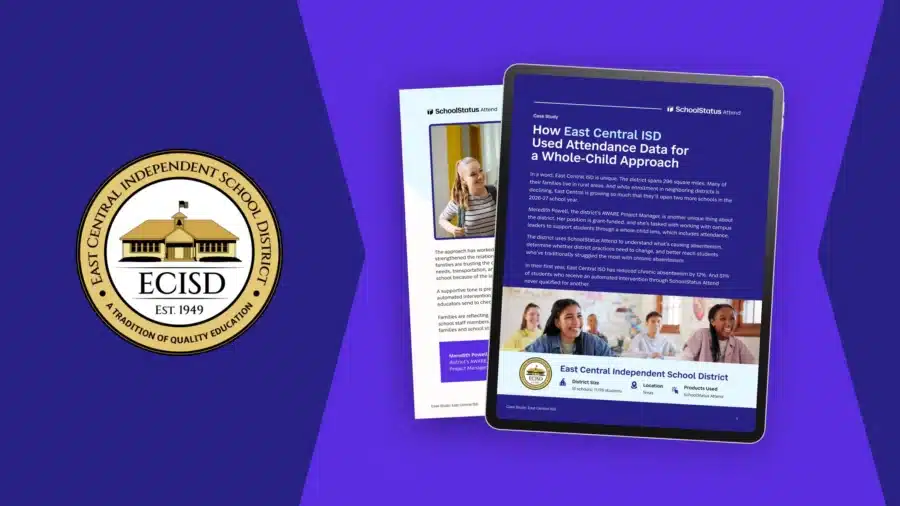

District: East Central Independent School District
Size: 15 schools; 11,176 students
Products Used: SchoolStatus Attend
Location: Texas
In a word, East Central ISD is unique. The district spans 296 square miles. Many of their families live in rural areas. And while enrollment in neighboring districts is declining, East Central is growing so much that they’ll open two more schools in the 2026-27 school year.
Meredith Powell, the district’s Advancing Wellness and Resiliency in Education (AWARE) Project Manager, is another unique thing about the district. Her position is grant-funded, and she’s tasked with working with campus leaders to support students through a whole-child lens, which includes attendance.
The district uses SchoolStatus Attend to understand what’s causing absenteeism, determine whether district practices need to change, and better reach students who’ve traditionally struggled the most with chronic absenteeism.
In the first year, East Central ISD has reduced chronic absenteeism by 12%. And 51% of students who receive an automated intervention through SchoolStatus Attend never qualify for another.
East Central ISD has two main goals for SchoolStatus Attend: stronger family engagement and a better understanding of attendance trends. Automated attendance interventions ensure families know when students are missing school. Centralized, easy to understand dashboards integrate with the district’s Student Information System (SIS) to help school and district staff better understand patterns and barriers.
The Total Absence Calendar Report has been key in decision-making. In a single view, leaders can see the total number of absences on each day. The report clearly delineates days with higher than usual absenteeism and days where more students are present than usual. The team noticed very quickly that Fridays were a problem.
That insight changed the way campus administrators approached programming. They planned attendance pop-ups, incentives, dances, and student speakers. Ms. Powell explained, “We wanted to see what we could do that promotes a sense of belonging and connection so that students are more likely to come to school.”
The Total Absence Report has also influenced East Central ISD’s calendar. “For years and years, we were seeing that the Monday after the Super Bowl, we had poor attendance,” Ms. Powell reflected. “So our district leadership decided that we’re going to shift that Monday to a staff development day.”
Small changes have resulted in big gains. Now, students have a reason to show up on Fridays, and days that are historically challenging for attendance are being repurposed.
Centralized data was also key in understanding many of the more challenging absences. Ms. Powell has special praise for the district’s data team, who “built attendance percentages based on bus routes, allowing [them] to see which bus numbers have what attendance rate.” They took that data and started having conversations with families. They heard things like:
Those stories led to quick action, which built family trust and got students back to school.
In Ms. Powell’s words, “we were never going to have that feedback if we didn’t have the data to prompt our thinking first.”
While attendance data can be an early warning that something is wrong, other data sources can help illustrate why students are missing school.
The team at East Central ISD integrated multiple data sources to better understand their students. One example is combining attendance data in SchoolStatus with school climate survey results. By looking at the two datasets, the district could see correlations between attendance and personal connection. Now, a student who is struggling with absenteeism and reports a low sense of belonging may be paired with a school staff member. That staff member can provide more personal attention to ensure the student remains engaged.
East Central also made homerooms a place for early action. When students don’t show up for the day, homeroom teachers immediately call families. The message is supportive, not punitive. Many times it’s, “Hey, is your child okay? We would love for them to come to school today, even if they’re late.”
The approach has worked wonders.
Having this timely outreach has really strengthened the relationships with families. We’re seeing that families are trusting the campuses more. They are asking for resources around basic needs, transportation, and healthcare. They’re seeing a stronger partnership with the school because of the language that we’re using when we’re discussing attendance.
Meredith Powell, AWARE Project Manager, East Central ISD
A supportive tone is present in everything the district sends to families, from the automated intervention letters sent through SchoolStatus to the text messages educators send to check on students.
Families are reflecting that tone of partnership. They’re bringing concerns directly to school staff members. Even when interconnected challenges impact attendance, families and school staff can find solutions together.
East Central ISD can be a blueprint. While their district is unique, their approach to combating absenteeism is one every district can employ. The data shows which families and students need extra support. Educators can use those insights to understand what’s causing absenteeism and offer real solutions. The team at East Central shows that when we start the conversation from a place of empathy, families are likely to engage, leading to real attendance improvement.