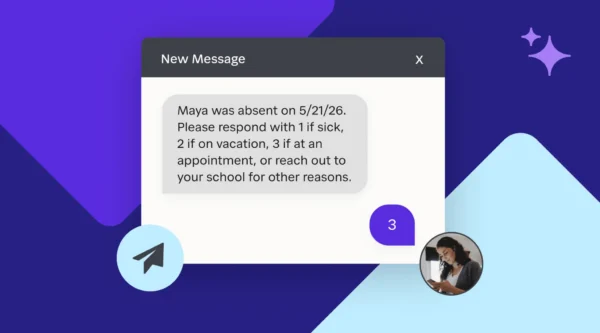
New in SchoolStatus for Back to School 2026: Attendance, Digital Forms, and More
read more


SchoolStatus Launches Literacy Solution to Help Districts Engage Families in Improving Reading Outcomes
Read More >

Key Attendance Trends from the 2025-26 School Year: Insights from 1.1M Students
Read More >

SchoolStatus employees are working in a mailroom right now. They print and mail letters, on behalf of school districts, to families whose kids have racked up a few absences.
The idea that families should get information about the importance of attendance after a few instances of absenteeism isn’t novel. The idea that they should still get that information via snail mail is.
Many solutions have gone completely digital, reaching families exclusively through text and email. We’ve kept our mailroom running and added digital messages to mailed letters rather than replacing them.
More than twenty years into helping districts reduce chronic absenteeism, I’m convinced this approach, which combines mailed interventions with digital ones, is the only path forward.
While education has changed a lot over the near quarter-century I’ve been supporting districts, so has the wider world of communication. Today, a family might receive a note about an upcoming sale, payment confirmation from their bank, a notice about their apartment building’s elevator, and a message from their child’s teacher all in the span of a few minutes. Even for the most engaged families, it’s hard to keep up.
A mailed attendance intervention is a pattern interruption.
It shows up in a family’s mailbox and is hard to ignore. Our data shows that it works, too. 54% of the families who receive one intervention from us never require another.
This is something we consider quite a bit. Our hybrid model, which we launched for the 2025/2026 school year, is now our recommended approach. Families receive attendance communication through the mail and digitally. This allows for mailed interventions to serve as a pattern interruption, without sacrificing a district’s ability to communicate with families who can only be reached digitally.
It can be easy to assume that everyone has reliable access to the internet and a device capable of accessing it. But that’s not the case. Six million households don’t have reliable internet access. Fifteen million people lack consistent access to a device capable of accessing the internet.
Certainly, the overall number of people who lack digital access is decreasing, but we can’t afford to leave these people out of the conversation about the importance of attendance. It’s also worth noting that there is significant overlap between chronically absent students and those who lack internet access, as both can be symptoms of poverty.
So until, and perhaps even after, every family can access attendance interventions sent digitally, we’re committed to getting them the message through the mail.
Whether or not families can receive a message digitally is one thing; whether a district has the right contact information is another. In working with hundreds of districts, we’ve found that many lack accurate digital data. This can be for several reasons, including contacts who change their phone number or email address frequently, typos, or even families who would prefer not to share their information. Since a physical address is often a requirement for enrollment, that information is generally much more readily available.
Attendance interventions can’t bring kids back to class if families never receive them.
That’s why we cover our bases by continuing to send mailed intervention letters.
Perhaps the chief reason we continue to mail attendance interventions in 2026 is that the data shows us it’s working. I mentioned before that 54% of families who receive an intervention never require another. That initial intervention is always sent in two ways—through the mail and digitally. After twenty years of these results, it’s important to continue.
There are also other metrics that tell us this hybrid approach is the right one. Districts that partner with SchoolStatus Attend have lower chronic absenteeism numbers than the national average. And when we look at districts in their very first year with us, there’s an average 18% decrease in chronic absenteeism. Of course, these numbers point to the efficacy of our whole approach. However, printing and mailing interventions are an important part of it.
Twenty years after joining SI&A, now SchoolStatus, I remain convinced that our mailroom matters. Printing and mailing attendance interventions on behalf of districts is meaningful work, and it’s one piece of a much larger puzzle. If you’re a district looking to reduce chronic absenteeism, ask your vendors whether they can mail letters. A vendor who can’t leaves you with a hard question: are you willing to move forward with a solution that’s likely to get lost in digital noise, fail to reach some of the families you’re trying to serve, and only go as far as the data you already have? Don’t settle for a vendor enabling you to print letters yourself; a vendor that prints and mails letters ensures you can reach every family, consistently.
If you want to hear more about our approach at SchoolStatus, we’d love to talk about it. Feel free to get in touch anytime at schoolstatus.com/demo
 Lexi Nutting
News, articles, and tips for meeting your district’s goals—delivered to your inbox.




















Ready to learn more about our suite of solutions?