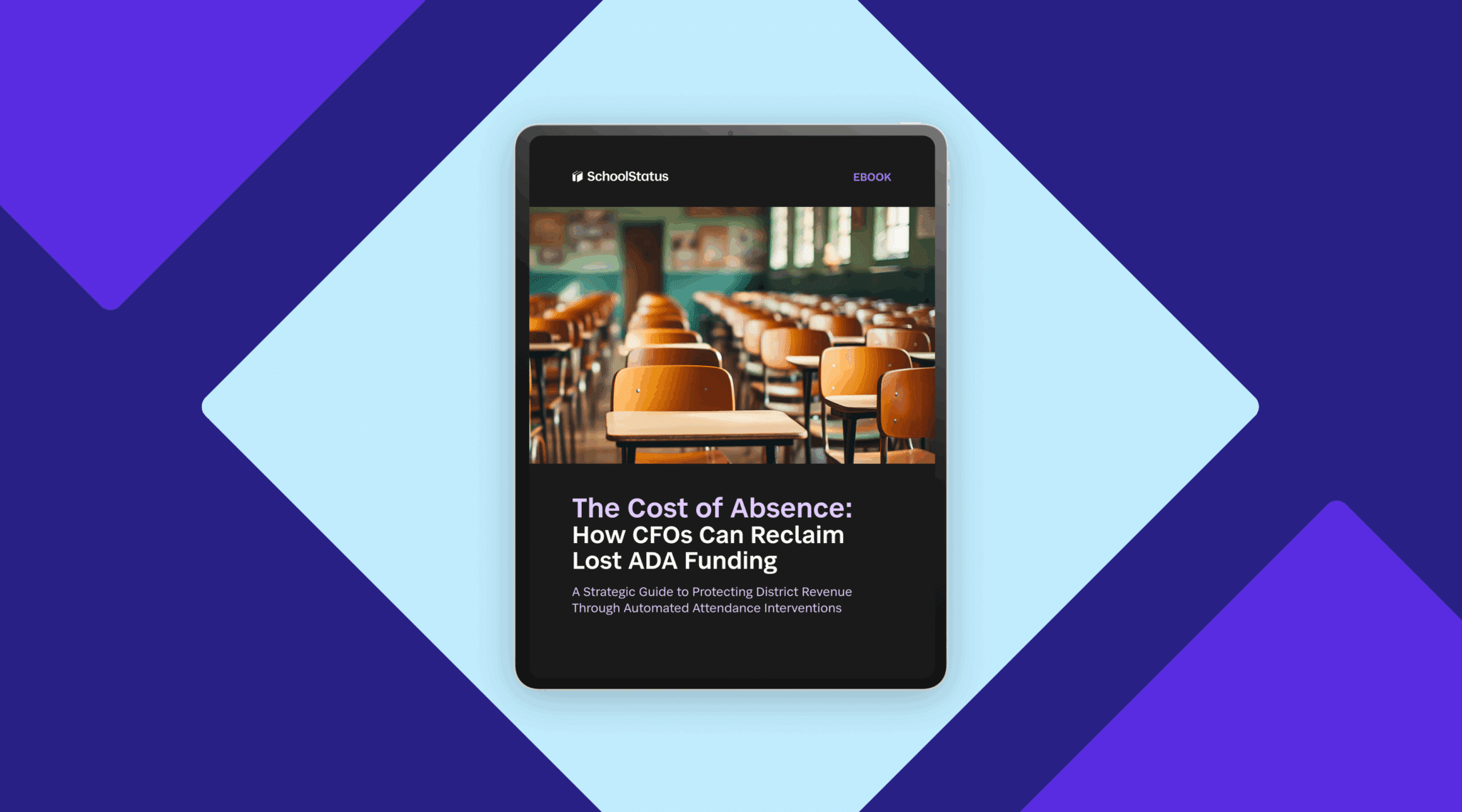




Featured Resource
SchoolStatus Launches Literacy Solution to Help Districts Engage Families in Improving Reading Outcomes
Read More >New Analysis Finds SchoolStatus Districts Reduce Chronic Absenteeism by 36% in Two Years. Learn more >>
SchoolStatus Launches Literacy Solution to Help Districts Engage Families in Improving Reading Outcomes
Read More >
Getting board approval for an attendance solution comes down to three things: framing the problem in budget and outcome terms, leading with data on what the solution delivers, and making a specific ask. A comparable district reduced chronic absenteeism from 16.6% to 12.2% in two years, and 54% of at-risk students return after just one outreach contact. Walk in with those numbers, and you are presenting a plan, not a pitch.
You’ve identified the problem. Chronic absenteeism is up, your current tools tell you who missed school, and your team is spending hours each week doing manually what a system could do automatically. You’re ready to bring a solution to your superintendent and board.
Too often, the proposal dies in committee because the framing of the request doesn’t work for this audience.
Board members and superintendents evaluate new spending through a specific lens, and understanding that lens is the difference between a yes and a “let’s revisit this in the spring.”
Here’s how to walk in ready.
Attendance coordinators experience chronic absenteeism as a workflow challenge. Superintendents and boards experience it as a budget issue, a community trust issue, an academic issue, and an accountability issue. Your proposal needs to speak the language of the room.
In ADA-funded states, every chronically absent student represents real revenue loss. A student missing 18 or more days a year isn’t just struggling academically. They’re costing the district money, and that cost is quantifiable. Before your presentation, calculate the ADA impact of your current chronic absenteeism rate. Put a dollar figure on the problem. Boards respond to that. A financial frame also creates urgency to act early in the school year, when intervention is still possible.
Pair the financial framing with quantifiable outcomes. Chronic absenteeism at high rates correlates with lower assessment scores, higher dropout risk, and weaker graduation rates—metrics the board already monitors. Connecting your attendance numbers to those downstream outcomes makes the case without you having to oversell it.
The board doesn’t need to know how the software works. They need to know what happens in districts that use it.
Come prepared with two or three concrete comparison points from districts of similar size, demographics, or geography. “A comparable district reduced chronic absenteeism from 16.6% to 12.2% in two years” lands differently than “districts see significant improvement.” If the vendor has outcome data tied to student return rates or staff time savings, use it. A 50% or greater return rate for at-risk students after a single outreach attempt is a proof point. “Better results” is not.
The superintendent is your internal ally here. They’ve already been asked about attendance by the board. They want a solution that works and that they can defend. Give them the numbers they’ll need at the next board meeting before they have to ask for them.
Vague asks get vague responses. “We’d like budget to explore attendance software” invites a committee. “We’re requesting approval for a 12-month pilot in three schools, with a cost of X and semester reports to the board” invites a vote.
Specificity signals preparation. It also reduces perceived risk. Board members are more likely to approve a bounded pilot than an open-ended investment. Build in defined evaluation criteria from the start: What metrics will you report at the new semester? Chronic absenteeism rate, staff hours recovered, family response rates? Name them. It signals accountability and gives the board a clear frame for success.
If possible, present a cost-per-student figure. Decision-makers in K-12 think in per-pupil terms. Translating an annual license cost into “X dollars per student” makes the investment easier to evaluate alongside other budget priorities.
Boards and superintendents ask predictable questions about new software.
How does it integrate with our existing systems? You need a clear answer here. Tools that require manual data entry or don’t sync with your SIS create staff burden rather than reducing it. Make sure you can describe exactly how the solution connects to what the district already uses.
What’s the implementation timeline? Board members want to know when they’ll see results. A realistic onboarding timeline, paired with a clear description of what implementation support is included, reassures decision-makers that this won’t stall out after approval.
What happens to student data? Data privacy is a genuine concern and a legitimate question. Know your vendor’s data handling policies and FERPA compliance posture before you walk in.
Getting school board buy-in for an attendance solution is a presentation challenge as much as a budget challenge. Translate the attendance problem into the board’s language: funding, student outcomes, community accountability. Lead with data on what the solution delivers. Make the ask specific and bounded. Anticipate the questions.
When you walk in with that, you’re presenting a plan.
It depends on district policy and the size of the investment. Many districts have a threshold above which any software purchase requires board approval. Even when board approval isn’t required, a superintendent, CAO, or someone in the cabinet typically needs to sign off. Building the case for that level of leadership is the same work either way.
Lead with outcomes your current tool hasn’t delivered. If chronic absenteeism has stayed flat or increased despite your existing investment, that’s the data point. Frame the switch as an evolution in approach: from compliance tracking to proactive outreach that brings students back.
Keep the board presentation tight: the problem, the evidence, the ask, and the outcome targets. Detailed product specs belong in appendix materials or a follow-up conversation. Board members make better decisions with clear summaries and accessible data.
Chronic absenteeism rate (district-wide and by school) and staff time spent on attendance management are the two most defensible. Family engagement metrics — read rates, response rates — add context if your solution includes outreach components.
Budget season is the obvious window, but it’s not the only one. Boards respond well to proposals tied to a recent data report, a state audit, or community pressure around attendance. If chronic absenteeism just appeared in your state’s accountability report, that’s your moment.
SchoolStatusSchoolStatus connects educators and families around the topics that matter most. The company partners with K–12 districts to improve attendance, engage families, and build trust so students can succeed. A recognized leader in data-driven attendance and family engagement solutions, SchoolStatus enables districts and educators to engage families with relevant, timely communications and proactive support on important topics including absenteeism, literacy progress, and overall student readiness. Today, SchoolStatus supports districts in all 50 states and serves more than 22 million students nationwide as a trusted partner in driving better student outcomes.
News, articles, and tips for meeting your district’s goals—delivered to your inbox.
Ready to learn more about our suite of solutions?