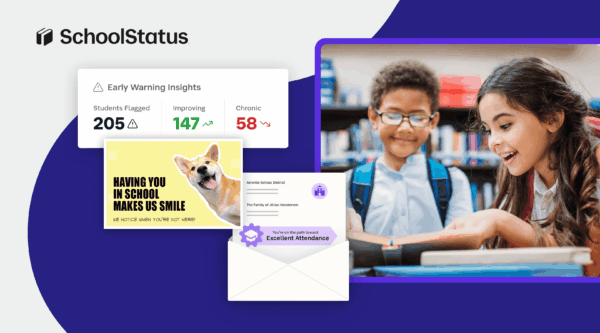
New Automated Early Warning System Identifies At-Risk Students Months Before They Become Chronically Absent
read more


SchoolStatus Launches Literacy Solution to Help Districts Engage Families in Improving Reading Outcomes
Read More >

Key Attendance Trends from the 2025-26 School Year: Insights from 1.1M Students
Read More >

Intentional attendance management in the first 30 days of school sets districts up for better attendance the rest of the year. In a recent SchoolStatus webinar, Dr. Kara Stern and Dr. Joy Smithson broke that window into three phases, each with its own 10-day action checklist: review, revise, and reach out.
The first 30 days of school are a crucial stretch of time to implement chronic absenteeism interventions, and the patterns that will shape the rest of the year are already visible if you know where to look.
Nationally, 22% of students, about 10.8 million, were chronically absent last year. This is nearly 50% above the pre-pandemic rate of 15%, according to RAND. NWEA found that districts with persistently high chronic absenteeism are about 50% further from academic recovery in math than districts with lower rates. In a recent SchoolStatus webinar, Dr. Kara Stern and Dr. Joy Smithson laid out three practices for the first 30 days that carry attendance gains through the rest of the year, along with starter action items for each.
The first practice is review. Start by pulling last year’s list: which students ended the year chronically absent, and which were trending that way by spring. Then, layer in the day of the week and the reasons behind each absence. Patterns usually emerge—some might even surprise you.
SchoolStatus data across 142 districts and more than 1.1 million students shows a consistent trend year after year. Chronic absenteeism is highest in pre-K and kindergarten, drops to its lowest point in third through fifth grade, and rises again from sixth grade through High School. Twelfth grade holds the highest rate and the slowest recovery of any grade, before or after the pandemic.
Strong attendance rates in third and fourth grade suggest that consistent support in elementary school pays off. The spike in sixth grade points to a critical transition: students are entering a new-building and adjusting to new schedules. Sixth grade is still early enough in a student’s path and provides an opportunity to address attendance problems before they become chronic patterns.
Cross last year’s list against these patterns, and you’ll identify which students and families need support first. This gives you the chance to review and reach out proactively—before a new absence is logged this year.
The second practice is built around revising attendance messaging for tone. Georgia Rhett, superintendent of Arvin Union School District in California, wrote about this for District Administration. Her district’s chronic absenteeism rate held around 9% before the pandemic, then rose above 24% by 2021. Incentives and raffles helped some students, but they left an open question: what happens once the prizes stop?
So her team audited what a student experienced walking in late or coming back from an absence. The answer was uncomfortable. A student could hear the same message about being late three separate times, from the front office, a campus supervisor, and a teacher, before they ever sat down.
Leadership decided to change the messaging students heard upon returning, training everyone to greet students with, “we’re so glad you’re here.” Admin reinforced it in every meeting until it stuck. Chronic absenteeism in Arvin Union now sits around 8%, and districtwide attendance is close to 96%.
What you can do: Pull two or three of your own attendance messages and read them for tone. Are they focused on warning or on partnership? Pick one building and rethink how staff greet a student who’s late or coming back from an absence.
Reach Out at Three to Five Absences
By the third phase of the first 30 days, you’ve set the tone and identified your highest-risk students. The next step is timing your outreach. For many students on a path toward chronic absenteeism, three to five absences is the point at which a pattern becomes clear, making this trend a useful trigger point for a family message.
SchoolStatus data shows that more than half of students who receive one early outreach never need a second intervention that year. Families who respond to an outreach message in August or September also continue to respond at higher rates throughout the year, well past the point when new school year momentum fades for everyone else.
Early engagement compounds. A family that replies once in September is a family your team can reach again in January, when it matters just as much.
Review, revise, and reach out are a rhythm you keep returning to, month after month, year after year. Districts using SchoolStatus average an 18% drop in chronic absenteeism in year one, a number that nearly doubles to 36% by year two. The districts hitting those numbers keep reviewing, revising, and reaching out long after the first 30 days pass.
One year is usually enough to spot a pattern, but two years shows you whether last year’s dip was a blip or a trend. If a student showed up on both lists, prioritize that family first.
A strong fourth-grade rate reflects the support the school has given up till then. Middle school is something different: new buildings, new schedules, and less adult oversight per student.
Treat it like a menu. Pick one item from review, one from revise, and one from reach out: an appetizer, a main, and a dessert. Build up to all three once the first one feels manageable.
Start with one building. Pilot the tone shift there, then share the numbers and how staff and families describe the change with other principals. Proof travels faster than a new policy memo.
Three to five absences. That’s the window where a warm, timely message has the best chance of preventing the pattern from repeating.
 SchoolStatusSchoolStatus connects educators and families around the topics that matter most. The company partners with K–12 districts to improve attendance, engage families, and build trust so students can succeed. A recognized leader in data-driven attendance and family engagement solutions, SchoolStatus enables districts and educators to engage families with relevant, timely communications and proactive support on important topics including absenteeism, literacy progress, and overall student readiness. Today, SchoolStatus supports districts in all 50 states and serves more than 22 million students nationwide as a trusted partner in driving better student outcomes.

News, articles, and tips for meeting your district’s goals—delivered to your inbox.




















Ready to learn more about our suite of solutions?