Skip to content

Join Mission: Attendance to reduce chronic absenteeism in 2025-26!  >> Learn How <<

Topbar Close icon
Site Logo
  • Products
      Attend

      Attendance Interventions

      Data-Driven Attendance Insights 
      Attendance Interventions 
      Student Postcards and Letters

      Connect

      Family Engagement

      Data-Driven Student Insights
      Mass Notifications
      Engagement Reports
      Two-Way Messaging
      School Newsletters
      Parent App

      Forms & Flows

      Digital Forms & Payments

      Digital School Forms
      Secure School Payments
      Automated Workflows

      Sites

      Accessible Websites

      ADA-Compliant, No-Code Websites
      Social Media Integration

      Boost

      Teacher Observation & Growth

      Observations
      Coaching

      Image of California state outline and positive attendance trends graph
      Featured Resource

      Why Over Half of California School Districts Trust SchoolStatus

      Read More >
    • Menu for Mega Menu
  • Who It’s For

      Superintendents

      District Leaders

      School Leaders

      Educators & Staff

      Families

      quote_icon
      SchoolStatus has provided us a tool to make communication easier, more transparent, and quantifiable.
      Dr. Ron Brown
      Former Superintendent, Lumpkin County Schools
      quote_icon
      We’ve seen an over 50% decrease in chronic absenteeism, which is the statewide goal. We’re already there, in just one year of work.
      Jessica Hull
      Executive Director of Communication and Community Engagement, Roseville City School District
      quote_icon
      The help [SchoolStatus] gave us was amazing; I’ve never before received help like that from any company. Honestly, we feel like we want to stay with [SchoolStatus] forever.
      Dina Testa
      Assistant Principal, Intermediate School 7 at NYCDOE
      quote_icon
      Everyone wins when you stay in the loop, and SchoolStatus Connect really helped me make that happen while also saving me time.
      Ellen Zissis
      First Grade Teacher, Chartiers Valley Primary School
      quote_icon
      Our families now feel that they’re not alone. They know we want to talk with them. That’s why we’re using SchoolStatus Connect.
      Maureen Brown
      Principal and Director of Outreach, Dove Schools
    • Menu for Mega Menu
  • Resources

      Resource Library

      News & Press

      Blog

      Case Studies

      eBooks

      Guides & Playbooks

      Reports

      Webinars

      Image of California state outline and positive attendance trends graph
      Featured Resource

      Why Over Half of California School Districts Trust SchoolStatus

      Read More >
    • Menu for Mega Menu
  • About

      About SchoolStatus

      Careers

      Contact

      quote_icon
      Working at SchoolStatus is an incredible experience—our supportive team culture creates an environment where I feel valued and inspired. The company prioritizes both personal happiness and professional growth.
      Dr. Stephanie Walters
      Customer Lifecycle Marketing Manager
      quote_icon
      I like the ease with which I can contact Families using my own personal phone without giving out my personal number. I also like that the student's contacts are readily available. This platform works well for Families to contact us, too. We can truly partner in the student's education and work towards a goal that works for all.
      Abigail S.
      Teacher
      quote_icon
      We’ve seen an over 50% decrease in chronic absenteeism, which is the statewide goal. We’re already there, in just one year of work.
      Jessica Hull
      Executive Director of Communication and Community Engagement, Roseville City School District
    • Menu for Mega Menu
Request a Demo Log In
Educator Development
Jul 06, 2021

Collective Efficacy Leverages Teamwork for Better Coaching Cycles

By Virginia Soukup • 5 min
Share

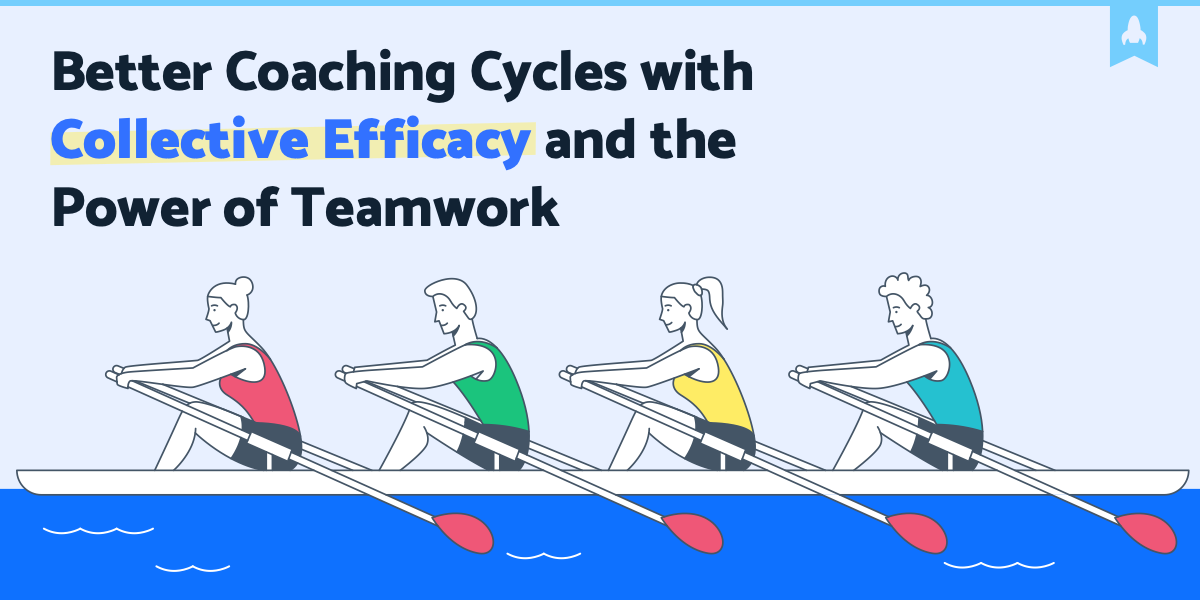
Header - Soukap - Collective Efficacy

Virginia Soukup, ELA and social studies curriculum specialist in Oklahoma, highlights three foundational elements of a coaching cycle that help guide a group of teachers to achieve their collective goal.


I

t’s difficult to reflect on the past school year without considering the pandemic and its effects on student learning. In such times, we could easily be tempted to wait until next year to try out new strategies to grow in our teaching practices. So, at the beginning of the school year, I was pleasantly surprised when a team of teachers approached me to support them with their new goals.

This group had set their sights on making the implementation of math fluency routines more consistent and intentional to help meet our district’s goal: “100% of elementary classrooms will implement math fluency routines as a component of their daily math instruction.”

As a team, they took on a partnership approach and decided to hold one another accountable and utilize me, their coach, to support them. Immediately, my thoughts went to collective efficacy, its effect size on student learning, and how a coaching cycle built around it can support the teacher’s goals.

What is collective efficacy?

Recent research suggests that the number one factor influencing student achievement is collective efficacy.

Collective efficacy is the belief that, through collective actions, educators can influence student outcomes and improve student learning. —
Jenni Donahoo

As evidenced in Collective Efficacy: How Educators’ Beliefs Impact Student Learning, teachers who share this belief will put forth a greater effort, have a willingness to try new approaches, and convey high expectations. These characteristics certainly shone through as the team worked through this coaching cycle.

Three winning maneuvers

1) Guiding questions

As a coach, it’s imperative to help teams devise a plan and take ownership of the process. With this particular team, we had an initial meeting to set a goal and our objectives. During this meeting, the teachers decided that they wanted to meet regularly to debrief, reflect, and answer these guiding questions:

  • How was I consistent?
  • How was I intentional?
  • How did I decide on the routines I chose?
  • What am I noticing with my students as a result?
  • What are my next steps?

This plan provided a source of accountability. Each month during the 2nd semester, we met as a team to answer and reflect on these guiding questions. As a result, teachers could talk through struggles, offer each other feedback, and suggest possible strategies to try in their fluency routines.

One such strategy involved supplying students with whiteboards for use during fluency routines; this simple tool provided teachers with 100% engagement and a quick, authentic assessment of student understanding and progress. The teachers were able to implement this strategy immediately in their instruction.

2) Learning and data collection

Part of our team’s plan included observing one another as peers to help norm their approaches. In addition, they wanted my support during fluency routines as a coach, observing their students and then providing the teachers with feedback about student engagement and their understanding of the math skill for that day. The immediate feedback I gave the teachers enabled them to make adjustments to their instruction if needed.

3) Reflection

As we approached the end of the coaching cycle, I asked the team of teachers how important a role they felt collective efficacy had played in the success of their implementation. One teacher said, “Students became part of a bigger community of learners when they realized their peers in the other classroom were learning math in the same way.”

Another teacher stated, “Being able to ask my partner teacher that taught the lesson first how it went. We each got to try different fluency routines first. That teacher and class become the guinea pig!” In the end, the fundamental reason all the teachers felt this partnership worked was that they all shared similar teaching philosophies driven by student achievement.

Final note

My plan moving forward is to continue working with these teachers into the next school year, so they can continue to grow collectively and impact student learning further. Now they have seen the initial successes of their efforts with collective efficacy, I’m excited to see where these teachers will go next with their math fluency routines in the years to come!


About our Guest Blogger

Virginia Soukup is an ELA and Social Studies curriculum specialist. Prior to her current role, she served as an instructional coach, a reading specialist, and a kindergarten teacher.

Virginia has a passion for bringing teachers together through collective efficacy to increase student achievement. As a curriculum specialist, part of her role is to serve as a district teacher trainer, preparing and delivering professional learning. She finds great value in reflecting on her practice through writing.

Follow her on Twitter @VLSoukup!

{{cta(‘352a410e-db79-4f33-a482-d301e8041965′,’justifycenter’)}}

Virginia Soukup

Stay Connected

News, articles, and tips for meeting your district’s goals—delivered to your inbox.

More Resources

5 Excel Functions Every Educator Needs to Know
Educator Development
Sep 18, 2023

5 Excel Functions Every Educator Needs to Know

read more
Messaging and Communication are Not the Same Thing
Communication
Sep 24, 2020

Messaging and Communication are Not the Same Thing

read more

Happy woman working on her laptop.
Communication
Sep 1, 2021

Why PowerSchool Districts Choose SchoolStatus for Data Analysis

read more
Buttons on an arcade game.
Communication
May 24, 2016

3 Easy Ways to Gamify Your Professional Development

read more
Collaboration between SchoolStatus and Operoo.
Communication
Oct 26, 2021

SchoolStatus Acquires Operoo; Accelerates Vision to Build World’s Leading Unified K-12 Analytics, Communications, and Workflow Platform

read more
Happy woman in a black blazer working on her laptop.
Communication
Nov 15, 2021

How to Use Family Communication Data for Student Success

read more

Logo

Want Updates?

Stay connected with news, articles, and tips delivered to your inbox.

Stay in the Loop

Facebook LinkedIn YouTube

Solutions

  • How it Works
  • Attendance Interventions
  • Family Engagement
  • Educator Effectiveness
  • Administrative Efficiency
  • Data Analytics

Who We're For

  • Superintendents
  • District Leaders
  • School Leaders
  • Educators & Staff
  • Families

Products

  • Products Overview
  • SchoolStatus Connect
  • SchoolStatus Attend
  • SchoolStatus Boost
  • SchoolStatus Forms & Flows
  • SchoolStatus Sites

Company

  • About SchoolStatus
  • Careers
  • Contact

Resources

  • Resource Library
  • News & Press
  • Blog
  • Case Studies
  • eBooks & Whitepapers
  • Webinars
  • Help Center
  • Customer Support
  • Website Terms of Use
  • SchoolStatus Privacy Policy
  • Accessibility
  • Sitemap
© 2025 SchoolStatus. All rights reserved