
Why Parents Are Often the Last to Know About Their Child’s Literacy Progress
read more


New Book Gives District Leaders a Practical Framework for Improving Chronic Absenteeism—and a Comprehensive Look at State-Level Attendance Policies
Read More >

Key Attendance Trends from the 2025-26 School Year: Insights from 1.1M Students
Read More >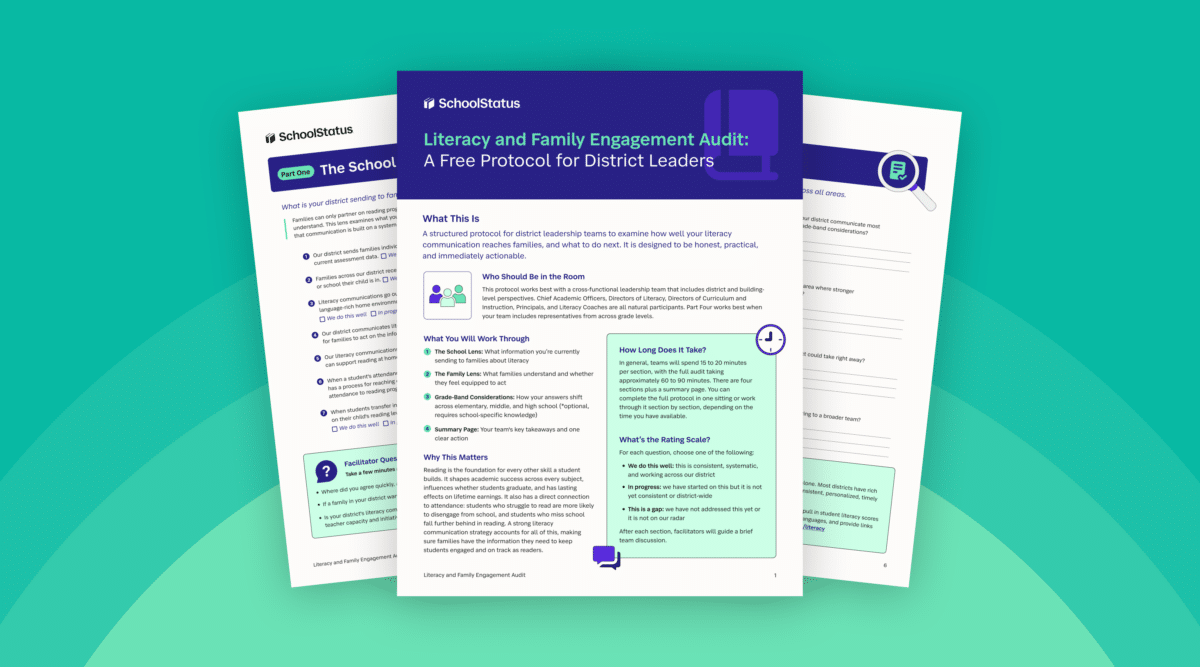

Districts have strong literacy data and families who want to be partners. The piece that often lags is consistent communication between the two. This post introduces a free audit protocol that helps district leadership teams honestly assess where their literacy communication is working, where it is in progress, and where the gaps are.
Here is a question worth sitting with: if a family in your district wanted to know their child’s current reading level today, how would they find out?
For many districts, the honest answer is complicated. The data exists. The assessment platforms are running. Screeners go out three times a year. And yet, families are often operating on a completely different picture of how their child is doing in reading than the one sitting in your data tools.
Nearly 9 in 10 families nationally believe their child is reading at or above grade level. Fewer than half of students are actually performing at grade level. That gap is real, and it has consequences. Families who believe their child is on track have little reason to engage differently at home. Students who struggle to read are more likely to disengage from school. And the attendance-literacy connection compounds over time: students who miss school fall further behind in reading, and students who struggle to read are more likely to miss school.
Strong literacy outcomes require informed family partners. Informed family partners require consistent, timely communication. And consistent communication requires a system.
That last part is where most districts have room to grow.
Individual teachers may be doing heroic work communicating with their students’ families. But when communication depends on individual initiative, families across the district have wildly different experiences. The family whose child is in one classroom gets timely literacy updates in plain language. The family in the next classroom hears nothing until report cards. District-wide literacy goals require district-wide communication practices.
That is the premise behind the Literacy & Family Engagement Audit.
The Literacy & Family Engagement Audit is a free protocol for district leadership teams to examine how well your literacy communication reaches families, and what to do next. It is structured, honest, and immediately actionable.
The audit works through three lenses.
The School Lens examines what your district is currently sending to families about literacy: whether updates are individualized, consistent across schools, available in home languages, and tied to a predictable schedule families can act on.
The Family Lens examines what families actually understand. Sending information and equipping families to act on it are different things. This section surfaces whether families in your district know their child’s reading level, understand what assessment scores mean, and feel like genuine partners in their child’s literacy journey.
The Grade-Band Considerations section lets you pressure-test your answers across elementary, middle, and high school. Districts that communicate well at one level often have real gaps at another. Communication for a third grader identified as at risk looks completely different from communication for a tenth grader reading below grade level. This section helps your team see that picture clearly.
The full audit closes with a summary page: your team’s strongest lens, your biggest opportunity, one concrete action you could take in the next 30 days, and the questions you are still sitting with.
The audit works best with a cross-functional leadership team. Chief Academic Officers, Directors of Literacy, Directors of Curriculum and Instruction, Principals, and Literacy Coaches all bring useful perspectives. The grade-band section benefits especially from having representatives from across school levels.
Teams typically spend 15 to 20 minutes per section, with the full protocol taking approximately 60 to 90 minutes. You can work through it in one sitting or break it into sections, depending on the time you have available.
For each item, your team chooses one of three ratings.
“We do this well” means the practice is consistent, systematic, and working across your district. “In progress” means you have started but it is not yet consistent or district-wide. “This is a gap” means you have not addressed it yet, or it is not currently on your radar.
The goal is honest, practical calibration. Not every item needs to be a strength. The audit is most useful when teams resist the urge to rate everything generously and instead name what is real.
The audit surfaces where your literacy communication is strong and where the gaps are. Once you have that picture, the next question is how to close the gaps systematically.
Most districts already have the assessment data families need. The challenge is getting that data into families’ hands in a way that is personalized, timely, and available in their home language, without adding manual work for staff. That is the problem SchoolStatus Literacy is built to solve. It pulls literacy scores from assessment platforms your district already uses, sends personalized updates to families in their home languages, and connects families to district resources they can use to support reading at home.
The audit helps you see what your communication strategy needs. SchoolStatus Literacy is one way to build it.
The audit is designed for district leadership teams, including Chief Academic Officers, Directors of Literacy, Directors of Curriculum and Instruction, Principals, and Literacy Coaches. It works best when the team includes perspectives from across grade levels.
Teams typically spend 15 to 20 minutes per section. The full protocol takes approximately 60 to 90 minutes. Teams can complete it in one sitting or work through it section by section.
The audit examines three areas: what your district sends to families about literacy (the School Lens), what families actually understand and feel equipped to do (the Family Lens), and how communication practices vary across grade bands (Grade-Band Considerations).
The audit examines systems and practices at the district level. The questions focus on whether consistent, district-wide communication practices are in place, not on individual teacher performance.
The summary page guides your team through identifying your strongest area, your biggest opportunity, one concrete action to take in the next 30 days, and the questions you want to keep exploring.
 Dr. Kara Stern
Director, Education and Engagement
Dr. Kara Stern has seen school from just about every angle: high school English teacher, middle school principal, fellowship director for math and science teachers across New York City, and head of school at a rural N-12 school. That breadth is what she brings to her work at SchoolStatus, where she writes, speaks, and challenges educators to build the kinds of school communities where every student thrives. She holds a Master’s in Education Leadership from Teachers College and a Ph.D. in Teaching and Learning from NYU.
News, articles, and tips for meeting your district’s goals—delivered to your inbox.

Ready to learn more about our suite of solutions?