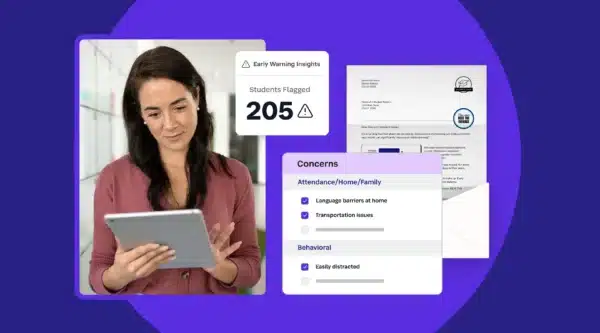
How to Get Superintendent and Board Buy-In for an Attendance Solution
read more


New Book Gives District Leaders a Practical Framework for Improving Chronic Absenteeism—and a Comprehensive Look at State-Level Attendance Policies
Read More >
Key Attendance Trends from the 2025-26 School Year: Insights from 1.1M Students
Read More >

Attendance improvement starts before absences become chronic. Roughly one in four students was chronically absent in the 2023-24 school year, more than double the pre-pandemic rate. The strategies that work share a common thread: early identification, personalized family outreach, and a school culture where showing up feels worthwhile. This post covers 12 evidence-backed approaches, including one that returns 54% of at-risk students to school after a single outreach.
Roughly one in four students was chronically absent in the 2023–24 school year. That’s more than double the pre-pandemic rate. The pace of improvement is slowing, raising the genuine possibility that elevated absenteeism becomes the new normal.
Districts can’t afford to let that happen. The strategies to improve school attendance work when districts have the right information to deploy them at the right time.
Here are 12 of them.
Before any attendance improvement strategy can work, you need to know which students need it. Chronic absenteeism data, defined as missing 10% or more of the school year, tells you who is actually falling behind, not just which days a seat was empty. Combine that with early warning data and you can identify students trending toward chronic absence before they cross the threshold. The earlier the flag, the more options you have.
Absences fall into three broad categories: aversion (students avoid school because of anxiety, bullying, or academic frustration), disengagement (students who don’t see school as relevant or welcoming), and barriers (transportation, illness, family obligations, housing instability). The intervention that works for a student with school anxiety is different from the one that works for a student who misses Mondays because of a bus route change.
Building this understanding requires talking with families. A form letter can document an absence. Only a conversation can explain it. The barriers to attendance almost always live outside the school building.
A student who misses three days in the first two weeks of school is on a trajectory that deserves immediate attention. Districts often don’t flag that pattern until the student has missed 15 or 18 days, at which point the outreach conversation is harder and the academic gaps are real.
Reaching out early and personally changes the dynamic: a phone call, a positive letter, a text in a family’s home language. It signals that the school noticed and that help is available. Districts using SchoolStatus Attend see 54% of at-risk students return to school after just one intervention. That’s what automated, consistent early outreach makes possible.
Positive letters that celebrate milestones, acknowledge effort, and invite conversation build the family trust that makes later, harder conversations possible. When a family hears from school only when something is wrong, they associate school contact with bad news. Rebalancing that ratio is an attendance strategy in its own right.
Attendance letters that lead with legal language and attendance thresholds have their place, but they work better when families already feel known by the school. Personal contact comes first.
If a family doesn’t understand what the school is saying, they can’t act on it. For multilingual families, outreach in their home language is the foundation of any attendance strategy. Letters and messages in the family’s language get read. Outreach that requires a family to find a translator often goes unanswered.
A family that receives outreach in their home language can act on it. That’s the difference between a message sent and a student back in school.
Every school needs a clear plan for what happens at five absences, at ten, and at fifteen. A structured framework ensures a consistent response. Without one, attendance intervention depends on whoever has capacity that week. Students in identical situations end up with different levels of support depending on luck of the draw.
A tiered framework mapped to your MTSS structure gives each tier a trigger, a response, and an owner. Tier 1 covers universal outreach and positive communication for all students. Tier 2 adds targeted support for students showing early warning signs. Tier 3 provides intensive, individualized intervention for students who are already chronically absent. No student falls through because the timing was wrong.
Families in high-absence districts are often harder to reach through a single channel. Phone numbers change, email goes to spam, and app notifications go unnoticed. Physical mail gets through when digital doesn’t land, and digital follow-up keeps the message alive after the letter arrives.
The most effective attendance outreach coordinates both. A mailed letter establishes the message. A digital follow-up reinforces it. When a letter arrives Tuesday and a text follows Thursday, both referencing the same student and the same concern, the outreach feels intentional. Because it is.
Students come to school when they feel connected to it. Research links school climate (students’ sense of safety, connection to adults, and sense of purpose) directly to attendance. A student who has one trusted adult at school is more likely to show up than one who doesn’t.
The investment is relational: knowing students’ names, noticing when they’re off, and making school feel like a place that notices.
Family engagement in attendance improvement means giving families the information and tools they need to be part of the solution. A family that understands why their child’s third-grade attendance shapes reading proficiency (and has concrete steps they can take at home) is far more equipped to act than one that receives a warning notice.
That reframe changes what families hear, and it changes whether they pick up the phone.
Recognition works. When schools acknowledge improved or consistent attendance, students show up more. The mechanism is direct: the school acknowledges the effort, the student feels seen, and coming to school becomes associated with something good.
Personalized letters, classroom celebrations, and public recognition at the school level all signal that attendance matters and that the effort to be there every day is noticed by real people who care.
Attendance improvement requires feedback loops. If a district deploys a new outreach strategy in September, someone needs to be examining whether absence rates are changing by November. Intervention effectiveness data (which outreach brought a student back, which families responded and which didn’t) gives teams the information to adjust in real time.
That tracking also builds the case for continued investment. A principal who can show that tiered outreach in November brought students back by January has the most persuasive argument there is: the kids themselves.
The first 30 days of school set the attendance trajectory for the year. Students who establish strong habits in August and September are more likely to maintain them. Students who miss school during the first two weeks are already behind in ways that compound across the school year.
Positive welcome letters before school starts, calls to families of students who were chronically absent the prior year, early check-ins at the first sign of missed days. These are the moves that set the year’s trajectory. For a student who almost didn’t come back, early outreach is what brought them back.
Improving school attendance is work that spans systems, relationships, and data. The districts making meaningful progress share a common approach: they act early, they communicate personally, they build the kind of school culture that gives students a reason to show up, and they measure what happens.
If you’re heading into a new school year, see how SchoolStatus Attend supports the first-30-day outreach plan that gives districts the strongest possible start.
Early, personalized outreach to families is consistently the highest-leverage intervention. A phone call or positive letter sent within the first two to three absences, before a pattern becomes chronic, outperforms any response deployed after a student has already missed 18 days. Districts using SchoolStatus Attend see 54% of at-risk students return to school after a single intervention.
Truancy refers specifically to unexcused absences and typically triggers legal processes. Chronic absenteeism captures any student who misses 10% or more of the school year, regardless of whether those absences are excused or unexcused. A student can be chronically absent without ever being truant. Chronic absenteeism is the more useful metric because it reflects the actual cumulative impact on learning.
A tiered framework provides the structure: universal positive outreach for all students at Tier 1; targeted intervention at 5–7 absences for students showing early warning signs at Tier 2; intensive, individualized support at 10+ absences at Tier 3. The key is having that protocol in place before the school year starts so the response is consistent, not dependent on who has time that week.
Understanding the barrier is the first step. Many families don’t proactively share what’s getting in the way because they don’t expect the school to help, or they don’t know help is available. Outreach that opens a genuine two-way conversation creates space for families to name the real obstacle. From there, districts can connect families with community resources, flexible scheduling, or transportation assistance.
Districts that invest in early outreach and tiered intervention see movement within a single semester. Troup County reduced chronic absenteeism from 16.6% to 12.2% over two years. Upper Lake USD moved from 48.6% to 27.8% in the same timeframe, with graduation rates up 14%. The pace depends on starting conditions and implementation consistency, but meaningful progress within a year is achievable.
 Dr. Kara Stern
Director, Education and Engagement
Dr. Kara Stern has seen school from just about every angle: high school English teacher, middle school principal, fellowship director for math and science teachers across New York City, and head of school at a rural N-12 school. That breadth is what she brings to her work at SchoolStatus, where she writes, speaks, and challenges educators to build the kinds of school communities where every student thrives. She holds a Master’s in Education Leadership from Teachers College and a Ph.D. in Teaching and Learning from NYU.

News, articles, and tips for meeting your district’s goals—delivered to your inbox.
















Ready to learn more about our suite of solutions?