School-Home Communication Audit: 10 Questions to Assess Your District’s Strategy
read more


New Book Gives District Leaders a Practical Framework for Improving Chronic Absenteeism—and a Comprehensive Look at State-Level Attendance Policies
Read More >
Key Attendance Trends from the 2025-26 School Year: Insights from 1.1M Students
Read More >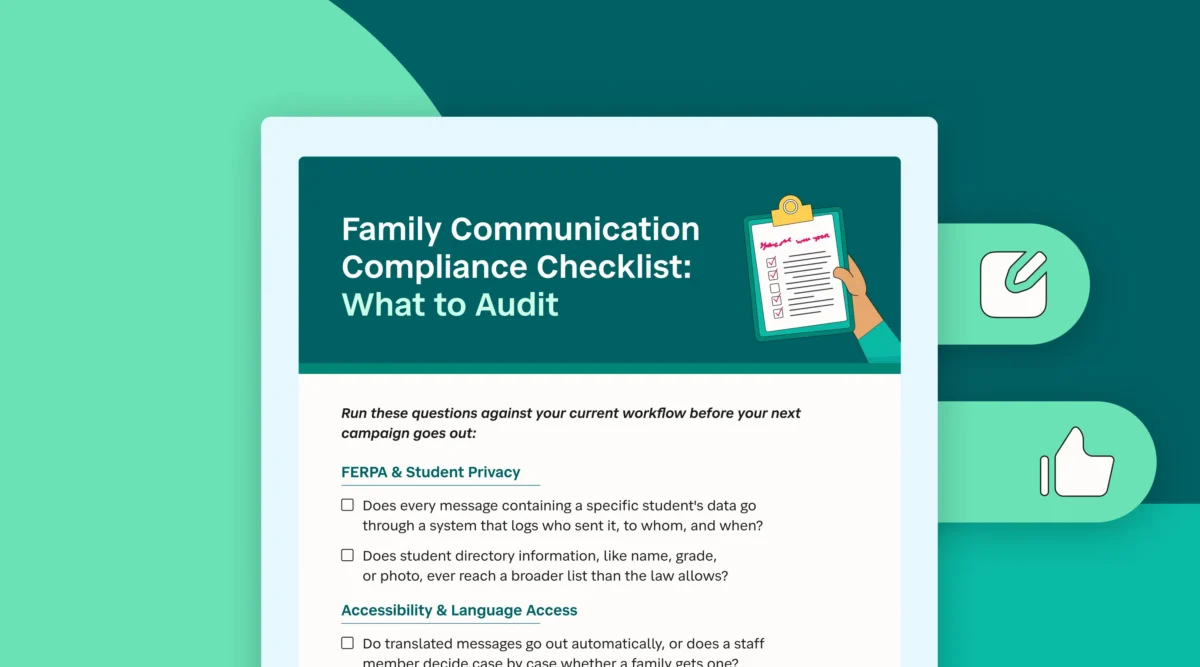

Family communication can create compliance risks when student data, accessibility, translation, and communication records are handled inconsistently. This checklist helps K-12 districts identify gaps in FERPA, ADA, and privacy practices, from who receives student-specific messages to how communications are translated, accessed, and documented.
A family whose child has an IEP meeting scheduled gets the notice in English. Every other form that family fills out at home comes back in Spanish. Nobody flagged that the message about the scheduled IEP meeting should be sent in Spanish. This mismatch happens far too often. A staff member might pull the standard template, hit send, and move on to the next fifty emails in the queue. Family communication compliance breaks down in these ordinary moments, repeated across every school and every listserv in a district, by people who had no idea they were creating a FERPA or ADA problem.
FERPA protects the privacy of student education records and limits who can see personally identifiable information without consent. In practice, that covers any message referencing a specific student’s grades, attendance, discipline record, IEP, or health information, whether it’s a quick text or the report card itself. A well-meaning staff member copying a colleague on a message about a struggling student, or a coach posting practice attendance to a public team page, can cross the line without anyone intending harm. The fix is a system that knows the difference between a general reminder and a message carrying a specific student’s data, and routes each one correctly.
The ADA and Section 504 require effective communication access. This means a family member who uses assistive technology, like a screen reader, needs the same information, at the same time, as everyone else. A PDF newsletter with no alt text, or a permission slip that only goes out in English, leaves that family without reasonable access to the information. State privacy laws add another layer on top of FERPA, covering how long you retain family contact data and what you can share with third-party vendors. A district using six disconnected tools for texts, emails, and translated messages has six separate places where an issue can surface, and no single person who can see all of them at once.
Run these questions against your current workflow before your next campaign goes out:
FERPA & Student Privacy
Accessibility & Language Access
Communication Records
A “no” to any of these is a place where one overworked staff member’s judgment call is standing in for a district policy.
A family that gets a 504 meeting notice they can read, in a language they understand, before the meeting happens, is a family that shows up. A family that can see exactly what the district sent them, and when, trusts the district more. The paperwork exists so a family finds out about something that affects their child while there’s still time to weigh in.
SchoolStatus Connect builds these protections into how messages get sent in the first place. Messages translate automatically into a family’s home language, every communication logs to a searchable record, and student-specific data reaches only the people who are supposed to see it. See how Connect handles compliance by design.
FERPA applies to any communication containing personally identifiable information from a student’s education record, regardless of the channel. A text about a specific student’s grades or attendance carries the same obligations as a printed report card.
The district holds the legal obligation under ADA and Section 504, and are responsible for choosing a platform that is accessible and compliant.
No. Districts carry the responsibility to provide communication in a family’s home language regardless of consent. FERPA’s consent requirements apply specifically to disclosing personally identifiable student data, a separate question from translation.
Retention requirements vary by state and by record type, so districts should confirm specifics with legal counsel. A platform that automatically logs and retains communication history removes the guesswork of tracking this manually across staff inboxes and phones.
This post offers general guidance for family communication practices. Districts should work with their own legal counsel to confirm compliance obligations under FERPA, ADA, and applicable state law.
Nef DukesManager of Education Strategy and Insights
Nef is a former teacher who is passionate about helping educators use data and communications to build family trust and improve educational outcomes. At SchoolStatus, Nef partners with districts to share practical insights and stories about what works in schools today.
News, articles, and tips for meeting your district’s goals—delivered to your inbox.














Ready to learn more about our suite of solutions?