What 146 Districts Taught Us About Getting Kids Back to School
read more


New Book Gives District Leaders a Practical Framework for Improving Chronic Absenteeism—and a Comprehensive Look at State-Level Attendance Policies
Read More >

Key Attendance Trends from the 2025-26 School Year: Insights from 1.1M Students
Read More >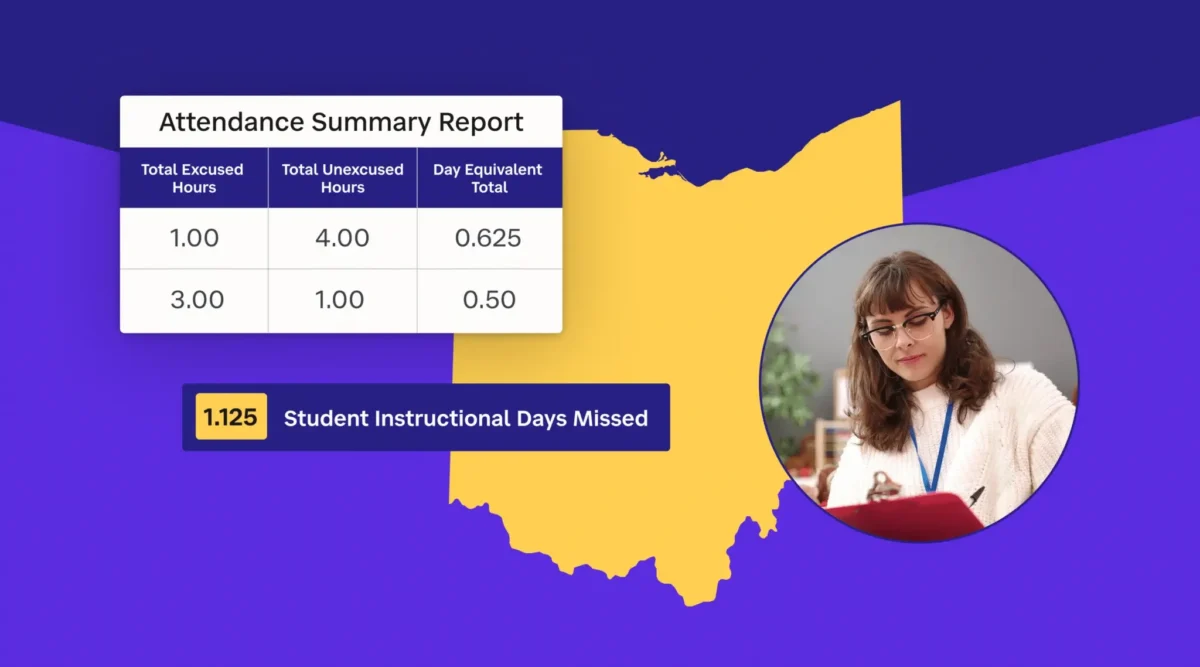

Since 2017’s passage of House Bill 410, Ohio has tracked attendance by hours, not days. Students are considered habitually truant after missing 30 hours of school. it changes how districts need to track attendance, identify risk, and respond.
For many schools adopting this approach, that could lead to greater complexity. But it could also unlock an opportunity to act earlier and build stronger relationships with families.
Most states define chronic absenteeism by the number of days missed. Ohio has taken a different approach. It tracks attendance by instructional hours. Once a student misses 30 hours without a valid excuse, they are considered habitually truant. This requirement has been in place for several years. But its impact is still playing out in how districts manage attendance day to day.
In theory, tracking attendance by instructional hours provides a more accurate picture of missed learning time. Putting it into practice adds complexity.
Districts now have to:
Most schools don’t have one system that covers all of this. They often have to pull the data together across different reports, spreadsheets, and manual checks. Even when the data exists, it isn’t always available in a way that supports timely action. That can definitely slow things down, and there’s a risk that something could be missed along the way.
Of course, the mechanics of tracking attendance hours are just the tactical side of the puzzle. If schools and districts get past how to track attendance by hours, they can see how the approach represents a more holistic way to view attendance.
For example, a student might miss:
In isolation, this missed time might not stand out. But when pulled together, they form a pattern.
When districts collect more granular attendance details, patterns become more visible. The next step is acting on those patterns.
Research on school data systems shows that even when districts have access to data, challenges with integration and usability can prevent teams from making timely decisions. So teams have had to find a way to adapt. They may have needed to pull reports from various systems, manually track some thresholds in a spreadsheet, and then assemble all the information into a cohesive view. Of course, this work takes time. And it can be further complicated if different schools in the district pull their data together in different ways. The end result could be that by the time any patterns are discovered, they’re already behind.
So the gap isn’t necessarily a lack of data. It’s that the time it takes to pull it all together doesn’t meet the urgency of reversing chronic absenteeism. Studies show that identifying students early depends on connecting attendance with other data like behavior and academics, which many districts still struggle to do in real time.
If there is a solution in place to handle data connectivity and perform predictive analytics, the work that staff have to do changes dramatically
Now they’ll be able to notice patterns earlier so they can dig in and understand the “why” behind absences. They’ll also be able to reach out to families sooner with proactive, positive interventions, helping reverse early trends before they become set patterns. In turn, timely, personalized outreach, coupled with consistent follow-up,builds trust with families and helps them feel like partners in helping their students get back to class.
It’s at this point that there is a real shift. Schools and districts move from managing data and reacting to trailing indicators to working proactively with families to improve student outcomes.
Tracking attendance in hours instead of days brings patterns into view sooner. A student doesn’t need to miss multiple full days to stand out. A few partial absences, an early dismissal, or missed time across classes can already point to a shift. That creates an earlier signal, but the value comes from how quickly schools respond to it. In other words, timing makes the difference.
If families hear about missed time in near real time, the conversation starts while the situation is still current. There isn’t a need to wait for a threshold or for a pattern to show up in a report weeks later. That delay often gives the behavior time to settle in.
Early communication keeps things grounded. A message goes out. A family responds. A school has space to listen and understand what is happening. What could have developed into a pattern becomes a brief conversation with a clear next step.
Along with timing, the tone of attendance intervention notices also matters. Attendance notices often come after a pattern has already formed. By that point, the message can feel formal or even a little threatening. A family may react defensively to those. It’s human nature.
If schools send out positive messages to families, that defensive posture can change. Especially if these messages mix early warning observations with celebrations of improvement. Families will not only hear from schools when something is wrong. Instead, the positive communication will feel like a conversation with the school.
Things might go like this:
When Ohio changed its definition of chronic absenteeism to focus on instructional hours, it introduced more complexity to how districts think about attendance, but it also created an opportunity.
The change allows the district to focus on more granular details of attendance with greater precision. They can also act earlier.
And there are solutions available so that Ohio districts, and districts anywhere, can accomplish this without doing manual work.
Solutions like SchoolStatus Attend:
SchoolStatus helps educators connect with families on the topics that matter most. They also help form a partnership built on trust. If you’re ready to see how your district can partner with SchoolStatus, reach out today to start the conversation.
Ohio tracks attendance by instructional hours, not days. A student is considered habitually truant after missing 30 hours without a valid excuse.
No. The law was passed in 2017. What’s changing is how districts track attendance and respond to it in practice.
It captures partial-day absences. Small gaps in time can add up quickly, and this approach helps districts see those patterns earlier.
Schools have to track attendance across periods, schedules, and partial days. In many districts, that still requires pulling data from multiple systems, which takes time and can delay action.
The focus shifts from counting absences to spotting patterns early. That allows schools to reach out to families sooner and address issues before they grow.
By using solutions that automate attendance tracking, flag thresholds, and send timely notifications. That gives staff more time to focus on working with families instead of managing data.
Nef DukesManager of Education Strategy and Insights
Nef is a former teacher who is passionate about helping educators use data and communications to build family trust and improve educational outcomes. At SchoolStatus, Nef partners with districts to share practical insights and stories about what works in schools today.

News, articles, and tips for meeting your district’s goals—delivered to your inbox.
















Ready to learn more about our suite of solutions?