How Ohio Changed Its Definition of Chronic Absence
read more


New Book Gives District Leaders a Practical Framework for Improving Chronic Absenteeism—and a Comprehensive Look at State-Level Attendance Policies
Read More >

Key Attendance Trends from the 2025-26 School Year: Insights from 1.1M Students
Read More >

State attendance laws are shifting. Recent legislation in Indiana, Ohio, California, and New York changed what districts must track, report, and do. Understanding your state’s current requirements is the baseline for building a response that goes beyond the legal minimum.
Every district leader knows attendance matters. The legal framework underneath it is harder to keep current with, because it keeps changing. State legislatures updated compulsory attendance ages, added chronic absenteeism reporting mandates, and revised how truancy is defined and handled. The compliance picture now looks materially different than it did three years ago.
A compulsory attendance law is a state statute that requires children within a specified age range to attend school. Every state has one. The variation is in the details: the age range, exemptions, and what happens when a student does not comply. In 2025, several states updated their compulsory attendance frameworks to add chronic absenteeism reporting requirements, revise truancy definitions, and change how districts must respond when students miss school.
Common exemptions include home instruction, physical or mental conditions that make attendance infeasible, or completion of equivalent high school requirements. Most states permit private school enrollment as an alternative to public school.
The practical implication: a student who turns 16 in a state with a 16-year upper limit is no longer legally required to be in school. Districts in those states need proactive family engagement strategies in place before students reach that age, because once the legal requirement ends, staying connected depends entirely on the relationships you’ve already built.
The 2025 legislative session brought meaningful shifts in several states. District leaders in these states should review current policy against new requirements.
California updated its truancy framework on two fronts. SB 691 removes punitive language from initial truancy letters sent by schools on or after July 1, 2025. Attendance research consistently shows that supportive first contact produces better results, and the law now aligns California’s written communications with that evidence. California’s existing threshold remains in place: a student absent without a valid excuse for more than 30 minutes on three school days in a year is classified as truant.
Indiana enacted Senate Enrolled Act 482, effective July 1, 2025, to improve how schools report student absences to the Indiana Department of Education. State statute requires superintendents or attendance officers to report habitually absent students to the local prosecuting attorney. Hoosier officials were clear that the law changed reporting requirements without altering local attendance policies or penalizing families for excused absences. That distinction required significant public clarification after the bill passed. Indiana also set a key deadline: K-8 students cannot be expelled solely for chronic absence or habitual truancy until July 1, 2026. After that date, removal becomes possible again.
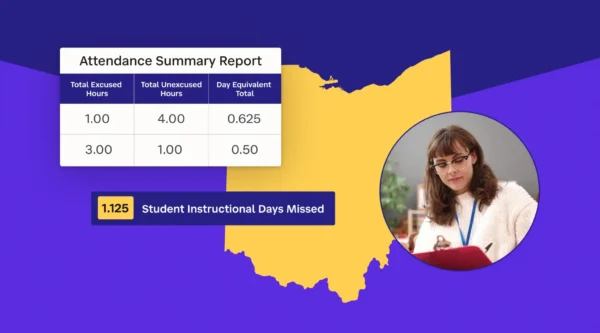
Ohio moved toward requiring formal local policy under HB 96. Ohio school districts must adopt a written policy on addressing chronic absenteeism no later than August 1, 2026. The state reminded districts to align those policies with county juvenile courts, covering factors like parental reporting of absences, parameters for excusing absences, and health-related attendance policies.
Texas Senate Bill 991 adds chronically absent students to the state’s definition of those “at risk of dropping out,” formally linking absenteeism to the dropout conversation at the policy level.
Virginia added requirements focused on data accuracy and risk identification with HB 2601, which requires schools to maintain class-by-class attendance records alongside daily totals, for more granular data.
State law tells you when to count an absence, when to classify a student as truant, when to notify families, and when to escalate. Getting students back requires something more.
Districts that reach families before students hit 10 missed days, personalize outreach based on what’s actually happening in a student’s life, and build relationships that make families want to respond see real results. Across districts working with SchoolStatus Attend, 54% of at-risk students return to school after just one outreach.
Does your attendance policy reflect current state law? Several states updated definitions, reporting requirements, or timelines in 2025. If your policy hasn’t been reviewed since before that session, check it against the current statute.
Are your family notifications meeting current tone requirements? California’s SB 691 is the clearest codified example, but it reflects a broader research consensus. Initial family contact should be supportive. Review your first-contact letter templates and flag anything that reads as punitive.
Are your internal early warning triggers set at the right threshold? State law sets thresholds for truancy referrals and escalation. Effective attendance programs set internal triggers earlier, flagging students at 5% absence before they reach the 10% chronic threshold. By the time a student qualifies for a legal referral, the support conversation is already harder.
Compliance sets the requirement. SchoolStatus Attend helps districts build the response: automated outreach, early warning tools, and 20+ years of experience connecting with families before students reach a truancy threshold. Request a demo to see what that looks like in your district.
Both, because they measure different things. Truancy typically refers to unexcused absences and triggers legal processes. Chronic absenteeism counts all absences, excused and unexcused, and is the metric most tightly linked to academic outcomes. ESSA requires chronic absenteeism reporting; your state law may also require truancy referrals. Many students who are chronically absent fall below the legal truancy threshold. Tracking only one metric leaves a significant population unseen.
ESSA requires reporting. The intervention protocol is yours to build. Federal funds are available for attendance-related training and programs, and states layer additional requirements on top, as Ohio and Indiana both did in 2025. Staying current on state legislation matters as much as knowing the federal baseline.
The direction is broader than California. New York’s proposed legislation removes law enforcement from the attendance process entirely. Districts everywhere should review their initial contact templates against what research consistently shows: supportive, non-threatening outreach in the first contact produces better outcomes than punitive framing.
Legally, yes. The compulsory requirement ends at the upper age limit. But state accountability systems and ESSA reporting cover all enrolled students. A 17-year-old who is enrolled and chronically absent still counts in your chronic absenteeism rate and still affects per-pupil funding in states where funding is tied to average daily attendance.
Students with IEPs and 504 plans have additional protections. California, for example, has specific reporting requirements when attendance is severed for students with exceptional needs. Districts generally must pursue additional supports before referring students with disabilities for truancy proceedings. Involve your special education director in any attendance escalation process involving students with documented disabilities, and check your state’s specific guidance before acting.
 SchoolStatusSchoolStatus connects educators and families around the topics that matter most. The company partners with K–12 districts to improve attendance, engage families, and build trust so students can succeed. A recognized leader in data-driven attendance and family engagement solutions, SchoolStatus enables districts and educators to engage families with relevant, timely communications and proactive support on important topics including absenteeism, literacy progress, and overall student readiness. Today, SchoolStatus supports districts in all 50 states and serves more than 22 million students nationwide as a trusted partner in driving better student outcomes.

News, articles, and tips for meeting your district’s goals—delivered to your inbox.

















Ready to learn more about our suite of solutions?