Creating a Schoolwide Culture of Growth at Mesa Verde
read more


SchoolStatus Launches Literacy Solution to Help Districts Engage Families in Improving Reading Outcomes
Read More >
Key Attendance Trends from the 2025-26 School Year: Insights from 1.1M Students
Read More >Explore how schools in Farmington are transforming instructional coaching with SchoolStatus—driving teacher growth, student voice, and schoolwide impact.
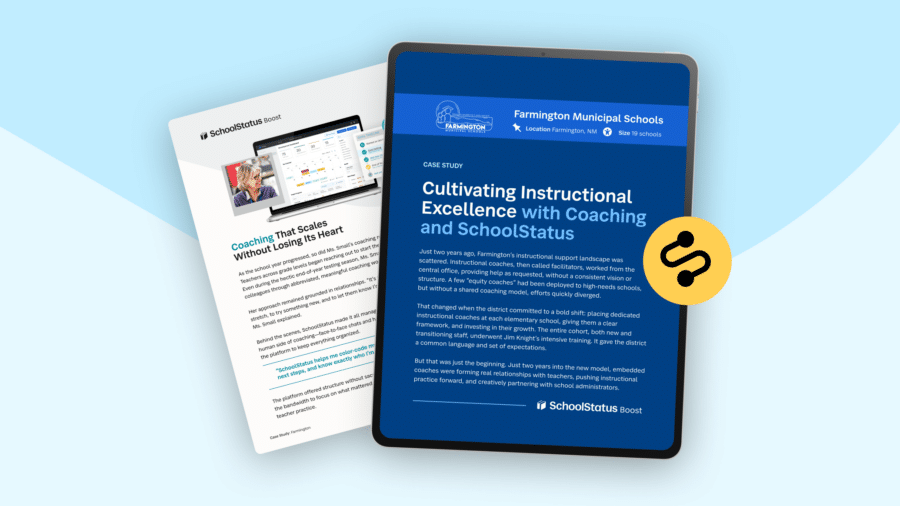

Organization: Farmington Municipal Schools
District Size: 19 Schools
Product: SchoolStatus Boost: Coach
Location: Farmington, NM
Just two years ago, Farmington’s instructional support landscape was scattered. Instructional coaches, then called facilitators, worked from the central office, providing help as requested, without a consistent vision or structure. A few “equity coaches” had been deployed to high-needs schools, but without a shared coaching model, efforts quickly diverged.
That changed when the district committed to a bold shift: placing dedicated instructional coaches at each elementary school, giving them a clear framework, and investing in their growth. The entire cohort, both new and transitioning staff, underwent Jim Knight’s intensive training. It gave the district a common language and set of expectations.
But that was just the beginning. Just two years into the new model, embedded coaches were forming real relationships with teachers, pushing instructional practice forward, and creatively partnering with school administrators.
Supporting ten coaches across ten schools required a new layer of leadership. “You can’t be in ten places at once,” Jennifer Bowles, Director of Early Education, admitted. That’s where SchoolStatus became an indispensable tool, allowing her to have eyes in each of the elementary schools even when she couldn’t be there physically.
Every coach logs their time, tracks their progress through Knight’s coaching cycle (Identify → Learn → Improve), and tags focus areas aligned to district priorities like assessment and direct instruction. This data fuels weekly team meetings between the coaches, mid-year progress checks, and realignment conversations with school administrators.
SchoolStatus gives me insight into what’s going well, where we’re stuck, and how we’re growing—even when I can’t be in the building.
Jennifer Bowles, Director of Early Education
Highlights from the data:
Easy access to data dashboards on SchoolStatus has made it easy for Ms. Bowles to advocate for her team and show the impact of their work on student learning.
Early on, some principals questioned whether instructional coaching might overlap with their own responsibilities. After all, they considered themselves the instructional leaders in the building. To that concern, Ms. Bowles provided a powerful reframe: administrators provide Tier 1 walkthrough support for all; instructional coaches offer Tier 2 intensive, sustained support for a few.
Principals set the bar. Coaches help teachers reach it. The clearer the bar, the more teachers seek out their coach to grow.
Jennifer Bowles, Director of Early Education
This clarified vision led to stronger alignment across schools:
The broad investment in instructional coaching at Farmington came with the expectation that the results would be widespread. And so far, that’s been the case:
And it’s not just anecdotes. With nearly 200 coaching cycles conducted in one school year and full coach retention heading into next year, Farmington has built a thriving, sustainable coaching culture.
As Farmington looks to the future, the focus is on both quality and equity:
Ms. Bowles explained the power of her team’s role:
Instructional coaching is how we meet our ambitious goal, 85% of students proficient, not by lowering expectations, but by helping every teacher find the path to reach them.
At Ladera del Norte Elementary, there’s a brand new instructional coach —but you wouldn’t know it by walking through the halls. In just her first year, Mindy Small is getting teachers to open their doors, try new strategies, and realize powerful results. She’s become a trusted partner for educators across the building.
Ms. Small’s coaching journey began in a unique way—her very first coaching cycle was with her daughter, fifth-grade teacher Kazhia Small. Their partnership set the tone for what coaching could look like at Ladera: collaborative, student-focused, and rooted in curiosity.
Their first session started with a simple, powerful question: “What do you want to learn?”
The younger Ms. Small didn’t hesitate. “Socratic seminars. That’s my thing,” she said.
She had tried to implement the strategy before, inspired by her own experience in high school. But without structured support, it hadn’t landed. “I thought just being a participant in one was enough. It was not,” she admitted.
With Instructional Coach Small’s guidance, that challenge turned into an opportunity for growth. Together, they crafted a student-centered goal: help students generate and defend claims during class discussions. They leaned on Marzano’s framework for clarity, visited a local high school to observe Socratic seminars in action, and brought that insight back to fifth grade. And through it all, SchoolStatus helped them stay aligned—scheduling meetings, tracking progress, and supporting reflection at every step.
The early days weren’t easy. Their first attempt at a seminar was bumpy. But with constructive feedback from a veteran high school teacher and consistent coaching support, things started to click.
By the end of the year, every student in Ms. Small’s class could confidently make a claim and back it up with evidence. They even started leading their own seminars.
One moment stood out: a quiet student who rarely spoke in class offered a moving interpretation of a Robert Frost poem while a group of visiting teachers observed.
“They were like, ‘I’ve never heard this kid talk.’ And he was making real connections—to poetry!” Ms. Small recalled.
The impact didn’t stop with English Language Arts. Students began applying their reasoning and communication skills across subjects—math, science, and social studies. Their growing confidence caught the attention of other teachers, who began asking how they could bring similar strategies into their own classrooms.
As the school year progressed, so did Ms. Small’s coaching reach. Word spread. Teachers across grade levels began reaching out to start their own coaching cycles. Even during the hectic end-of-year testing season, Ms. Small continued supporting colleagues through abbreviated, meaningful coaching work.
Her approach remained grounded in relationships. “It’s fun to get teachers to stretch, to try something new, and to let them know I’m there so they won’t fail,” Ms. Small explained.
Behind the scenes, SchoolStatus made it all manageable. While she prefers the human side of coaching—face-to-face chats and handwritten notes—she relied on the platform to keep everything organized.
SchoolStatus helps me color-code my schedule, keep track of next steps, and know exactly who I’m working with.
Mindy Small, Instructional Coach
The platform offered structure without sacrificing connection, giving Ms. Small the bandwidth to focus on what mattered most: building trust and growing teacher practice.
Perhaps the most powerful result of Ms. Small’s coaching work has been the cultural shift it sparked across the school.
Even in her first year, she knew she had to change how coaching was perceived. “I think coaching used to have a negative connotation,” she reflected. “Like, ‘You have to work with the coach.’ Now it’s, ‘You get to work with the coach.’”
That reframing opened the door to vulnerability, experimentation, and growth. Teachers started setting bold goals—not just for academic outcomes, but for how they could inspire their students.
“At first, I just wanted kids to learn,” Ms. K. Small said. “Now, I want to inspire them. Truly inspire them.”
And she’s not alone. What started as one cycle has grown into a school-wide shift. At Ladera del Norte, instructional coaching isn’t just about improvement—it’s about empowerment. With trust, purpose, and support from SchoolStatus, teachers are building confidence, students are finding their voices, and the culture of learning is stronger than ever.
At Mesa Verde Elementary School, a collaborative spirit between administrators and instructional coaches is redefining what it means to support teachers. Principal Jessica Doyle and Assistant Principal Lynsay Reinhardt are frequently in classrooms. They’re conducting observations and setting the bar for quality instruction. Meanwhile, second-year Instructional Coach Anna Zepeda helps teachers reach that bar with deep coaching cycles that are teacher-led and inherently collaborative.
Together, they’ve created a strong culture shift where teachers are excited to attend PLCs, start new coaching cycles, and contribute to the schoolwide goal.
At the heart of the school’s coaching philosophy is the belief that instructional growth should be teacher-driven. “We started by making sure teachers understood that coaching wasn’t about fixing them,” said Principal Doyle. “It was about helping them grow in an area they wanted to develop.” To reinforce that message, the school administrators stepped out of the room during Ms. Zepeda’s introduction at the first staff meeting, letting teachers share their own experiences with the coach in a relaxed, authentic environment.
That trust was critical. Teachers were given autonomy to set personal instructional goals, aligned or distinct from schoolwide priorities, and collaborate with their coach, Ms. Zepeda, without administrator oversight during the cycle. “Coaching is not evaluative,” Anna explained. “The data belongs to the teacher. I’m there to support, not to assess.”
Still, administrators stayed looped in at a high level. SchoolStatus allowed Ms. Zepeda to download spreadsheets that detailed how many teachers were engaged in cycles, which Marzano strategies were in focus, and how many were working on schoolwide goals. This balance between transparency and autonomy allowed administrators to see high-level data without compromising the integrity of instructional coaching.
The use of SchoolStatus has amplified the effectiveness of coaching at Mesa Verde. For Ms. Zepeda, the tool integrates directly with her calendar and documents every coaching cycle: what strategy the teacher is working on, what stage they’re in, and what data is being collected. “Everything we do as instructional coaches is in SchoolStatus,” she said.
She can log meetings, upload student work, and document instructional strategies.
On the administrator side, SchoolStatus’s evaluation platform supports goal-setting, PLC observations, and walkthrough documentation. Teachers also have access to SchoolStatus, something the Mesa Verde team capitalized on. At staff meetings, teachers were given dedicated time to reflect on their professional growth goals using templates within SchoolStatus. As Principal Doyle noted,
This year, it felt like it wasn’t a compliance task. It was authentic. Teachers knew what they were working on and had time to work on it.
Jessica Doyle, Principal
That authenticity spilled into the PLCs. Administrators used SchoolStatus to document meetings, share next steps, and guide teams in applying instructional strategies. “They weren’t just meeting for the sake of meeting,” said Assistant Principal Reinhardt. “They were pushing student learning forward.”
The impact of school administrators and instructional coaches working together is best seen through the stories of teacher growth. One second-grade teacher, new to the profession and initially hesitant to engage with coaching, ended the year confidently using the Marzano compendium to guide instruction, implementing student-led strategies like turn-and-talks and creating visible learning targets. Her transformation was driven by her initiative and supported by consistent coaching from Ms. Zepeda.
Another new teacher, juggling 15 credit hours of coursework while managing her first classroom, found a lifeline in her instructional coach. Ms. Zepeda modeled lessons, co-taught, and provided real-time feedback. By year’s end, the teacher posted some of the highest student growth in the grade level, a testament to both her resilience and the strength of the coaching relationship.
Even in high-stakes situations, like when a teacher was placed on a growth plan, the coaching model held firm. Weekly check-ins, artifacts, and classroom observations provided targeted support that led to renewed confidence and improved classroom management. “She started to believe she could get better,” recalled Principal Doyle. “That shift in mindset changed everything.”
The whole team at Mesa Verde understands that systems matter, but culture sustains. Administrators model transparency, seek teacher feedback through surveys, and focus relentlessly on the positive. Monthly staff shoutouts celebrate growth, and schoolwide goals are chosen collaboratively by the leadership team.
We told teachers: You can focus on our schoolwide goal, or pick your own. Either way, you’ll have time and support to grow.
Jessica Doyle, Principal
Next year, the team is planning to deepen their walkthrough routines and conduct more frequent instructional “pulse checks.” By pairing their evaluative observations with the longer, relationship-based coaching cycles Ms. Zepeda leads, they’ll better identify where teachers are thriving and where they may need extra support.
Ms. Zepeda is also planning to launch “Anna’s Corner,” a short segment in staff meetings offering quick, actionable strategies teachers can use immediately—no extra work, just practical ideas rooted in their reality.

Ready to learn more about our suite of solutions?