What 146 Districts Taught Us About Getting Kids Back to School
read more


SchoolStatus Launches Literacy Solution to Help Districts Engage Families in Improving Reading Outcomes
Read More >
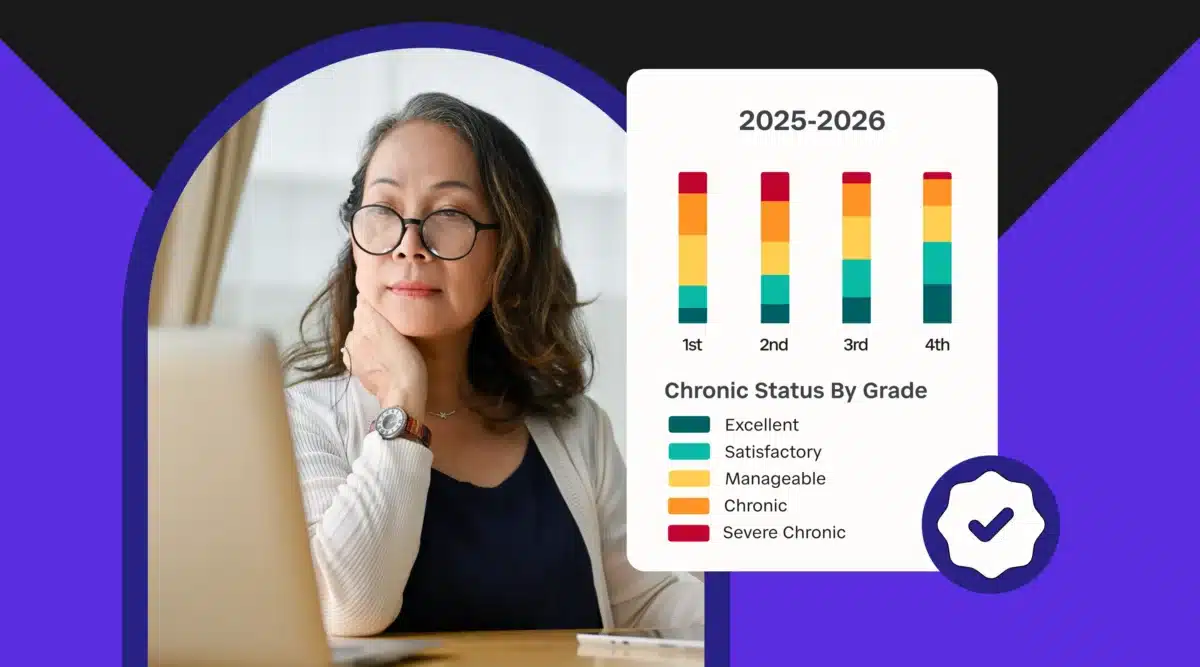

Districts using automated attendance intervention software spend less time reviewing spreadsheets and more time with the students and families who need them most. The system monitors absence records daily, sends personalized outreach when a student crosses a threshold, and logs every action. Districts using SchoolStatus Attend averaged 20.92% chronic absenteeism in 2024-25, compared to the national average of 23.5%.
District leaders tracking chronic absenteeism know the pattern: automated attendance intervention software flags it as a priority, the team commits to earlier outreach, and then Monday arrives with a stack of absence records no one has had time to act on. The gap between when an absence happens and when a family hears from the school is where chronic absenteeism takes hold.
What is Automated Attendance Intervention Software? Automated attendance intervention software connects to a district’s student information system, monitors individual absence records in real time, and automatically sends personalized outreach to families when a student crosses a defined absence threshold. It replaces the manual process of identifying at-risk students and sending intervention letters one by one, at district scale, across every school simultaneously.
→ Attendance Early Warning Systems for K-12 Districts
The districts closing the gap on chronic absenteeism are not staffing their way out of it. They have systems doing the routine work for them.
Without automation, the typical week looks like this: pulling absence reports, cross-referencing student records, manually drafting intervention letters, running mail merges, logging every call, and starting the process over again the following Monday.
Two problems compound each other. There are more students to intervene on than any one person can realistically track without missing someone. And every hour spent on administrative tasks is an hour not spent with students who need a real conversation about what is going on at home.
Districts using automated attendance interventions see up to 75% reductions in staff time spent on attendance notifications. That time goes somewhere better: to the families who need a phone call, not a form letter.
→ What Is Chronic Absenteeism? Causes, Impact and How to Fix It
Before a single absence becomes a pattern, the system is already at work. Positive outreach goes out automatically when students hit attendance milestones, building school-to-home trust before there is ever a problem to address.
When a student crosses a defined absence threshold, targeted outreach goes out automatically. It names the child, cites the specific days missed, and explains the impact. No one has to initiate it.
When a student’s absences don’t improve, the system escalates, surfacing them for counselor follow-up with a complete record of every prior outreach attempt already logged. The counselor walks into that conversation knowing exactly what has already been tried.
That sequencing matters. It means every family gets a response proportional to what their student actually needs, and no one slips through because the week got busy.
→ Navigating K-12 Attendance Trends: Insights from 2024 to Shape 2025
The data is consistent. Districts using proactive automated attendance strategies averaged 20.92% chronic absenteeism in 2024-25, compared to the national average of 23.5%. 54% of at-risk students return to school after just one intervention contact. More than 334,000 Hispanic and Latino students improved attendance after receiving one intervention letter in their home language.
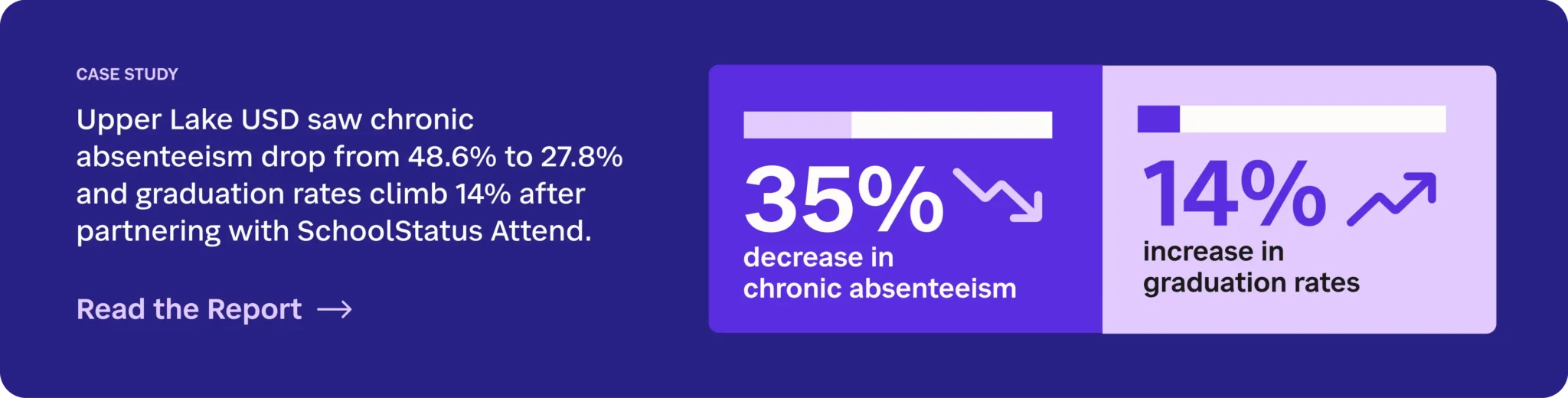
Upper Lake USD saw chronic absenteeism drop from 48.6% to 27.8% and graduation rates climb 14% after implementing automated, multi-channel outreach.
→ 2024-25 K-12 Attendance Trends Report
The difference between districts improving and those stagnating is almost always the consistency and speed of outreach, not the size of the attendance team.
Most districts already know what good attendance intervention looks like. The barrier is execution at scale, consistently, across every school, every week, without anything falling through.
SchoolStatus Attend integrates directly with your SIS and pulls attendance data automatically every day. From there:
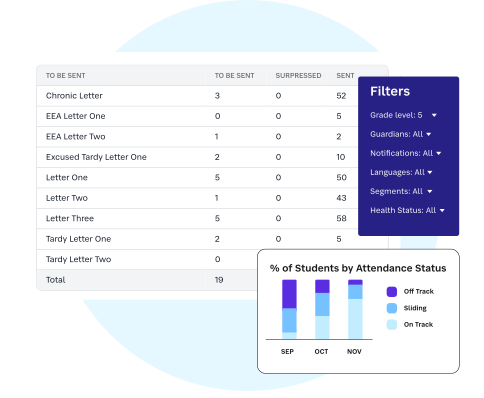
Districts that close the gap on chronic absenteeism do not do it by hiring more staff — they do it by ensuring no absence goes unaddressed. Automated attendance intervention software handles the routine work at district scale, so the time that used to go into spreadsheets and mail merges goes into the conversations that actually change outcomes.
Districts using SchoolStatus Attend averaged 20.92% chronic absenteeism in 2024-25, nearly 3 percentage points below the national average of 23.5%. The families who needed outreach on Monday get it — automatically, in their language, across every school, every week.
See how districts across all 50 states use SchoolStatus Attend to reduce chronic absenteeism without adding staff. Request a personalized demo.
The most effective tools do. SchoolStatus Attend integrates with multiple SIS providers and pulls attendance data automatically every day, so absence records are always current without manual entry.
SchoolStatus Attend implementation is handled by the SchoolStatus team. Intervention thresholds, SIS integration, outreach workflows, and language settings are all configured during onboarding so your staff are not building anything from scratch.
SchoolStatus Attend escalates automatically. If a student’s absences don’t improve after the first contact, subsequent digital interventions are triggered and the student is surfaced for direct counselor follow-up with a full outreach history already logged.
Yes. SchoolStatus Attend automatically sends outreach in 130+ languages via SMS, email, and physical mail. No separate translation step is required.
Both. SchoolStatus Attend automatically sends positive outreach to families when students hit attendance milestones, not just when absences are a concern. Building trust with families before a problem develops is part of how the system works.
 Dr. Kara Stern
Director, Education and Engagement
Dr. Kara Stern has seen school from just about every angle: high school English teacher, middle school principal, fellowship director for math and science teachers across New York City, and head of school at a rural N-12 school. That breadth is what she brings to her work at SchoolStatus, where she writes, speaks, and challenges educators to build the kinds of school communities where every student thrives. She holds a Master’s in Education Leadership from Teachers College and a Ph.D. in Teaching and Learning from NYU.

News, articles, and tips for meeting your district’s goals—delivered to your inbox.



















Ready to learn more about our suite of solutions?