What 146 Districts Taught Us About Getting Kids Back to School
read more


New Book Gives District Leaders a Practical Framework for Improving Chronic Absenteeism—and a Comprehensive Look at State-Level Attendance Policies
Read More >

Key Attendance Trends from the 2025-26 School Year: Insights from 1.1M Students
Read More >

Chronic absenteeism, defined as missing 10% or more of school days, now affects nearly 1 in 4 U.S. students. Students missing this much school in early grades are significantly less likely to read on grade level by 3rd grade and face higher dropout rates later. The districts closing the gap identify at-risk students early, reach families with personalized outreach, and document every intervention. Generic outreach does not work. Targeted, timely communication does.
In the years since the pandemic, chronic absenteeism has become the defining academic equity issue in K-12 education. Before 2020, 1 in 6 students were chronically absent, the number is now 1 in 4. But the headline number isn’t the real problem. Many districts are tracking average daily attendance — which can look fine — while chronic absenteeism quietly compounds in the background.
This page covers what chronic absenteeism is, the factors driving it, its impact on students, and what districts making measurable progress are doing to reduce it.
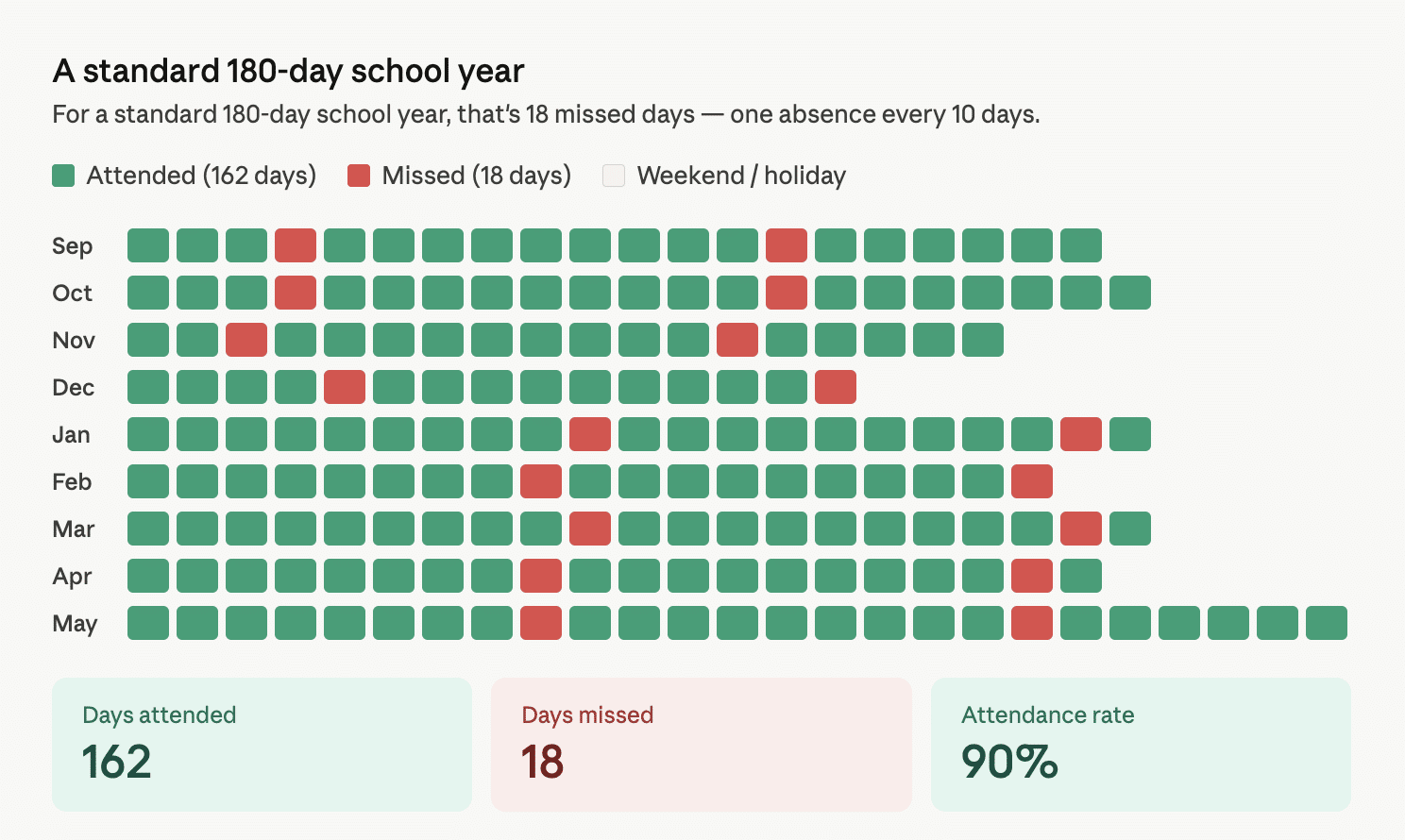
What is chronic absenteeism? Chronic absenteeism means a student has missed 10% or more of enrolled school days, for any reason: excused absences, unexcused absences, and suspensions all count. For a standard 180-day school year, that’s 18 days. It is the federal standard used for ESSA accountability reporting and the metric that predicts long-term academic risk far better than average daily attendance.
The 10% threshold isn’t arbitrary. It’s the federal standard under ESSA, used for school performance ratings and state accountability reporting. And it counts everything: a student with 18 doctor’s appointments, 18 sick days, or 18 suspension days all qualify as chronically absent.
That distinction matters because it’s easy to conflate chronic absenteeism with two other attendance metrics that describe different problems.
| Attendance Metric | Definition | What It Measures | Key Limitation |
| Chronic Absenteeism | Missing 10%+ of school days | Student-level academic risk | Often identified too late |
| Truancy | Unexcused absences only | Compliance/legal concern | Excludes excused absences |
| Average Daily Attendance (ADA) | Percentage of enrolled students attending daily | School-wide attendance trends | Can hide at-risk students |
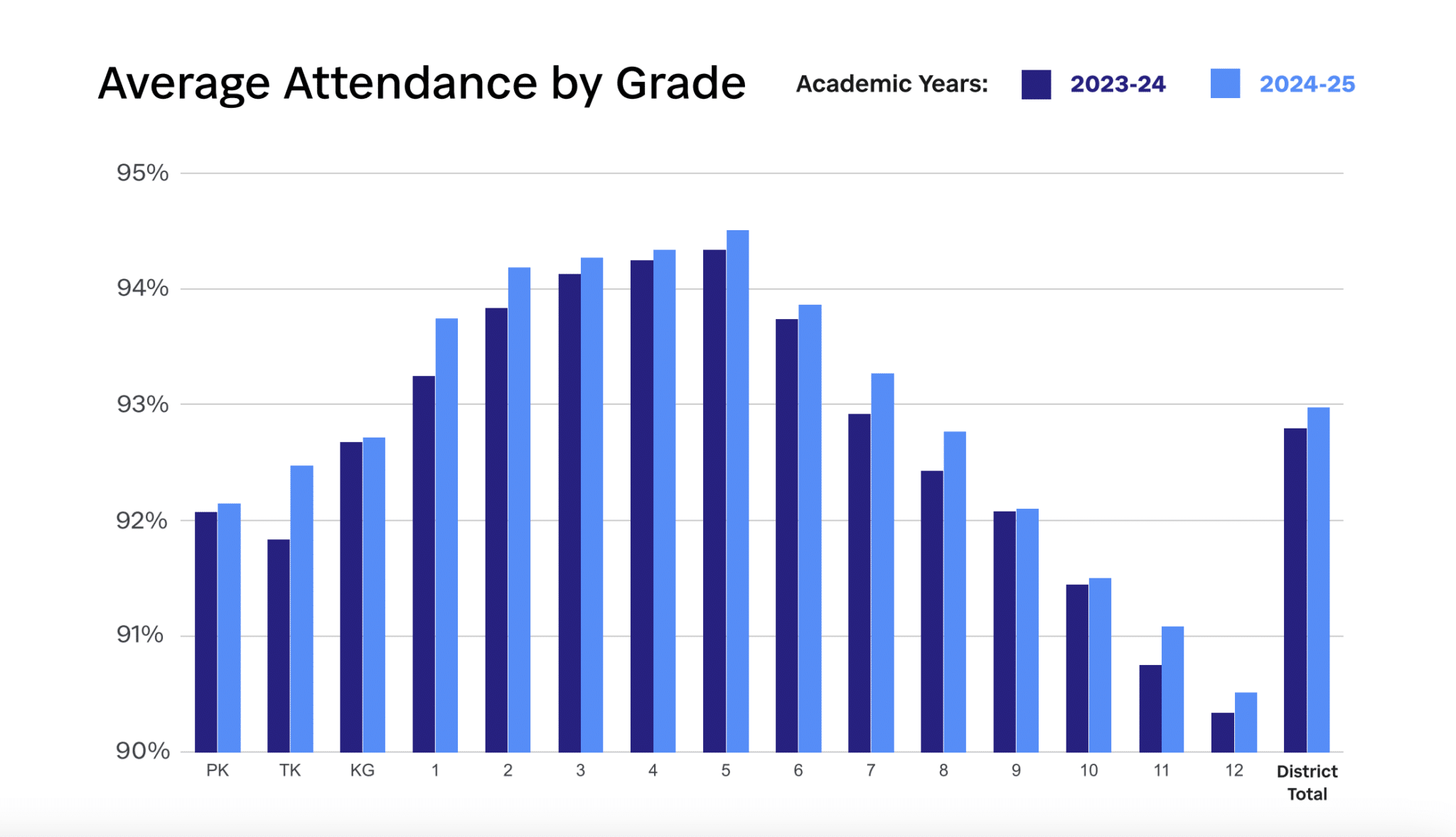
Truancy refers only to unexcused absences and is a legal classification. A student can be chronically absent with a spotless excused-absence record. Average daily attendance (ADA) is a district-level aggregate, not a student-level indicator. A school can report a 94% ADA while a significant portion of its students quietly accumulate absences that will affect their academic trajectory for years.
Chronic absenteeism is the student-level metric. It’s what tells you which individual kids are in danger.
Before 2020, roughly 16% of U.S. students were chronically absent each year. By 2021–22, that number climbed to approximately 26%. The recovery since then has been real but slow: a 3-point improvement in 2022–23 narrowed to just 1.9 points in 2023–24. Many districts are still far from where they were, and high school students are carrying the steepest gaps.
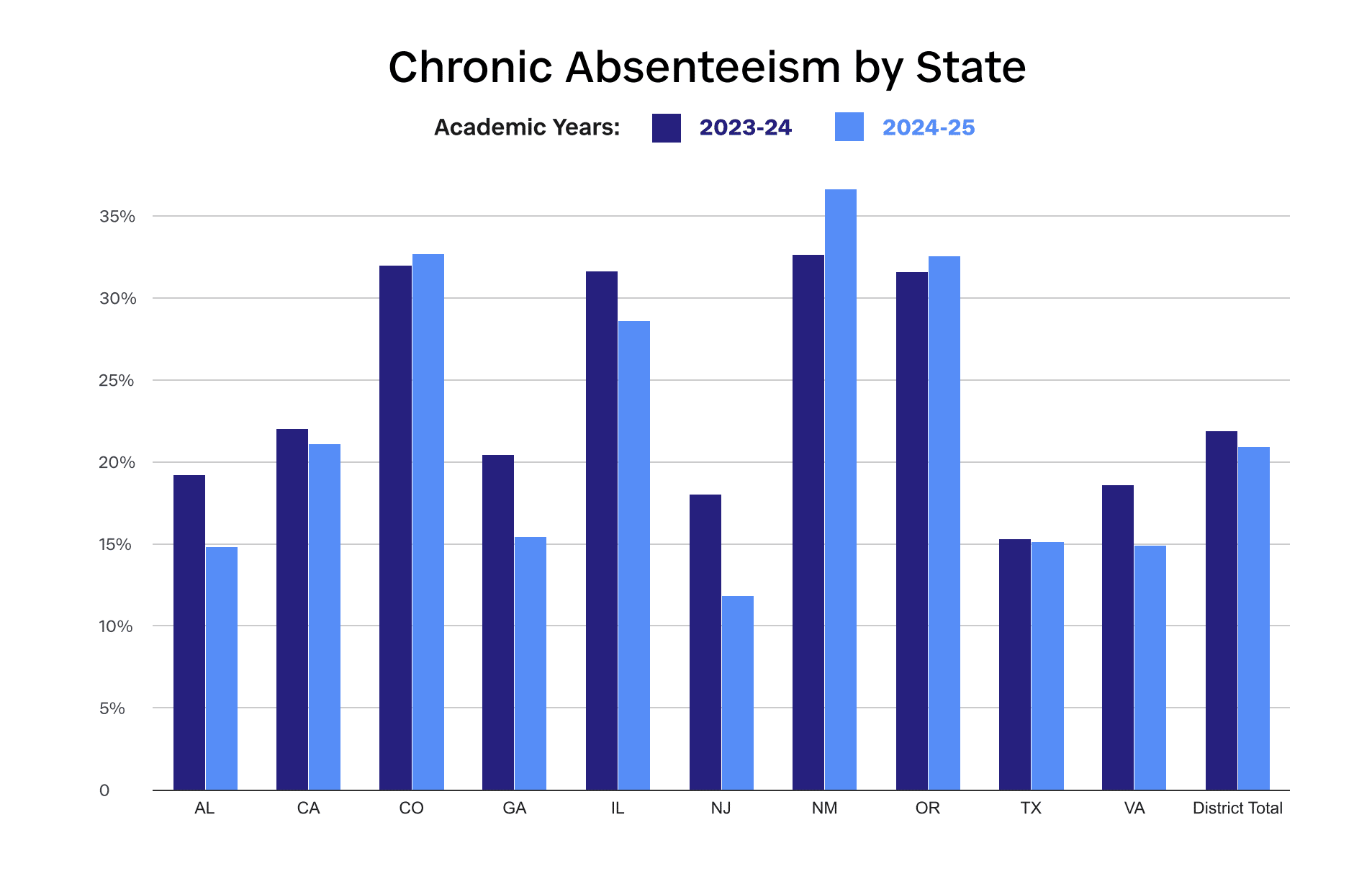
SchoolStatus’s analysis of data from 1.3 million students shows that districts using proactive interventions had an average chronic absenteeism rate of 20.92% in 2024–25, compared to a 23.5% national average. That gap, nearly 3 percentage points, represents thousands of individual students who didn’t cross the chronic absence threshold.
There is no single cause. The research consistently surfaces the same clusters of barriers, though the mix varies significantly by student, school, and community.
And then there’s family unawareness. Many families genuinely don’t know their child’s attendance record, or don’t realize that missing two days a month adds up to 18 days by the end of the year. A family that sees each absence as an isolated event, not a pattern, can’t be a partner in solving the problem until they know there is one.
This is why personalized communication matters. Generic outreach tells families a child was absent. A targeted message tells a specific family that their child has missed 9 days, explains what that means for the school year, and opens a door for them to share what’s getting in the way. That’s the conversation that changes behavior.
Missing 10% of school sounds manageable. Eighteen days doesn’t sound like that many. The compounding effect is what catches people off guard.
A student chronically absent in their early years is significantly less likely to read on grade level by the end of 3rd grade. Across those four years, 18 missed days per year equals roughly 72 days of instruction, nearly half a school year. The skills built in those early years don’t wait. Phonics instruction in October doesn’t hold until the student is ready to engage in February.
Unfortunately, the academic impact of chronic absenteeism continues as students age. Research shows that attendance issues account for 67% of course failures, far more than any other single factor. By high school, chronically absent students face higher dropout rates, lower lifetime earnings, and worse long-term health outcomes. Each annual cohort of dropouts costs the U.S. economy approximately $272,000 per student in lost tax revenue and increased social services over their lifetime.
What attendance data tells you →
Improving attendance with analytics →
Student Insights That Help Schools Act Earlier →
The literacy-absenteeism cycle is one of the more stubborn patterns in K-12 education: students with low literacy find school frustrating and painful, so they avoid it. They miss reading instruction. Their literacy falls further. The school becomes an even less appealing place to be. Repeat.
Breaking the cycle requires addressing attendance and literacy simultaneously, not as separate programs competing for counselor time, but as connected problems with overlapping solutions.
The connection between literacy and attendance →
While rates aren’t rising, they’re not recovering fast enough. They remain significantly above pre-pandemic baselines in most states. The pace of improvement has slowed: the 3-point decrease seen in 2022–23 dropped to 1.9 points in 2023–24. Mid-year 2024–25 data shows that high school students are at the steepest risk.
The dangerous assumption is that the crisis is behind us. For many districts, ADA numbers have stabilized enough that the urgency has faded, while chronic absenteeism rates remain elevated, and the students accumulating absences are doing so without triggering the alarm bells that ADA reporting would catch.
The districts that have made significant, sustained progress share recognizable practices. None of them are magic. Most of them are about doing the right thing earlier and more consistently than the district was doing before.
Don’t wait for absences to accumulate into a crisis that’s difficult to reverse. Predictive analytics in SchoolStatus Attend, built on years of attendance data, can identify students likely to end the year chronically absent within the first 60 days of school, when there’s still time to intervene.
Early identification is only valuable if it triggers early action. The goal is to know in September who needs you most so you can reach them before December.
Identify at-risk students before they become chronically absent →
Automation isn’t the opposite of personal outreach. Used well, it’s what makes personal outreach possible at scale.
Threshold alerts, milestone messages, and routine absence notifications can be automated, which frees counselors and family liaisons for the students who need an actual conversation. The message that names a specific child and cites their actual attendance record outperforms a generic district-wide notification by a significant margin. Districts using automated attendance interventions average nearly 3 percentage points better than the national chronic absenteeism rate.
Speed up attendance intervention with SchoolStatus →
Different families respond to different channels. Text works for some families. Email works for others. A physical letter in the mailbox reaches families who don’t regularly check digital messages and signals a level of effort and seriousness that a push notification can’t match. For families whose home language isn’t English, all of this is moot unless outreach arrives in a language they actually read. More than 334,000 Hispanic and Latino students improved their attendance after a single intervention letter sent in the right language.
Tiered support means matching the intensity of the intervention to the severity of the need. Universal positive messaging about attendance goes to all students. Targeted outreach goes to students with emerging absence patterns, early enough to prevent those patterns from becoming chronic. Intensive, personalized support involving counselors, social workers, and family liaisons goes to students already in chronic territory.
MTSS integrated with real-time attendance data makes this workable. Without the data, the tiers are theoretical. With it, teams can act faster and more consistently, replacing punitive letters with the warm, positive outreach that actually changes behavior. Districts that have made this shift report more students attending and more families engaged.
| Tier | Student Risk Level | Example Intervention |
| Tier 1 | All students | Positive attendance messaging and reminders |
| Tier 2 | Emerging attendance patterns | Personalized outreach and attendance check-ins |
| Tier 3 | Chronically absent students | Intensive support involving counselors, social workers, and family liaisons |
Documentation isn’t paperwork for its own sake. A complete, timestamped record of every contact attempt is legal protection when absences escalate to formal proceedings. It’s the evidence base that shows what’s actually working, and for which student segments. Without it, you can’t prove what you tried, and you can’t learn from what happened.
Recognition works at least as well as accountability, and often better. Celebrating improved attendance, acknowledging milestones, and inviting families to share the barriers they’re facing (rather than just informing them of consequences) shifts the relationship from punitive to collaborative. Families who feel like partners in the solution show up differently than families who feel like they’re in trouble.
Why student belonging matters for school attendance →
Roseville City School District cut chronic absenteeism by more than 50% in a single year, meeting the statewide goal ahead of schedule. “It’s really shifted the focus from the technical side of attendance to the right conversations around supporting families,” said Erin Peterson, Director of Educational Services.
Sanger Unified School District in California dropped from 31% to 17% chronic absenteeism across more than 13,600 students in one year. Troup County went from 16.6% to 12.2% over two years. Upper Lake USD moved from 48.6% to 27.8%, with graduation rates up 14 percentage points.
The pattern across every district that gets this right is the same: see trends early, reach families through the right channel with the right message, log every intervention, and keep going. The technology handles the scale. The relationships handle the rest.
Get proactive about attendance — downloadable guide →
Mesa Verde Elementary case study →
Chronic absenteeism is solvable. Not easily, and not without effort. But it doesn’t require a new hire or a full culture overhaul to make meaningful progress.
What it requires: see trends before they become crises. Reach families through personalized communication that actually gets read. Track every intervention in one place. SchoolStatus Attend brings predictive analytics, automated multi-channel outreach, and intervention logging into one system, built on 20 years of working directly with districts on this exact problem. Early Warning Insights flags at-risk students after 60 days of school. Outreach goes out in 100+ languages across text, email, and physical mail. Every interaction is logged and reportable.
When student data and communication tools live in the same system, you stop reacting to absenteeism and start preventing it.
Get a personalized demo and see how districts across all 50 states use SchoolStatus to flag at-risk students early, reach every family, and reduce chronic absenteeism at scale.
Missing 10% or more of enrolled school days in a year, for any reason: excused absences, unexcused absences, and suspensions all count. For a 180-day school year, that’s 18 days. It’s the federal standard used for ESSA accountability reporting and a stronger predictor of academic risk than average daily attendance.
The most common root causes are health challenges (physical and mental), economic instability, safety concerns, transportation barriers, academic disengagement, and family unawareness of how individual absences compound into a pattern. Root causes vary significantly by student, which is why generic outreach consistently underperforms personalized communication.
The most effective approach combines early identification of at-risk students (within the first 60 days), personalized family outreach across multiple channels and in families’ home languages, tiered interventions matched to the severity of each student’s need, consistent documentation of every contact, and a positive school culture that celebrates attendance gains. At district scale, this requires systems, not just individual educator relationships.
Truancy refers only to unexcused absences and is a legal classification. Chronic absenteeism counts all absences, excused or not, and is a better predictor of academic risk because students with many valid absences still miss critical instruction time. A student can be chronically absent without a single unexcused day on record.
ADA is a district-level aggregate that tells you how many students, on average, showed up across the whole school. It can look healthy while individual students accumulate absences that put them at serious academic risk. Chronic absenteeism is a student-level metric. It tells you which specific students are in danger, so you can do something about it.
It’s strongly linked to below-grade reading proficiency by 3rd grade, higher dropout rates, lower lifetime earnings, and worse long-term health outcomes. Attendance issues account for 67% of course failures. The impact compounds: each year of elevated absence multiplies the instructional time lost, and the academic consequences accumulate in ways that become increasingly difficult to reverse.
 Dr. Kara Stern
Director, Education and Engagement
Dr. Kara Stern has seen school from just about every angle: high school English teacher, middle school principal, fellowship director for math and science teachers across New York City, and head of school at a rural N-12 school. That breadth is what she brings to her work at SchoolStatus, where she writes, speaks, and challenges educators to build the kinds of school communities where every student thrives. She holds a Master’s in Education Leadership from Teachers College and a Ph.D. in Teaching and Learning from NYU.

News, articles, and tips for meeting your district’s goals—delivered to your inbox.

















Ready to learn more about our suite of solutions?