Skip to content

New from SchoolStatus: Connect with families to accelerate student reading progress. Learn more >>

Topbar Close icon
Site Logo
  • Products
      Attend

      Attendance Interventions

      Data-Driven Attendance Insights 
      Attendance Interventions 
      Student Postcards and Letters

      Connect

      Personalized Communications

      Data-Driven Student Insights
      Mass Notifications
      Engagement Reports
      Two-Way Messaging
      School Newsletters
      Parent App

      Literacy

      Literacy-Focused Family Engagement

      Send Literacy Messages
      Share District Resources

      Forms & Flows

      Digital Forms & Payments

      Digital School Forms
      Secure School Payments
      Automated Workflows
      Digital Signatures

      Boost

      Teacher Observation & Growth

      Observations
      Coaching
      Goal Setting

      Sites

      Accessible Websites

      ADA-Compliant, No-Code Websites
      Social Media Integration

      Featured Resource

      SchoolStatus Launches Literacy Solution to Help Districts Engage Families in Improving Reading Outcomes

      Read More >


    • Menu for Mega Menu
  • Solutions

      Attendance Improvement

      Literacy Progress

      Family Engagement

      MTSS Data

      Actionable Insights

      Administrative Efficiency

      Educator Effectiveness

      quote_icon
      When we took away the clerical piece of attendance interventions, principals became more connected to students and families. They started to recognize the real-life barriers to attendance. Now, they’re connected to people and not paper.
      Dr. Margie Boulware
      Executive Director of Special Programs, Corsicana ISD
      quote_icon
      Research demonstrates that family support for language and literacy activities at home is positively related to children’s outcomes, including reading acquisition, language, vocabulary learning, conceptual development, and literacy achievement.
      Partnering with Families for Early Language and Literacy: Research-based Strategies for Early Childhood Educators – 2nd Edition
      B.J., Cunningham, P.D., Bachman, H.F. & Wellman, M.E.
      quote_icon
      Having a student’s data and family communication on a single screen means that we’re seeing issues sooner, and then can address those issues immediately.
      Elizabeth Lalor
      Assistant Superintendent, Galena Park ISD
      quote_icon
      For us, SchoolStatus is a data warehouse where we can see the whole child. If we’re doing an MTSS process on a student, I can see attendance, discipline, grades, test scores, and what kind of engagement educators have had with the parent — all in one place.
      Pamela Dillard
      Director of Technology, Greenville Public Schools
      quote_icon
      SchoolStatus is a powerhouse data and communication tool.
      Chad Shealy
      Superintendent, Vicksburg Warren School District
      quote_icon
      We’ve saved hundreds of hours of staff time, and I’m sure many more for our parent community. By digitizing and automating everything through [SchoolStatus Forms & Flows], there’s no more populating information from the DOE into forms by hand.
      Renny Fong
      Principal at PS 130 Hernando De Soto (Manhattan)
      quote_icon
      [SchoolStatus Boost: Inspire] has played a huge role in our continuous learning and coaching process, which has led to the observed professional growth of our teachers.
      Josh Snyder
      Director of Learning, Wahoo Public Schools
    • Menu for Mega Menu
  • Who It’s For

      Superintendents

      District Leaders

      School Leaders

      Educators & Staff

      Families

      quote_icon
      SchoolStatus has provided us a tool to make communication easier, more transparent, and quantifiable.
      Dr. Ron Brown
      Former Superintendent, Lumpkin County Schools
      quote_icon
      We’ve seen an over 50% decrease in chronic absenteeism, which is the statewide goal. We’re already there, in just one year of work.
      Jessica Hull
      Executive Director of Communication and Community Engagement, Roseville City School District
      quote_icon
      The help [SchoolStatus] gave us was amazing; I’ve never before received help like that from any company. Honestly, we feel like we want to stay with [SchoolStatus] forever.
      Dina Testa
      Assistant Principal, Intermediate School 7 at NYCDOE
      quote_icon
      Everyone wins when you stay in the loop, and SchoolStatus Connect really helped me make that happen while also saving me time.
      Ellen Zissis
      First Grade Teacher, Chartiers Valley Primary School
      quote_icon
      Our families now feel that they’re not alone. They know we want to talk with them. That’s why we’re using SchoolStatus Connect.
      Maureen Brown
      Principal and Director of Outreach, Dove Schools
    • Menu for Mega Menu
  • Resources

      Resource Library

      News & Press

      Blog

      Case Studies

      eBooks

      Guides & Playbooks

      Reports

      Webinars

      Featured Resource

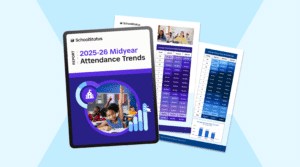
      Key Midyear Attendance Trends from the 2025–26 School Year

      Read More >
    • Menu for Mega Menu
  • About

      About SchoolStatus

      Careers

      Contact

      quote_icon
      Working at SchoolStatus is an incredible experience—our supportive team culture creates an environment where I feel valued and inspired. The company prioritizes both personal happiness and professional growth.
      Dr. Stephanie Walters
      Customer Lifecycle Marketing Manager
      quote_icon
      I like the ease with which I can contact families using my own personal phone without giving out my personal number. I also like that the student's contacts are readily available. This platform works well for families to contact us, too. We can truly partner in the student's education and work towards a goal that works for all.
      Abigail S.
      Teacher
      quote_icon
      We’ve seen an over 50% decrease in chronic absenteeism, which is the statewide goal. We’re already there, in just one year of work.
      Jessica Hull
      Executive Director of Communication and Community Engagement, Roseville City School District
    • Menu for Mega Menu
Request a Demo Log In
Educator Development
May 22, 2022

Documenting Your Coaching Work

SchoolStatus logo.
By SchoolStatus • 4 min
Guest Blogger,Instructional Coaching,Professional Development
Share

Ellen Eisenberg, from the Pennsylvania Institute of Instructional Coaching (PIIC), provides coaching tips for documenting work and creating opportunities for self-reflection.


Many coaches struggle with the practicality of keeping notes about their work with colleagues. It’s not that they don’t want to keep appropriate and professional notes. Rather, it’s more about the time it takes and the kind of notes that cause coaches to anguish over how to complete the process. It’s certainly not easy to do, yet the rewards for taking the time to maintain records is crucial to a coach’s success.

What many practitioners don’t understand is that coaches don’t walk into school and announce, “Oh, what should we do today?” Coaches plan and prepare for their work with teachers every day. So how do they know what they need to do in preparation for their work with teachers? ICs keep notes so they can differentiate their support to teachers: to know where they are, where they want to go, and to plan the steps to get there.

Snapshots in Time

Coaches need to document not only what or how they work with colleagues, but also what their next steps are to provide ongoing, job-embedded professional development. However, coaching is confidential so the documentation stays in the hands of the coach and the teacher(s) being coached.

PIIC instructional coaches and mentors practice the “BDA” (before, during, and after) coaching cycle throughout the coaching process. Coaches and teachers work together and co-construct what to “look for” (before) in their collaborative consultation. When the coach visits the classroom (during), the coach uses the co-constructed form—the agreed upon data—to document what happened in the classroom. The form is used again as the coach and teacher reflect and debrief (after) the lesson. This kind of documentation is known as record keeping: a way for both the coach and teacher to keep track of their work together.

Promoting Reflection

A more deliberate and thought-provoking kind of documentation is reflecting about the practice. To promote reflection, a coach may include questions like:

  • How do you know the students were engaged in the work?
  • Why were specific decisions made?
  • How do you know that the students reached the intended outcomes?
  • How can this practice be improved?
  • What are the next steps to improve learning?

These are great conversation starters that encourage deep thinking and contemplation—which are critical for ongoing discussions about student learning.

Self-Reflection

At the same time, coaches need to reflect on their own work with teachers and ask questions like, “What am I doing to help teachers change and improve their practice?” or “What am I doing to help teachers improve student engagement and outcomes?” Their relationships are developmental, as is the process for reflecting and determining next steps.

Coaches need to know what kind of support is necessary and if resources are required. They need to reflect on the conversations, actions, and thinking throughout the BDA cycle of coaching. Coaches need to prepare themselves for the work they want to accomplish with their colleagues and review their goals and objectives to determine if they’ve achieved what they set out to do. Self-reflection must be continuous in order to strengthen practice. One can’t simply rely on memory to achieve it.

Tips for Documenting Work

Prior to taking notes on what you’ve noticed or talked about with your coachee, remember to establish agreed upon ground rules. Here are a few tips to get you moving in the right direction:

  1. Ask the teacher’s permission to take notes
  2. Leave the notes with the teacher and remind the teacher to bring the notes back for the debriefing
  3. Only address and share the agreed-upon items. Save the rest for another time
  4. Watch, listen, and be “in the moment.” Don’t spend all the time checking off boxes

Final Note

The debriefing process takes time. It doesn’t have to be a difficult conversation, although they can be. As a coach, you should take time to plan with the teacher, visit the class, think about what you saw as you visited, refer to the goals of the lesson, process how the goals were achieved, write your notes to share with the teacher, then debrief the lesson with your prepared questions––not answers. Remember: coaches, too, have a learning curve about how to approach conversations involving teaching and learning.


About Our Guest Blogger

Ellen Eisenberg is the Executive Director of the Pennsylvania Institute for Instructional Coaching (PIIC). PIIC, a partnership of the Annenberg Foundation and the Pennsylvania Department of Education, is a statewide resource for developing and supporting consistent, high-quality instructional coaching in Pennsylvania schools.

SchoolStatus logo.
SchoolStatus
SchoolStatus connects educators and families around the topics that matter most. The company partners with K–12 districts to improve attendance, engage families, and build trust so students can succeed. A recognized leader in data-driven attendance and family engagement solutions, SchoolStatus enables districts and educators to engage families with relevant, timely communications and proactive support on important topics including absenteeism, literacy progress, and overall student readiness. Today, SchoolStatus supports districts in all 50 states and serves more than 22 million students nationwide as a trusted partner in driving better student outcomes.
Stay Connected

News, articles, and tips for meeting your district’s goals—delivered to your inbox.

More Resources

EdTech Breakthrough Awards 2025 logo
GSV 150 2026 logo
Cool Tool Awards
Tech & Learning Awards of Excellence 2025 Winner Badge for SchoolStatus
2025 District Administration Top EdTech Products Awards logo
Badge, Supes' Choice
G2 Badge Users Love Us
G2 Winter 2026 Badge for Best Results
G2 Winter 2026 Badge for Leader in Education Technology
G2 Winter 2026 Badge for Easiest To Do Business With
Document icon

Ready to learn more about our suite of solutions?

Request a Demo
Logo

Want Updates?

Stay connected with news, articles, and tips delivered to your inbox.

Stay in the Loop

Facebook LinkedIn YouTube

Solutions

  • Attendance Improvement
  • Literacy Progress
  • Family Engagement
  • MTSS Data
  • Actionable Insights
  • Administrative Efficiency
  • Educator Effectiveness

Who We're For

  • Superintendents
  • District Leaders
  • School Leaders
  • Educators & Staff
  • Families

Products

  • Products Overview
  • SchoolStatus Attend
  • SchoolStatus Connect
  • SchoolStatus Literacy
  • SchoolStatus Boost
  • SchoolStatus Forms & Flows
  • SchoolStatus Sites

Company

  • About SchoolStatus
  • Careers
  • Contact

Resources

  • Resource Library
  • News & Press
  • Blog
  • Case Studies
  • eBooks & Whitepapers
  • Webinars
  • Help Center
  • Customer Support
  • Website Terms of Use
  • SchoolStatus Privacy Policy
  • Accessibility
  • Sitemap
© 2026 SchoolStatus. All rights reserved