
New Automated Early Warning System Identifies At-Risk Students Months Before They Become Chronically Absent
read more


SchoolStatus Launches Literacy Solution to Help Districts Engage Families in Improving Reading Outcomes
Read More >
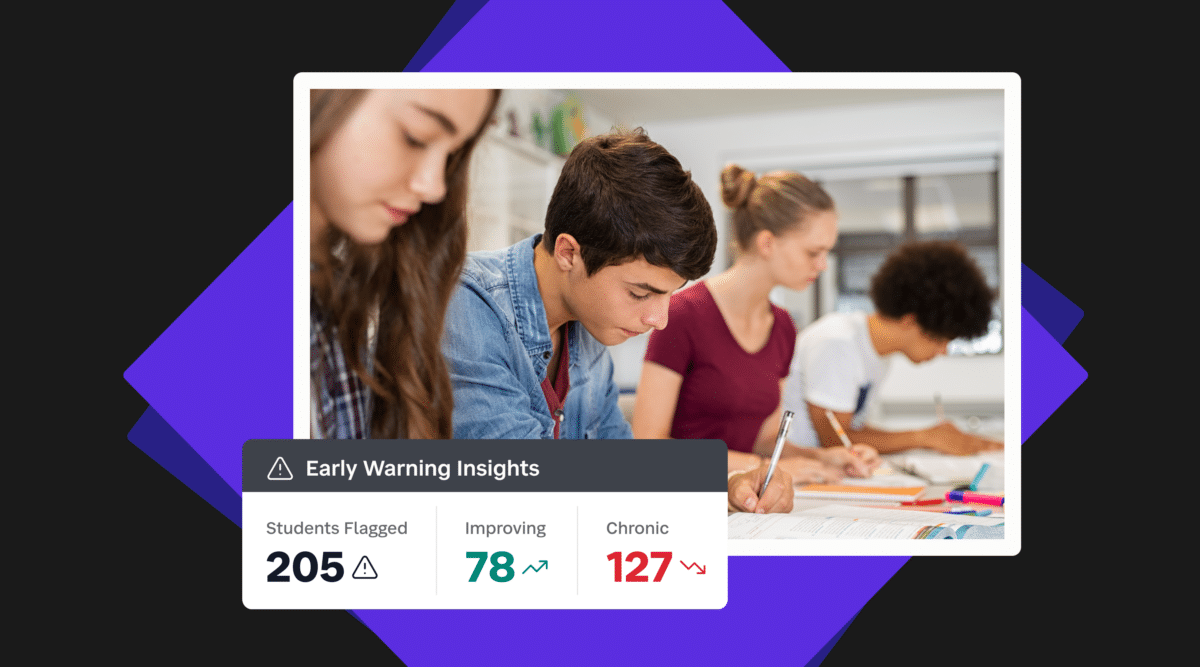

Once chronic absenteeism sets in, it’s hard to reverse. An attendance early warning system reads the student-level data your SIS already collects and surfaces who is trending toward chronic absenteeism before the pattern locks in, giving your team the window to intervene when it still matters.
Your average daily attendance report comes back at 95%. Budget season arrives, and the funding gap is larger than you expected. The daily average looked healthy. The students pulling it down were invisible.
An attendance early warning system is designed to prevent exactly that scenario. It reads the data your SIS already collects, but differently: student by student, in real time, against a threshold that matters.
District leaders are navigating two separate problems right now. The first is a chronic absenteeism rate that remains stubbornly elevated: in 2024, the national rate sat at 23.5%, down less than two points from the year before. The second is the gap between what ADA tells you and what is actually happening in your schools. ADA measures daily enrollment totals. Chronic absenteeism measures individual students missing 10% or more of the year. Those two numbers can look very different, and only one of them tells you which students need support.
Most districts are managing ADA. The ones pulling ahead are managing what ADA cannot see.
What is an Attendance Early Warning System? An attendance early warning system is a data-driven tool that monitors individual student absence patterns in real time and automatically flags students trending toward chronic absenteeism before the 10% threshold is crossed. It reads cumulative absence data from your SIS over time, surfaces at-risk students by name, and triggers outreach before the pattern becomes entrenched.
A standard student information system records attendance. An early warning system reads that data over time, identifies which students are trending toward chronic absenteeism, and surfaces them to the right person before the 10% threshold is crossed.
Think of it as infrastructure for district leadership and school-level staff: a real-time view of attendance risk across every school, every grade, and every student population at once. A student who misses one day a week looks fine in a daily report. Over nine weeks, that student is chronically absent. The SIS captured every absence. Nobody added them up. That is the gap automated attendance intervention software is built to close.
Manual attendance monitoring misses students quietly. A district with 5,000 students cannot have staff reviewing every individual attendance record every week. The math simply does not work. When monitoring depends on a staff member noticing, the students who get early attention tend to be the ones whose families are most vocal or whose teachers happen to flag them. Students navigating housing instability, chronic health conditions, or language barriers are the ones most likely to accumulate absences before anyone acts.
By the time a pattern becomes visible without systematic flagging, the student has often already crossed the chronic absenteeism threshold under ESSA accountability standards. Outreach at that point is recovery work. Recovery is harder than prevention, and the data on national recovery bears that out: the chronic absenteeism rate dropped just under two percentage points in 2024, compared to a three-point drop the year before. At that pace, the country will not return to pre-pandemic levels until 2029.

Most districts have more predictive information sitting in their SIS than they realize. The problem is that a single absence record, viewed in isolation, tells you almost nothing. Patterns tell you everything. Effective early warning systems read multiple signals at once:
Cumulative absence rate projected forward. A student missing two days a month in September and October is likely to end the year chronically absent. The math is visible long before the label applies.
Consecutive absence streaks. Three or more consecutive absences often signal something acute, a family crisis, a health issue, a housing disruption, that requires a counselor conversation rather than a form letter.
Day-of-week patterns. A student who consistently misses Mondays may be dealing with a structural barrier that generic outreach will not address. That pattern deserves a different response than a student whose absences are scattered.
Population-level risk factors. Students with IEPs, students experiencing homelessness, and students with chronic health conditions often warrant flagging at lower thresholds than the general population. A system that applies the same threshold to every student will consistently miss the students most at risk.
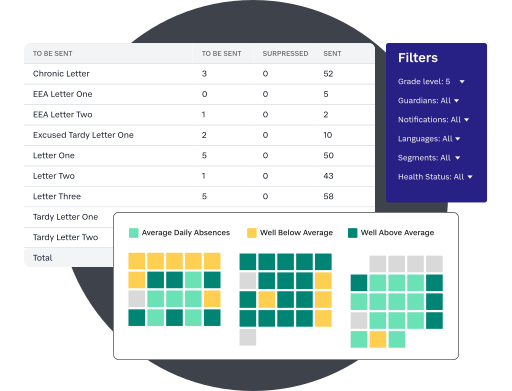
Reading these signals together changes who gets attention and when. Without them, intervention resources follow volume and visibility rather than actual need. For a deeper look at how average daily attendance is calculated and where it falls short as a standalone metric, start here.
The districts outperforming the national average on chronic absenteeism are working with the same student populations, the same staffing constraints, and the same community pressures as everyone else. The variable is timing.
Districts using proactive attendance strategies averaged 20.92% chronic absenteeism in 2024–25, compared to the national average of 23.5%, during a year when national recovery stalled at just 1.9 percentage points. That 2.6-point gap represents tens of thousands of students who got flagged and reached in time. It compounds across a school year.
54% of at-risk students return to school after just one intervention contact. Early and consistent outreach produces results even when the system is imperfect. The intervention does not have to be elaborate. It has to happen before the pattern is entrenched.
Upper Lake USD in California is the clearest illustration of what this looks like at scale. Chronic absenteeism dropped from 48.6% to 27.8%. Graduation rates rose 14 percentage points. Those results did not come from a staffing increase. They came from identifying students earlier and reaching their families faster. The full picture of what drove those results is in the 2024–25 K-12 attendance trends report.
Tools marketed as early warning systems vary significantly in what they actually do. These questions separate student-level infrastructure from repackaged reporting dashboards.
Does it flag individual students or aggregate to school-level averages? A tool that shows you school averages is giving you a better version of what your SIS already produces. An early warning system tells you which specific students are trending toward chronic absenteeism by name, right now.
Does it send outreach in families’ home languages automatically? If translation requires a separate request or a waiting period, it will not happen consistently for every family. The language access has to be built into the workflow, not bolted on.
Does it support positive outreach when students are improving? Attendance intervention that only sends warning letters misses a significant part of what moves behavior. Recognizing a student who is turning a corner, and letting the family know, is part of what makes the work sustainable for staff and students alike.
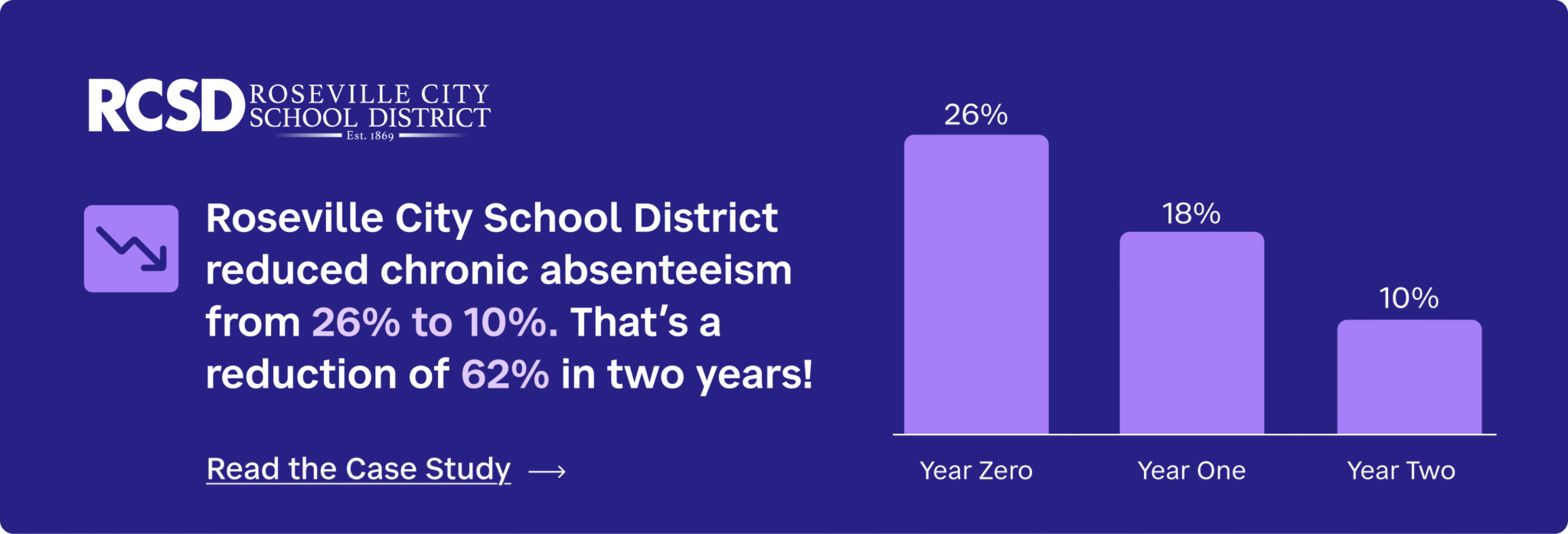
Each of the questions above maps to something SchoolStatus Attend was built to answer.
Early Warning Insights uses predictive analytics to identify which students are likely to end the year chronically absent after just 60 days of school, surfacing them by name before the pattern is entrenched. Outreach goes out by physical mail, SMS in 130-plus languages, and digital channels, with no manual drafting and no separate translation request.
Campus-level data views let district leaders compare attendance school-to-school, identify where risk is concentrated, and direct support to the buildings that need it most. Every intervention is logged automatically, creating a complete record of what was sent, when, and to whom. When a board member asks what the district is doing about chronic absenteeism, that record is already there.
And when a student who has been missing school starts showing up consistently, Attend surfaces that, too. Positive outreach goes out to the family. The student gets recognized. The behavior gets reinforced.
Every student who ends the year chronically absent was showing signals months earlier. Cumulative absences adding up in October. Consecutive days missed in November. Day-of-week patterns that repeated all fall. The data was there. The infrastructure to read it, in real time, for every student, was not.
That is what changes with an early warning system. The students who previously accumulated absences undetected get flagged in by Thanksgiving instead of April. Families get reached before the pattern is locked in. And the gap between a district that closes on chronic absenteeism and one that does not comes down to something concrete: whether the right person saw the right data in time to act.
| Stat | What It Means |
|---|---|
| 23.5% | U.S. national chronic absenteeism rate in 2024–25 (SchoolStatus Attendance Trends Report) |
20.92% | Average chronic absenteeism among districts using proactive attendance strategies |
1.9 pts | National year-over-year improvement—down from 3 points the prior year |
54% | At-risk students who return to school after just one intervention contact |
| 48.6% → 27.8% | Chronic absenteeism drop at Upper Lake USD after implementing early warning outreach |
Yes. SchoolStatus Attend integrates with multiple SIS providers and automatically pulls attendance data. The implementation team configures the integration to match your district’s specific setup.
The 4-6 week implementation process is handled by the SchoolStatus team. Intervention thresholds, SIS integration, and outreach workflows are all configured during the onboarding process so districts are not building anything from scratch.
SchoolStatus Attend includes intervention effectiveness reporting that shows which outreach efforts are bringing students back to school. Districts can see response rates by intervention type and adjust strategies based on real data.
District leaders have a districtwide view that lets them compare attendance data school-to-school and identify outliers. School-level staff see individual student dashboards with absence counts, attendance rates, and full intervention history.
Districts using SchoolStatus Attend averaged 20.92% chronic absenteeism in 2024-25 compared to the national average of 23.5%. The attendance impact calculator on the SchoolStatus Attend page estimates the effect on student attendance, staff time, and state funding specific to your district.
What is an Attendance Early Warning System? An attendance early warning system is a data-driven tool that monitors individual student absence patterns in real time and automatically flags students trending toward chronic absenteeism before the 10% threshold is crossed. It reads cumulative absence data from your SIS over time, surfaces at-risk students by name, and triggers outreach before the pattern becomes entrenched.
Yes. SchoolStatus Attend supports time-based, period-based, and full-day attendance tracking. Districts in states with specific hourly or period mandates, including Ohio and Oregon, can configure the system to meet those requirements exactly.
 Dr. Kara Stern
Director, Education and Engagement
Dr. Kara Stern has seen school from just about every angle: high school English teacher, middle school principal, fellowship director for math and science teachers across New York City, and head of school at a rural N-12 school. That breadth is what she brings to her work at SchoolStatus, where she writes, speaks, and challenges educators to build the kinds of school communities where every student thrives. She holds a Master’s in Education Leadership from Teachers College and a Ph.D. in Teaching and Learning from NYU.

News, articles, and tips for meeting your district’s goals—delivered to your inbox.



















Ready to learn more about our suite of solutions?