Leading with Positivity: The Power of Positive School-Family Communication
read more


New Book Gives District Leaders a Practical Framework for Improving Chronic Absenteeism—and a Comprehensive Look at State-Level Attendance Policies
Read More >
Key Attendance Trends from the 2025-26 School Year: Insights from 1.1M Students
Read More >

Educators and administrators alike recognize the challenge of transitioning back to the classroom environment following extended breaks. The return from Spring Break presents a special opportunity to reset expectations, rebuild classroom dynamics, and recommit to educational excellence through supporting our students. By implementing some of these best practices, schools can transform this transition period into a catalyst for improved student outcomes and academic achievement.
Recognizing the psychological impact of schedule disruptions is essential for fostering student success. The abrupt shift from non-school routines back to structured learning environments affects everyone in the educational ecosystem. Educational leaders who proactively address this transition create psychologically safe spaces that support student well-being and academic readiness.
Consider implementing these discussion prompts to facilitate constructive dialogue:
Or, offer a multiple choice writing prompt to engage students with selections like:
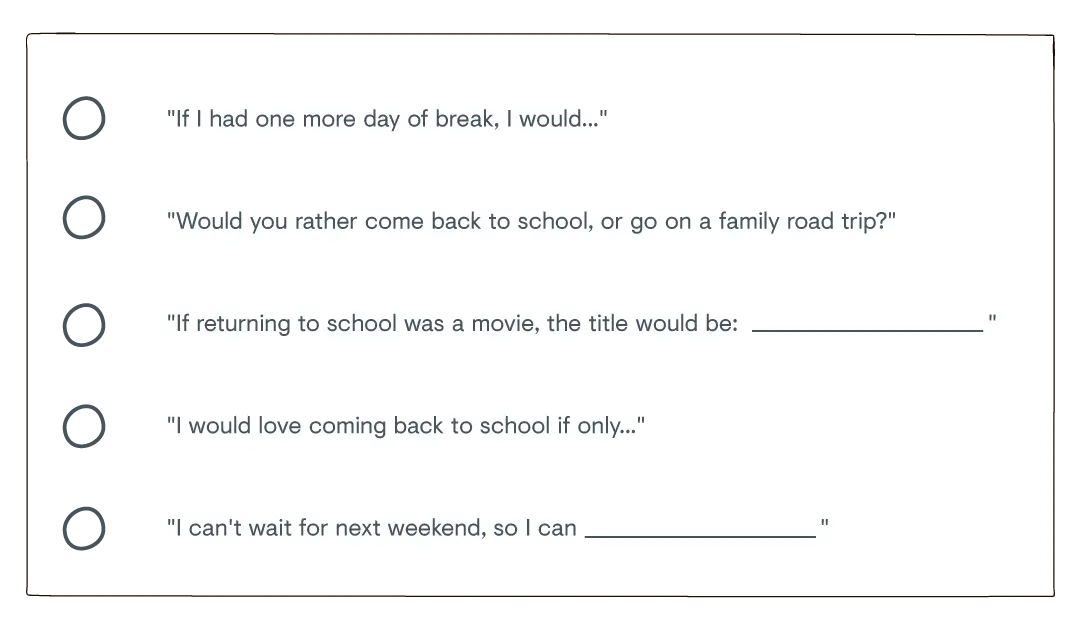
This intentional approach acknowledges that transitions impact learning outcomes while promoting self-awareness, social-emotional development, and community building—all critical components of comprehensive student success frameworks.
The post-break period offers an invaluable opportunity to strengthen the learning community foundation that supports academic achievement.
Effective community-building strategies include:
Consider implementing a values clarification exercise where students position themselves along a continuum regarding statements such as:
These structured interactions reinforce belonging while creating the psychological safety necessary for risk-taking and intellectual growth.
While curricular pressures may tempt educators to accelerate immediately to full academic intensity, research on cognitive load theory suggests that a strategic, incremental approach yields better outcomes. Educational leaders who design progressive reentry plans demonstrate their commitment to both their students and instructional practices.
Consider implementing a graduated return by:
This measured approach to reengagement acknowledges that academic behaviors require a renewal after disruption. Districts that prioritize this progressive structure report higher completion rates and improved quality of student work following breaks.
Experiencing success increases motivation and engagement. Strategic educators capitalize on this by engineering early victories that rebuild student confidence and academic self-efficacy.
Effective confidence-building strategies include:
These structured experiences remind students of their capabilities while reinforcing the collaborative nature of the learning community. The positive momentum generated during this reentry phase creates a foundation for sustained engagement throughout the remainder of the academic term.
Mid-year attendance data underscores the critical importance of early engagement strategies. Research shows that younger students (PK–4) demonstrate the strongest attendance recovery, approaching pre-pandemic levels with an above-average rate of 93.82% and improvement of 0.56% from 2023-24 to 2024-25. However, seventh grade emerges as a significant “tipping point” where attendance rates begin to decline and chronic absenteeism rises substantially—mirroring national trends of middle school disengagement. By successfully reengaging students immediately following breaks, educators can reinforce the positive attendance patterns established in earlier grades and potentially mitigate the attendance challenges that typically emerge in middle and high school. The investment in early academic momentum not only enhances immediate learning outcomes but also helps establish attendance habits that support long-term educational success.
When students have successfully re-acclimated to the learning environment, educational leaders can leverage this stability to establish compelling objectives that drive continuous improvement. Explicit goal-setting improves student performance across multiple measures.
Consider implementing these goal-oriented practices:
For example, a mathematics department might introduce complex problem sets that students cannot initially solve but will master by term’s end. Language arts educators might establish clear project or portfolio goals that will demonstrate growth over time. This forward-looking approach transforms daily instruction into purposeful progress toward meaningful achievements.
The return from Spring Break represents more than a logistical challenge—it offers an opportunity to enhance educational effectiveness. By implementing these approaches, educational leaders transform potentially disruptive transitions into platforms for renewed commitment to student success.
Districts that prioritize thoughtful reentry strategies report stronger student engagement, improved attendance patterns, and enhanced academic outcomes following breaks. By investing in deliberate transition management, schools demonstrate their commitment to optimizing every aspect of the educational experience.
Let’s reframe the post-break period not as an obstacle but as an opportunity to strengthen relationships, clarify objectives, and recommit to the pursuit of educational excellence. This mindset transforms the return to school into a powerful time for continued growth and achievement.
See how Smore Newsletters can help re-engage, reset, and re-energize your classroom community >
Learn about impactful messages that resonate across different age groups from ABCs to SATs >
Proven strategies for building strong school-home relationships that support student success >
 Hunter Sunrise
Chief Marketing Officer
A former college educator in Creative Writing, Hunter Sunrise is an accomplished strategic marketing leader delivering 20+ years of impact across marketing and product innovations. Throughout his career, Hunter partnered with brands including DIAGEO, AT&T, Bank of America, GameStop, Kendra Scott, Thinkful and Alaska Airlines to help translate organizational goals into actionable marketing and experience-design programs with human-centric solutions. At SchoolStatus, Hunter helps develop and mentor motivated teams built on a foundation of cross-functional collaboration, clear and inspirational leadership, and mutual respect.
News, articles, and tips for meeting your district’s goals—delivered to your inbox.

Ready to learn more about our suite of solutions?