Chronic Absenteeism Drops for Third Straight Year in 146 K-12 Districts Serving 1.17 Million Students
read more


New Book Gives District Leaders a Practical Framework for Improving Chronic Absenteeism—and a Comprehensive Look at State-Level Attendance Policies
Read More >
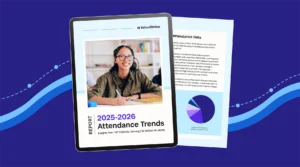
Key Attendance Trends from the 2025-26 School Year: Insights from 1.1M Students
Read More >

Schools collect data across attendance, academics, and behavior. The value comes from connecting those signals so teams can recognize patterns early, understand what may be behind them, and move forward with the right next step.
Districts have no shortage of information about students. Attendance updates every day. Grades shift throughout the term. Behavior and assessment data add more context.
Even with that level of visibility, teams still spend time trying to decide how to respond to the data they have.
That uncertainty slows things down in ways that are easy to overlook. A student who needs support blends into a larger set of data. A conversation with a family happens later than it could have. Staff move between systems, trying to piece together a full picture before they feel confident acting.
Most systems are designed to organize and display data about what has already taken place. They capture absences, grades, referrals, and other important signals, but each one tends to sit on its own.
Looking at those signals in isolation makes it harder to see connections. A drop in attendance may be tied to something happening in a specific class. A change in behavior may line up with a shift in performance.
Seeing those relationships requires time and effort, which often means the picture comes together later than it should.
Insight becomes useful when it brings those data signals together in a way that’s clear enough to act upon. It gives staff an idea of where to focus and how to begin.
A pattern in attendance paired with changes in coursework tells a different story than either one alone. That context shapes the next conversation, whether it happens with a student, a family, or another member of the team.
Clarity at that level reduces the time spent searching for answers and increases the time spent responding to what students need.
Student challenges rarely reach a critical point with a single event. They build gradually, often through small signals that are easy to miss when viewed separately.
Research on early warning systems shows that combining attendance, behavior, and course performance data helps schools recognize when a student may need support earlier in the year.
Seeing those patterns early changes the response. A conversation in the first few weeks of school feels different from one that happens after the pattern is established.
Clear insight also changes how schools communicate.
Messages grounded in context about the student feel more relevant than system-generated warning emails because they reflect what is actually happening with that student. Families can see that the outreach is specific to their child. That helps build trust that someone at school is looking out for their child and is working toward their best interests.
That specificity changes how conversations unfold. It’s easier to talk through what a student may be experiencing and what support might help. Over time, those interactions build a stronger sense of partnership between schools and families.
In districts where this approach takes hold, insight becomes part of how teams operate.
Educators see a fuller picture of each student without moving between multiple systems. Patterns are easier to recognize, and next steps feel more apparent.
As a result, staff spend less time collating information, and more time responding to it in ways that support students directly.
The signals schools need are already there. Attendance, academics, and behavior each tell part of the story.
Connecting data into actionable insights creates a clearer picture of where to focus and how to move forward. It allows teams to recognize patterns earlier, engage families with more context, and support students while momentum is still on their side.
Actionable insights connect data across attendance, academics, and behavior to help schools understand which students may need support and how to respond.
Reporting shows what has happened. Insight connects those signals so staff can interpret patterns and decide on next steps more easily.
By bringing multiple data sources together and presenting them in a way that highlights patterns and supports timely action.
They help schools recognize needs earlier, communicate with more context, and provide support before challenges grow.
 Dr. Kara Stern
Director, Education and Engagement
Dr. Kara Stern has seen school from just about every angle: high school English teacher, middle school principal, fellowship director for math and science teachers across New York City, and head of school at a rural N-12 school. That breadth is what she brings to her work at SchoolStatus, where she writes, speaks, and challenges educators to build the kinds of school communities where every student thrives. She holds a Master’s in Education Leadership from Teachers College and a Ph.D. in Teaching and Learning from NYU.
News, articles, and tips for meeting your district’s goals—delivered to your inbox.

Ready to learn more about our suite of solutions?