How MTSS Can Lead To Better K-12 Attendance Outcomes
read more


SchoolStatus Launches Literacy Solution to Help Districts Engage Families in Improving Reading Outcomes
Read More >

A tiered attendance intervention framework gives your team a clear protocol for who gets what level of support and when, before absences stack up. Districts using this kind of tiered approach have seen real results: Corsicana ISD cut chronic absenteeism from 19.7% to 10.7% in a single year, and Upper Lake USD dropped from 48.6% to 27.8% while graduation rates rose 14 percentage points. This post walks through what each tier looks like in practice and what separates a framework that works from one that lives in a binder.
Chronic absenteeism doesn’t announce itself. A student misses a day here, two days there. By the time a pattern is visible to someone with the authority to act, that student may have already missed enough school to put their reading level, credit attainment, or graduation at risk.
A tiered attendance intervention framework solves the timing problem. It gives your team a shared protocol for identifying and responding to absence at every level of concern before students reach the threshold where intervention gets exponentially harder. If your district already runs MTSS, you have the architecture. This is about filling it in with attendance-specific practice.
Tier 1 is for all students. It targets the conditions that make attendance possible and the systems that catch early warnings before patterns solidify.
At this tier, your team communicates proactively with all families starting in the first weeks of school, tracks absence data at least weekly, and sends positive outreach when students hit milestones worth celebrating. That last piece matters more than it sounds. Families who only hear from schools when something is wrong bring a different posture to that conversation. Families who receive a friendly check-in from you in September are easier to reach in November when you need to problem-solve.
Tier 1 also means examining whether building-level decisions—transportation, scheduling, early dismissal policies—are creating barriers that show up as absences in the data.
Tier 2 is for students showing early warning signals: typically two to four unexcused absences in the first weeks of school, or an emerging pattern that suggests something more is going on.
A Tier 2 response is a phone call, a message in the family’s home language, or a meeting that opens with curiosity rather than consequence. What’s going on? Is there something getting in the way? The families you most need to reach at this tier are often the ones who have had impersonal or punitive contact before. Trust is a resource, and it depletes. Rebuilding it takes longer than spending it did.
This is also where your team documents barriers—transportation, illness, housing instability, work schedules—because that information shapes what comes next. A student missing school for a chronic health condition needs a very different response than a student avoiding school because of a social conflict.
Tier 3 is for students who are already chronically absent or on a clear trajectory to get there. These students need a case manager, a plan with specific goals and check-in dates, and often a coordinated team: counselor, community liaison, and family. At this tier, the goal is to understand the full picture. Chronic absenteeism in this range is rarely about motivation. There’s almost always an underlying cause worth uncovering.
Students move up when the data crosses a threshold your team defines in advance. Two to four unexcused absences in the first weeks of school signals entry into Tier 2. A pattern that continues despite that outreach, or absences that reach the chronic threshold, signals entry into Tier 3. Written criteria, applied consistently, make escalation a data decision that any staff member can act on, no matter who reviews the report that week.
Stepping down follows the same logic. A student moves back to Tier 2 or Tier 1 after a defined window of improved attendance (many districts use four to six weeks with no new unexcused absences) and confirmation from the case manager that the underlying barrier has been addressed. A clean four weeks with an unresolved transportation problem still sitting underneath calls for another cycle at Tier 2 before stepping down further.
Building tier movement into the protocol from the start gives staff a shared answer before a student’s status becomes a debate, and keeps Tier 3 case managers focused on the students who still need them most.
Teams with hundreds of students to monitor can’t manually review attendance records at the frequency a tiered framework requires. By the time a pattern surfaces through a weekly report, the window for a light-touch Tier 2 intervention may have already closed.
The frameworks that sustain over time have clear ownership at each tier and data systems that surface the right students automatically. Corsicana ISD reduced chronic absenteeism from 19.7% to 10.7% in a single year. Upper Lake USD brought their rate from 48.6% to 27.8% and saw graduation rates rise 14%. The details of those frameworks look different, but the logic is consistent: right student, right response, right time.
When teams spend less time pulling data and generating letters, they spend more time on the conversations that require a human. That’s the whole point.
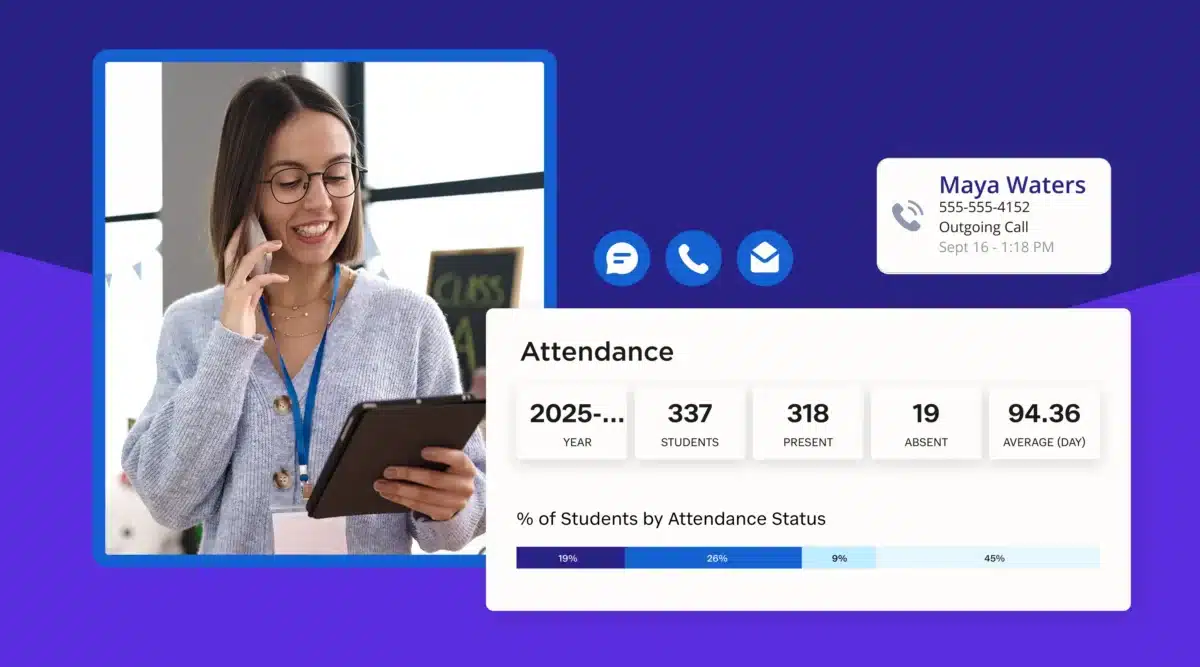
SchoolStatus Attend supports exactly this kind of tiered work—identifying students early, automating outreach at Tier 1, and freeing your team for the relationships that move the needle. Schedule a demo to see how districts are making it work.
If you have attendance data and staff who communicate with families, you have the foundation. The framework organizes what you’re likely already doing into a consistent protocol. The most important readiness question is whether there’s leadership alignment on what “early enough” means for your district.
MTSS is a broader system for delivering tiered support across academic, behavioral, and social-emotional domains. A tiered attendance framework can live inside MTSS—and aligning the two makes coordination easier—but attendance-specific frameworks exist in districts that haven’t fully built out MTSS as well.
Two to four unexcused absences in the first four to six weeks of school is a common starting point. What matters more than the exact number is consistency—the same criteria applied to every student, so early warning doesn’t depend on which teacher or counselor happens to notice first.
Persistent, varied contact is the baseline: multiple channels, multiple times of day, outreach in the family’s home language. If a family isn’t responding, that’s information. It may point to a barrier that requires a home visit or a community partner. Escalating to Tier 3 doesn’t wait for family response; it responds to the absence pattern.
Yes, but it requires deliberate choices about where human attention goes. Tier 1 universal communications and early data monitoring are the highest-leverage places to use automation, so staff capacity is preserved for Tier 2 and Tier 3, where the relationship does the work.
 Dr. Kara Stern
Director, Education and Engagement
Dr. Kara Stern has seen school from just about every angle: high school English teacher, middle school principal, fellowship director for math and science teachers across New York City, and head of school at a rural N-12 school. That breadth is what she brings to her work at SchoolStatus, where she writes, speaks, and challenges educators to build the kinds of school communities where every student thrives. She holds a Master’s in Education Leadership from Teachers College and a Ph.D. in Teaching and Learning from NYU.

News, articles, and tips for meeting your district’s goals—delivered to your inbox.




















Ready to learn more about our suite of solutions?