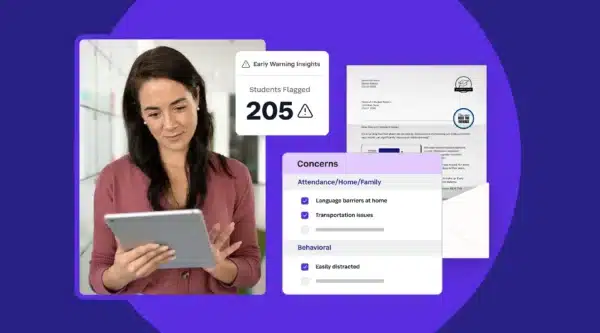
New Automated Early Warning System Identifies At-Risk Students Months Before They Become Chronically Absent
read more


New Book Gives District Leaders a Practical Framework for Improving Chronic Absenteeism—and a Comprehensive Look at State-Level Attendance Policies
Read More >

Key Attendance Trends from the 2025-26 School Year: Insights from 1.1M Students
Read More >

Chronic absenteeism spiked dramatically during the pandemic and most states are still well above pre-pandemic levels. Recovery is happening, but slowly, and the pace is decelerating. Where your state lands is context. What your district does about it is the job.
According to Nat Malkus of the American Enterprise Institute, whose 2025 analysis draws on the Return to Learn tracker, roughly 15% of K–12 public school students in the U.S. were chronically absent before 2020. That number was already considered a crisis by researchers and the U.S. Department of Education. Then the pandemic hit, and by 2022, that figure had jumped to 28.5%, an 88% increase from pre-pandemic levels.
The national picture has improved since then, but modestly. The chronic absenteeism rate fell to 25.4% in 2023 and to 23.5% in 2024. At the current pace of decline, the pre-pandemic average would not be reached until 2029. If the pace keeps slowing, the country could stall above 20% indefinitely.
For district leaders, the state number is context. Your district’s number is the job.
Before the pandemic, the national chronic absenteeism rate held steady at about 15%. Alaska was the highest-rate state, at 28% in 2019, while states like Alabama, Tennessee, and Virginia ran closer to the low teens. According to the AEI analysis, every single state’s rate was higher than its pre-pandemic baseline by 2022, with 46 states seeing increases of at least 50%. The national average that year exceeded Alaska’s pre-pandemic rate, which had been the country’s highest.
Declines followed in 2023 and 2024, but progress has been uneven. A handful of states saw drops of more than five percentage points in a given year; others saw rates hold flat or increase. The clearest way to put 2024 in perspective: a district with today’s national average rate would have ranked among the most severely affected districts in the country before the pandemic.
Fifteen states have formally adopted a goal of cutting their 2022 chronic absenteeism rates in half by 2027: Alabama, Arkansas, California, Colorado, Connecticut, Iowa, Maryland, Nebraska, Nevada, New Mexico, Ohio, Rhode Island, Virginia, Washington, and West Virginia. As of 2024, only about one-third of students nationally attend districts on pace to meet that target.
As of 2024, Washington D.C., Alaska, New Mexico, Michigan, and Oregon remain among the states with the highest chronic absenteeism rates, all still significantly elevated from their pre-pandemic baselines. The AEI report notes that states with higher pre-pandemic rates also saw the largest absolute increases in 2022, and while they have seen somewhat sharper declines since, they remain the furthest from recovery in absolute terms.
A note of caution on cross-state comparisons: states measure absenteeism differently. Some count a half-day absence; others require a full day. Some include all students enrolled for at least 10 days; others set a higher threshold. A 3-percentage-point difference between two similar states may reflect measurement differences as much as real behavioral ones. Directional trends within a state over time are more reliable than precise rankings across states.
What the state rate can tell you: whether your district is swimming upstream or downstream relative to the broader policy environment. A district running at 22% in a 28%-rate state has a different story to tell its board than a district running at 22% in a 15%-rate state.
California leads in recovery progress, with 79% of its students in 2024 attending districts on pace to cut absenteeism in half by 2027. Connecticut, Hawaii, Idaho, Maine, Massachusetts, Michigan, Nevada, New Mexico, Rhode Island, and Virginia also had a majority of students in on-track districts as of 2024.
What the recovery data make clear is that progress is possible at scale. The SchoolStatus districts driving down chronic absenteeism in these states built systems to identify students early and reach families proactively. The results are measurable. Corsicana ISD brought chronic absenteeism from 19.7% to 10.7% in a single year. Upper Lake USD dropped from 48.6% to 27.8% while graduation rates rose 14%. Troup County cut its rate from 16.6% to 12.2% over two years.
These results come from early intervention, not reactive enforcement. By the time a student is flagged at 15 or 20 absences, the academic gap is already compounding and the family conversation is harder. The districts closing the gap are catching students at two or three absences.
The AEI report documents something district leaders should find both sobering and clarifying: chronic absenteeism rose at nearly identical proportional rates across all district types in 2022, regardless of poverty level, prior achievement, urbanicity, or size. The pandemic did not discriminate. Recovery, however, is not equally distributed.
The right questions to bring to your board: How does your district’s current rate compare to your 2019 baseline? Are you on pace to meet your state’s recovery targets — or the 50%-by-2027 benchmark 15 states have formally adopted? And given that only one-third of students nationally attend districts on track to meet that goal, what would it take for your district to be in that group?
State data sets the standard. District data determines whether you’re meeting it. The superintendents closing the gap fastest are the ones who built systems to identify at-risk students early and act before patterns become crises.
SchoolStatus Attend’s early warning system surfaces at-risk students within the first 60 days of school, giving teams time to reach families before patterns become chronic. When that outreach is positive, personal, and in the family’s home language, it works: 54% of at-risk students return to school after just one intervention.
See how SchoolStatus Attend helps districts benchmark, identify at-risk students early, and automate outreach before absences compound.
Chronic absenteeism is defined as missing 10% or more of the school year — typically 18 or more days in a 180-day calendar. The definition is consistent across federal reporting, but how absences are counted varies by state and district. Some count half-day absences; others require a full day. Some include all students enrolled for at least 10 days; others use higher thresholds. This means cross-state comparisons should be treated with caution, while trends within a state over time are more reliable.
The pandemic disrupted attendance habits, eroded family-school trust, and introduced barriers — housing instability, mental health challenges, changed work schedules — that did not disappear when buildings reopened. The AEI data show that districts with higher pre-pandemic absenteeism saw the largest absolute increases in 2022 and remain furthest from recovery. The students most affected were already the most disadvantaged, and the gap has widened.
Place your district’s rate against both the state average and your own 2019 baseline. If you’re below the state average but above your pre-pandemic level, you have a recovery story alongside a continued improvement goal. If you’re above the state average, the state data makes the case for investment: your district has more ground to recover than peers, which means the cost of inaction is higher. SchoolStatus Attend’s early warning data and district-level comparison tools give you the specifics to make that case.
No, and state averages obscure this. The AEI report found that in 2022, 39% of Black students and 36% of Hispanic students were chronically absent, compared to 24% of white students. Districts with higher concentrations of students experiencing poverty saw the largest absolute increases during the pandemic and remain furthest from recovery. For a superintendent, this matters at the accountability level: state and federal reporting increasingly disaggregates absenteeism by subgroup, and board presentations that only cite the district average are missing the part of the story that drives both equity concerns and targeted resource allocation
Start earlier. Most districts identify chronically absent students after the pattern is already established, often at 15 or 20 absences. By then, the intervention is heavier, the family conversation is harder, and the academic gap is wider. SchoolStatus Attend identifies students trending toward chronic absence within the first 60 days of school, enabling positive, proactive outreach before a concerning pattern becomes a chronic one.
 Dr. Kara Stern
Director, Education and Engagement
Dr. Kara Stern has seen school from just about every angle: high school English teacher, middle school principal, fellowship director for math and science teachers across New York City, and head of school at a rural N-12 school. That breadth is what she brings to her work at SchoolStatus, where she writes, speaks, and challenges educators to build the kinds of school communities where every student thrives. She holds a Master’s in Education Leadership from Teachers College and a Ph.D. in Teaching and Learning from NYU.

News, articles, and tips for meeting your district’s goals—delivered to your inbox.


















Ready to learn more about our suite of solutions?