Sending Announcements and Newsletters with SchoolStatus Connect
read more


New Book Gives District Leaders a Practical Framework for Improving Chronic Absenteeism—and a Comprehensive Look at State-Level Attendance Policies
Read More >
Key Attendance Trends from the 2025-26 School Year: Insights from 1.1M Students
Read More >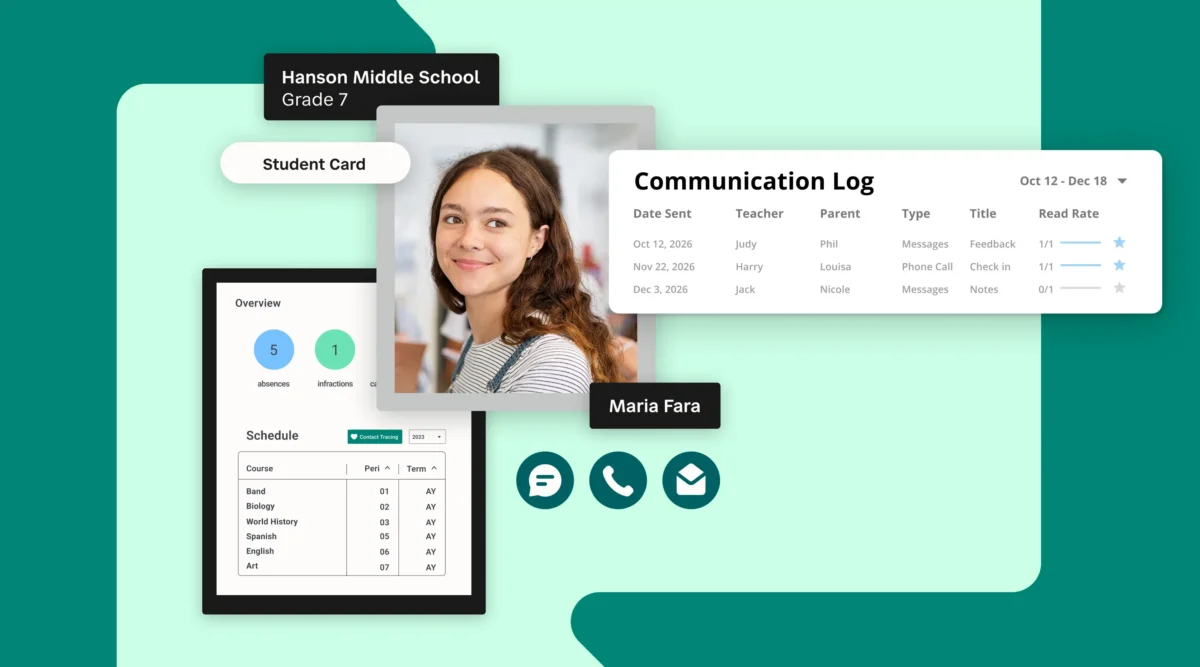

A communication calendar decides when a message goes out. Student data decides whether it should have been sent at all. Schools already collect enough to know which families need something specific—attendance records, grades, behavior notes. What is missing is giving whoever already has a relationship with that student the full picture before they reach out. That is what data-driven family communication is built to do.
Before calling home, it helps to know what other staff members have already learned about a student. Has the family mentioned a transportation problem? Have the student’s grades changed along with their attendance? Without that context, a family may have to explain the same problem twice. Or a teacher may call about a falling grade without realizing the student has missed two weeks of class.
What is data-driven family communication?
Data-driven family communication is the practice of using student-level information, including attendance records, grades, behavior notes, and engagement history, to determine what message a family receives, who sends it, and when. Rather than sending the same message to every family at the same time, it ensures each outreach reflects what is actually happening with that specific student.
Here’s a hypothetical situation about two students in the same high school: one has been marked present every day since August but just dropped two letter grades in Algebra. The other has three unexcused absences in two weeks and a note from last spring about transportation issues at home. A generic weekly digest sends both families the identical update, which doesn’t actually support either student with their individual challenges.
Data-driven family communication starts with giving whoever is closest to each of these students—the Algebra teacher, the attendance liaison, the counselor—the same full view: attendance, grades, behavior, and engagement history together, beyond whatever slice they’d normally see on their own. That’s what makes it possible for the right person to reach out about the grade change, and a different person to reach out about the absences, in the same week, instead of folding both into the same mass email.
That’s the actual difference between personalization and a data-driven decision. Personalization drops a student’s first name into a template every family gets. A data-driven decision starts with what’s specific to that student, seen by the person who already has a reason to reach out, then decides what the message should say.
Darlington County School District didn’t change how often it messaged families. It changed how specific each message was, built around what a given family actually needed to know instead of a universal announcement. Their average message read rate hit 73.4%. That means nearly three out of every four families opened the message. Families open the messages that are actually about their kid.
That kind of read rate comes from the same upstream work every time. Pulling attendance, grades, assessment scores, and engagement history into one view, so whoever reaches out—a teacher, a counselor, an attendance team member—already knows the fuller story before they write a word. That’s a different starting point than sending the same message to every family on the same day.
A school’s communication calendar can still set the schedule. Report cards go home in October. The newsletter goes out on Fridays. A counselor checks in with families every grading period. What should change is what each of those people knows before they write anything.
Before a message goes out about a specific student or a specific group, whoever’s sending it should be able to see that student’s attendance, grades, behavior, and engagement history together, beyond whatever single piece happens to land on their desk. A family whose student just made honor roll needs a different message than a family whose student was flagged for extra reading support last week. And the person best positioned to send each one is usually whoever already has a relationship with that family, whether a teacher, counselor, attendance liaison, or principal.
Every person who reaches out to a family works from the same full picture. That’s what makes the message actually about that student, no matter who sends it.
Families who get a message built around their own child already know why the school is reaching out. They read it, because for once, it’s actually about them.
If different people at your school are all working from a different slice of a student’s data, SchoolStatus Connect gives everyone the same full view, so whoever reaches out can make it specific. Request a demo to see it in action.
Attendance records, grades, assessment scores, behavior notes, and prior engagement history like open rates and replies all count. The point is combining more than one data source so a message reflects the full picture of a student.
Start with the reason for reaching out. If a student’s attendance has changed, the person contacting home should be able to see whether grades have changed too and whether the family has shared a concern before. That context can help them ask a better question. The family can tell them what’s happening now.
Mass notifications still matter for closures and districtwide news. Data-driven messaging works underneath that. Whoever is closest to a specific student, a teacher, a counselor, an attendance liaison, can add something the mass notification never could: a message built around what’s actually happening with that student.
Yes. Districts that connect messaging decisions to real student data see engagement climb, because families can tell the difference between a message meant for everyone and one that’s about their child. Darlington County went from a generic send schedule to a 73.4% average read rate, close to three in four messages actually opened, once the outreach was tied to real data.
Start with the next message already scheduled to go out, whether that’s a newsletter, a report card notice, or a counselor’s check-in. Before it goes out, make sure whoever’s sending it can see the full picture, attendance, grades, behavior, for the students involved, and ask whether any of them need a different version. Build that habit on one send first, then make it standard practice for every send after.
Nef DukesManager of Education Strategy and Insights
Nef is a former teacher who is passionate about helping educators use data and communications to build family trust and improve educational outcomes. At SchoolStatus, Nef partners with districts to share practical insights and stories about what works in schools today.
News, articles, and tips for meeting your district’s goals—delivered to your inbox.














Ready to learn more about our suite of solutions?