Daily Attendance Notifications: The First Step in a Smarter Approach to Chronic Absenteeism
read more


New Book Gives District Leaders a Practical Framework for Improving Chronic Absenteeism—and a Comprehensive Look at State-Level Attendance Policies
Read More >

Key Attendance Trends from the 2025-26 School Year: Insights from 1.1M Students
Read More >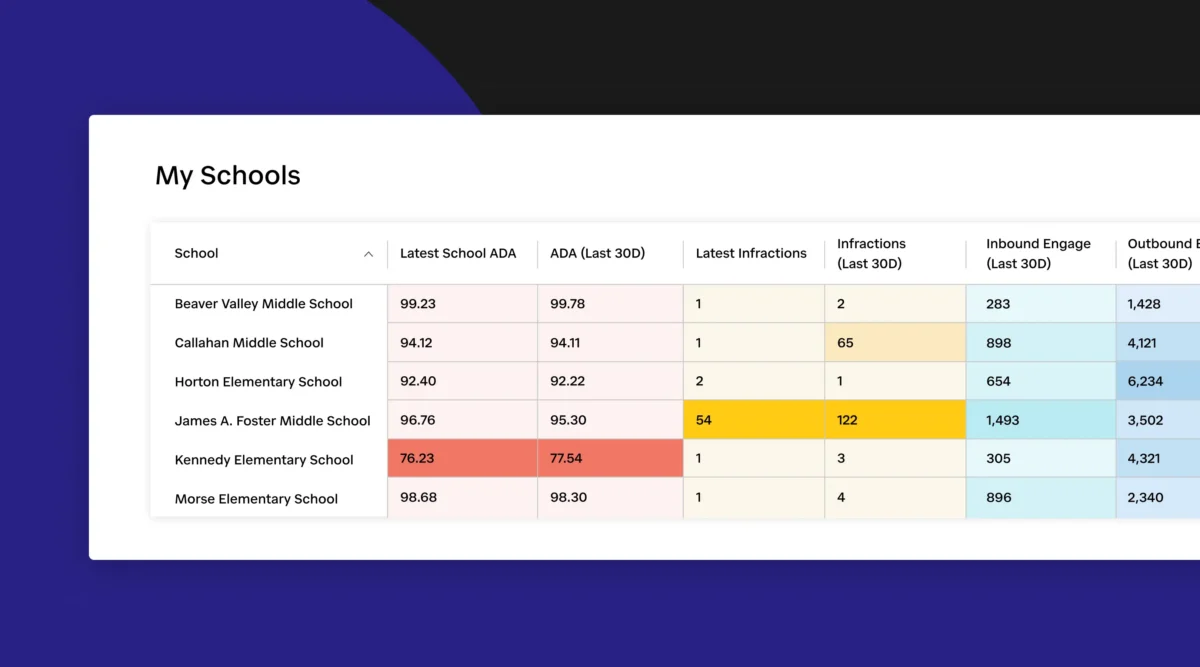

Average daily attendance determines how much funding your district receives. But a district can report 95% ADA and still have 20% of students chronically absent. ADA is a school-level aggregate. Chronic absenteeism is a student-level measure. One hides inside the other. Districts using proactive attendance strategies averaged 20.92% chronic absenteeism in 2024-25 compared to the 23.5% national average. Tracking both metrics is how districts protect funding and students at the same time.
Average daily attendance (ADA) is the average number of students physically present in school each day over a given reporting period. It is calculated by dividing total student days attended by the total number of days school is in session. In some states, per-pupil funding is based on ADA, not enrollment. A 1% drop in ADA is a 1% drop in revenue, and it does not come back.
ADA is a school-level aggregate metric. It tells district leaders how many students are in seats on a typical day. It does not tell them which students are missing, how often, or why.
Enrollment counts every registered student regardless of whether they show up. ADA counts only students actually present each day. The gap between those two numbers is where funding loss lives.
ADA = Total student days attended ÷ Total days of school in session
A district with 5,000 students across 180 school days has a maximum of 900,000 student-days. If students attended 855,000 of those days, ADA works out to 4,750 students per day, or a 95% ADA rate.
Reporting periods vary by state. Some states calculate ADA monthly, others by semester, others annually. The period your state uses is the one that determines your funding allocation. A week of lower-than-normal attendance in October is funded at October’s rate. There is no mechanism to recoup that allocation later in the year, which is why understanding how attendance affects school funding is the starting point for protecting it.
Districts that do not know exactly when ADA snapshots are taken miss the intervention windows that could protect their budget.
In attendance-based funding states, per-pupil revenue follows ADA, not enrollment. A district with 5,000 students and 95% ADA is being funded for 4,750 students every day. At $10,000 per pupil annually, that gap is $2,500,000 in lost revenue with no mechanism to recover it.
Use the Attendance Impact Calculator to estimate your district’s specific exposure by state, enrollment, and current attendance rate.
A district can report 95% ADA and still have 20% of its students chronically absent. Both can be true at the same time. That is the ADA paradox.
In a 100-student school, imagine 20 students each miss 18 days on different days. The daily headcount barely moves. ADA looks healthy. Every one of those 20 students has missed 10% or more of their instruction and qualifies as chronically absent under the ESSA definition.
ADA is a school-level aggregate. Chronic absenteeism is a student-level measure. One hides inside the other.
Districts that track only ADA will not see chronic absenteeism building until it is already visible in student outcome data: reading levels, course failure rates, graduation risk. By the time the aggregate numbers surface the problem, it has had months to compound.
District leaders need both metrics: ADA to manage funding and state reporting, and chronic absenteeism tracking to identify which students need support before the pattern takes hold via an attendance early warning system.
The widely accepted benchmark is 95% or above. At 95%, the average student is missing about nine instructional days per year. Below 90% is a significant concern for both funding and student outcomes.
Before the pandemic, districts hovered between 94% and 96% ADA. Many have not returned to those baselines. Among SchoolStatus districts using proactive attendance strategies in 2024–25, the average daily attendance rate was 93.45%, compared to a national average of 90%, findings detailed in the SchoolStatus 2024–25 Mid-Year Attendance Snapshot.
The 95% benchmark is a funding signal. Student-level chronic absenteeism data is the learning signal. Different students are absent on different days, so a healthy aggregate rate can coexist with significant individual-level risk. Districts need both readings to act.
ADA tells district leaders what already happened. SchoolStatus Attend identifies which students are building toward chronic absence, early enough to intervene.
Using predictive analytics, Attend identifies which students are on track to end the year chronically absent within the first 60 instructional days. Outreach goes out automatically across physical mail and digital channels the moment a student qualifies, with no manual drafting or translation required. Campus-level data views let district leaders compare attendance school-to-school and direct resources where the need is highest.
54% of at-risk students return to school after just one SchoolStatus Attend outreach contact. Districts that wait until January to act on attendance data have already lost months of intervention time. Attend surfaces the students who need outreach before winter break, when the school year still has room to turn a pattern around. Getting students back in seats is also how districts protect their ADA. Every student who returns is a day of attendance recovered. In attendance-based funding states, that translates directly to per-pupil revenue.
ADA tells you how much funding your district is entitled to. The students building toward chronic absence are invisible inside that number until the pattern is already set. Tracking both metrics is how districts close the gap between what the funding formula sees and what is actually happening in their schools.
Average Daily Attendance (ADA)
The average number of students physically present in school each day, calculated by dividing total student days attended by the total number of days school is in session. In attendance-based funding states, per-pupil revenue follows ADA—not enrollment.
Formula: Total student days attended ÷ Total days of school in session
See how districts use SchoolStatus Attend to protect ADA and catch the students hiding underneath it.
Average daily attendance is the average number of students present each day during a given reporting period. It is calculated by dividing total student days attended by total days of school in session and is the basis for per-pupil funding in most states.
Enrollment counts every registered student regardless of attendance. ADA counts only students physically present each day, averaged across the reporting period. In attendance-based funding states, districts are funded on ADA, not enrollment, so the gap between the two is a direct revenue loss.
The widely accepted benchmark is 95% or above. Below 90% is a significant concern for both funding and student outcomes. A 95% ADA rate is still compatible with high chronic absenteeism, because different students may be absent on different days.
ADA is a school-level aggregate showing how many students are present on average each day. Chronic absenteeism is a student-level metric measuring whether an individual student has missed 10% or more of school days. A district can have healthy ADA and high chronic absenteeism at the same time.
Multiply your district enrollment by your per-pupil funding rate, then multiply by the percentage of ADA you are losing. The SchoolStatus Attendance Impact Calculator estimates this automatically based on your state, enrollment, and current attendance rate.
Districts protect both by tracking each metric separately and acting on student-level data early. Districts using proactive attendance interventions averaged 20.92% chronic absenteeism in 2024–25 compared to the national average of 23.5%, while maintaining attendance rates close to pre-pandemic norms.
 SchoolStatusSchoolStatus connects educators and families around the topics that matter most. The company partners with K–12 districts to improve attendance, engage families, and build trust so students can succeed. A recognized leader in data-driven attendance and family engagement solutions, SchoolStatus enables districts and educators to engage families with relevant, timely communications and proactive support on important topics including absenteeism, literacy progress, and overall student readiness. Today, SchoolStatus supports districts in all 50 states and serves more than 22 million students nationwide as a trusted partner in driving better student outcomes.

News, articles, and tips for meeting your district’s goals—delivered to your inbox.

















Ready to learn more about our suite of solutions?