Why Your MTSS Framework Needs Attendance Tracking
read more


SchoolStatus Launches Literacy Solution to Help Districts Engage Families in Improving Reading Outcomes
Read More >
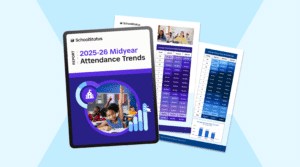


Chronic absenteeism affects millions of students each year and remains one of the biggest challenges facing K–12 districts. This guide explains what chronic absenteeism is, why it continues to rise, and the strategies districts can use to identify at-risk students, intervene earlier, and improve attendance outcomes.
Chronic absenteeism is defined as a student missing 10% or more of school days during an academic year, whether absences are excused or unexcused. For a typical 180-day school year, that’s 18 days.
Nationally, chronic absenteeism is a problem with rates that remain above pre-pandemic levels. Equally as alarming: improvement has slowed from a 3-point decline in 2022–23 to 1.9 points in 2023–24, according to SchoolStatus’s 2024–25 Attendance Trends Report. This means that we’re seeing some improvement in the numbers but that improvement isn’t fast enough to get us back to pre-pandemic numbers any time soon.
Stubbornly high chronic absenteeism is likely the cause of a change in attitude about schooling after the COVID shutdowns. However, another thing could be at play. Since a student is chronically absent after just eighteen missed days in most school districts, intervention may never happen. That breaks down to just two missed days per month, which may never raise alarm.
Chronic absenteeism can reduce district funding, increase compliance risk, and contribute to lower academic achievement and graduation rates. The longer attendance issues go unaddressed, the greater the operational and financial impact on the district.
Every chronically absent student sitting in your data right now represents three things at once: a funding loss, a compliance risk, and an academic outcome failure. You’re managing all three simultaneously, even on the days it only feels like you’re managing one.
In attendance-based funding states, chronically absent students directly reduce your ADA funding, and that money doesn’t come back once the year closes. Calculate your district’s specific exposure.
The costs run deeper than the funding line alone. Districts are also expected to document attendance interventions, communicate with families, and demonstrate consistent efforts to improve student attendance.
At the same time, state legislation continues to place greater emphasis on attendance accountability. If your district can’t demonstrate a consistent intervention process when asked, that gap can become both a compliance risk and a missed opportunity to support students earlier.
Most districts rely on attendance reports that summarize past absences instead of identifying emerging attendance patterns in real time. By the time semester or quarterly reports are reviewed, students may have already crossed the threshold for chronic absenteeism, leaving schools with fewer opportunities for early intervention, and a huge gap between a student becoming chronically absent and the first signal.
That five-month gap actually costs you something specific. A counselor watching a caseload of four hundred students can catch the student who missed fifteen days in a row. That same counselor can’t catch the student who missed one day a week, every week, for nine straight weeks, because no single day in that pattern looks urgent enough to flag on its own. Add the days up, though, and that student already qualifies as chronically absent before anyone in the building knew there was a pattern worth watching.
This is why many districts are moving from reactive attendance reporting to attendance early warning systems that monitor attendance trends continuously. Instead of relying on staff to manually identify patterns, these systems automatically flag students who are beginning to show signs of attendance risk, allowing interventions to begin weeks or even months earlier. See how attendance early warning systems work to close that gap before a person ever has to notice on their own.
Chronic absenteeism in your district almost never traces back to one cause. Underneath your aggregate number are health challenges, economic instability, transportation gaps, safety concerns, academic disengagement, and families who genuinely don’t realize their individual absences are compounding into something serious. Each of those is a different problem with a different fix, even though they all land on the same line of your attendance report. Districts that get ahead of this start before the school year even begins.
That’s why generic outreach falls flat here, even when it comes from a good place. A letter written for every family addresses the average family, and the average family is rarely the one you’re actually trying to reach. See how districts are reaching the right families with the right message.
The districts getting this right put informational materials and two-way messaging in place so families stay informed and engaged, past the point of a single notification home. They connect families to the specific resource that solves their specific barrier: transportation help for the family without reliable transportation, child care information for the family juggling younger siblings, a resource that details health care access for the family managing a chronic condition. The fix has to match the barrier.
When schools understand the reason behind a student’s absences, interventions become more targeted, family engagement improves, and districts are more likely to prevent occasional absences from becoming chronic absenteeism.
Effective early identification reads more than raw absence counts. It reads cumulative absence rate, consecutive absences, day-of-week patterns, grade-level context, and prior year history, layered together, because any one of those signals alone can look like nothing.
Early identification means recognizing attendance risk before a student becomes chronically absent. Instead of waiting until a student has already missed 10% of the school year, districts can monitor early attendance patterns to identify students who may need support weeks or months sooner.
Students with IEPs, students experiencing homelessness, and students with chronic health conditions are carrying higher baseline absence risk before the school year even starts. Flagging them at the same threshold as everyone else means flagging them too late, by definition. They need a lower threshold built in from day one.
Districts should establish risk thresholds based on student need rather than applying a single attendance threshold across the entire student population.
See how K-12 attendance early warning systems surface at-risk students automatically, so that lower threshold becomes a setting your team configures once, instead of a judgment call somebody has to remember to make for every student, every week.
A Multi-Tiered System of Supports (MTSS) helps districts organize attendance interventions based on student need. Instead of responding to every student the same way, MTSS provides escalating levels of support as attendance risk increases.
MTSS gives you a structure you already trust for other student needs, and it works just as well applied to attendance. Here’s how the approach works.
Tier 1 is positive outreach to every family before a problem ever develops, the same message delivered the same way district-wide. Tier 2 is personalized outreach the moment a specific student crosses a threshold you’ve defined. Tier 3 is direct counselor involvement, a call or a meeting, for students who don’t respond to the first two tiers.
The goal of MTSS isn’t to move every student into higher intervention tiers—it’s to identify attendance concerns early enough that most students can be supported through Tier 1 and Tier 2 interventions before intensive support becomes necessary.
The decision that determines whether the whole system holds together is how much of Tier 1 and Tier 2 you automate, because that’s what frees your counselors’ time for Tier 3, the one tier that actually requires a trained person in the room. Here’s how that works in practice.
Automating routine outreach, reminders, and attendance notifications allows district staff to focus their time on students who require individualized intervention rather than repetitive administrative tasks.
Align this approach with your district’s existing MTSS structure, so no family’s outreach depends on which building their student happens to attend.
When a district commits to this approach, the numbers start to look a lot better. Districts using proactive attendance strategies averaged 20.92% chronic absenteeism in 2024-25, compared to a national average of 23.5%, according to SchoolStatus’s 2024-25 Attendance Trends Report. That’s the difference between a school board presentation explaining a stalled number versus presenting a turnaround.
Let’s look more granularly. Fifty-four percent of at-risk students returned to school after just one intervention contact. This means that one message, delivered at the right time, moved more than half the students it reached. Compare this to compliance-driven attendance work, which takes years of accumulated letters and calls to get any traction.
Districts across the country are seeing these results. East Central ISD in Texas reduced chronic absenteeism by 12% and saw a 51% return rate after just one intervention by connecting attendance data to behavior and academic signals. Watch the full breakdown of their approach.
The specific number your district needs to hit will look different than the district down the road from you, but the sequence that gets you there doesn’t change: find the student earlier, reach the family in the way that works for them, and write down what happened so the next person isn’t guessing.
SchoolStatus Attend combines attendance early warning insights, automated family outreach, and intervention tracking in a single platform. It helps districts identify at-risk students earlier, automate attendance interventions, and document every step of the intervention process.
Early Warning Insights identifies students likely to end the year chronically absent after just 60 days, which means you’re acting in October instead of discovering the problem at semester’s end.
SchoolStatus Attend also automates family engagement. Outreach goes out automatically across physical mail, SMS, and digital channels the moment a student qualifies, so every family gets reached in their home language, without your staff having to build that logic themselves or remember to check it every week.
By automating multilingual, multi-channel communication, districts can ensure families receive timely attendance messages while reducing the administrative burden on school staff.
The system logs every intervention automatically, which means when a board member asks what the district is doing about chronic absenteeism, you already have a complete record sitting there, with dates, showing exactly what your team sent to which family and what happened next, instead of a summary you’d otherwise have to reconstruct from three different spreadsheets the night before the meeting.
Automated intervention tracking also helps districts support attendance reporting, demonstrate consistent intervention efforts, and maintain a complete history of family communication. That’s the return on a single, well-timed outreach, sent automatically the moment a student qualifies, before your team has spent a single hour manually tracking that student down.
Reducing chronic absenteeism requires a proactive strategy that combines early identification, personalized family engagement, MTSS-based interventions, and ongoing attendance monitoring. Districts that implement these practices consistently are better positioned to improve attendance outcomes over time.
Post-pandemic recovery has stalled, and nothing about that trend line is going to fix itself on your timeline. The districts pulling ahead right now are the ones seeing their at-risk students early, reaching families before the pattern compounds, and documenting every step along the way, instead of waiting to see if this year’s numbers come down on their own.
Every decision covered in this guide adds up to the same underlying choice. Where you set your identification threshold, how much of your Tier 1 and Tier 2 response you automate, all of it comes down to whether your district finds out about a struggling student in October or in June. That choice gets made once, at the district level, and then it holds for every building and every family from that point forward.
The gap between the district presenting a turnaround story to its board next spring and the district still explaining why the numbers climbed again almost always comes down to the same thing: how early they started acting on data they already had sitting in front of them.
By combining attendance early warning systems, family engagement, intervention tracking, and MTSS workflows, districts can move from reacting to chronic absenteeism to preventing it. The earlier schools identify attendance risk and intervene, the greater their opportunity to improve student outcomes, increase attendance, and support long-term academic success.
Chronic absenteeism measures all missed school days, whether they are excused or unexcused. Truancy only refers to unexcused absences and is often tied to state attendance laws. Because chronic absenteeism captures the full impact of missed instructional time, many districts use it as their primary attendance improvement metric.
Results are visible within the first semester when you move identification into the first 60 days of school. Districts using proactive strategies averaged 20.92% chronic absenteeism in 2024-25 against a national average of 23.5%, and 54% of at-risk students returned to school after just one intervention contact. You’re not waiting a full year to know whether this is working.
Lead with the funding argument, because it’s the one every board member already understands. In attendance-based states, every chronically absent student is a direct revenue loss that can’t be recovered once the year closes. Pair that number with outcome data from a comparable district. See the board buy-in guide.
Track three things: the percentage of flagged students who improve after first contact, your chronic absenteeism rate semester over semester, and how many students needed escalation past Tier 2. SchoolStatus Attend tracks this through SaveRate, so you’re not building that measurement system from scratch.
SchoolStatus Attend integrates directly with major SIS providers and syncs attendance data automatically. SchoolStatus configures thresholds and outreach workflows during implementation, so your team isn’t entering data by hand.
It depends on your starting rate and your intervention capacity, which is different for every district reading this. Use the attendance impact calculator to estimate your district’s specific exposure, rather than aiming at a number calculated for someone else’s district.
Start with students who were chronically absent last year and are already showing the same early patterns this September. Students with IEPs, housing instability, or chronic health conditions should get flagged at a lower threshold than the general population, because their baseline risk was already higher before the year started.
Start with students who were chronically absent last year and are already showing the same early patterns this September. Students with IEPs, housing instability, or chronic health conditions should get flagged at a lower threshold than the general population, because their baseline risk was already higher before the year started.
 Dr. Kara Stern
Director, Education and Engagement
Dr. Kara Stern has seen school from just about every angle: high school English teacher, middle school principal, fellowship director for math and science teachers across New York City, and head of school at a rural N-12 school. That breadth is what she brings to her work at SchoolStatus, where she writes, speaks, and challenges educators to build the kinds of school communities where every student thrives. She holds a Master’s in Education Leadership from Teachers College and a Ph.D. in Teaching and Learning from NYU.
News, articles, and tips for meeting your district’s goals—delivered to your inbox.




















Ready to learn more about our suite of solutions?